Introduction
Large component manufacturing, especially in heavy industries such as energy, aerospace, and heavy machinery, requires a different approach. While micron level deviations may seem insignificant on small components, these errors can add up in several machining steps and result in costly assembly mistakes, malfunctions, and major delays in the projects, causing considerable financial losses.
It is not due to the absence of quality assurance in the process; however, rather, the problem lies in the traditional machine-measure-rework approach, which cannot eliminate systematic deviations and distortion due to heat. In this paper, we will discuss a comprehensive strategy to counteract this issue and ensure a successful first-time assembly of large components.
What Makes Precision Machining of Large Parts Difficult?
Traditionally, the symptoms were managed without getting to the root of the problem; therefore, there was no guarantee that precision would be achieved when machining large parts. The basic problem is that due to their size, the small errors in machining due to heat or mechanical forces accumulate. There cannot be any consistency in the machining process because of the inability to predict the dimensioning.
Domino Effect of Heat and Mechanical Force: Large parts are particularly vulnerable to the effects of heat and the release of internal stresses. In case there are no controls over temperatures in the factory, there might be an excessive thermal expansion of the piece by several meters due to temperature variations throughout the day. At the same time, stresses accumulated in the manufacturing of the parts are freed during machining.
Illusion of “Final Check” in Multi-Setup Processing: Using just the final check to ensure quality is highly risky. Geometric defects made at early set-ups become fixed and cannot be rectified when further processing occurs. According to the ASME Y14.5 standard, adhering to GD&T requirements for multi-set up processing is extremely challenging unless a consistent datum system is used. This can result in non-conforming assemblies that passed individual testing.
Weaknesses of Experiential Trial and Error-Based Approach: Historically, most processes have been planned based on past experiences. The trial and error method does not offer any predictive analysis capability of detecting problems like tool deflections in cavities and chatter in large thin-walled structures. With no physics-based modeling and analytics involved, such a process is unpredictable and produces inconsistent products.
How Would Data-Driven Process Control Drive Accuracy in Heavy Duty Machining?
The concept of data-driven manufacturing process improvement converts machining operations into a science rather than an art by using real-time data generated through the integration of the machine tool and the parts being machined to facilitate predictive controls and adaptations.

1. Shifting from Reaction to Prediction Through the Usage of Advanced Sensors
Current advanced CNC process controls utilize built-in sensors to generate information regarding the load on the spindle, vibrations, and the thermal expansion of parts within the tooling path. The purpose of these sensors is not only logging information but also building a digital representation of the process, enabling predictions about imminent tool failure and feed rate optimization to prevent such situations.
2. Closed-Loop Metrology: Real-Time Verification and Adjustment
The essence of precision large part machining lies in verification during the machining process, not afterwards. Through the integration of machine probing and laser tracker systems, the dimensions of the parts are measured on-the-go. The program is then adjusted in real-time in case there is any deviation, and thus, the final machined product will always meet specifications without expensive reworking processes.
3. Intelligent Machining Methods: Adaptive Toolpaths for Dynamic Stability
Through data-based approaches, adaptive toolpaths become possible as the machining system is no longer limited to predetermined parameters but is able to adapt to the material’s properties as well as the stock remaining in order to minimize unnecessary air cutting, resulting in more efficient production with consistent surface finishes.
What Strategies Effectively Counteract Deformation During Mass Production of Large Parts?
Deformation management is perhaps the only most important aspect for successful mass production of large parts. The process calls for an integrative approach to handling all stages of the manufacturing process, starting from the stage of material preparation and ending at the final stabilization of the dimensions of the parts manufactured.
1. Preventive Stress Relieving Treatments: A Prerequisite for Dimensional Stability
Any deformation-preventing process should begin with stress-relieving treatment such as thermal aging and vibratory stress relieving. In the course of stress relieving treatment, a metal structure gets stabilized, and therefore, there is no risk for deformation. Ignoring stress-relieving treatments can lead to parts’ warping days or even weeks after completing machining.
2. FEA-Based Fixturing Design and Machining Sequence
With modern technologies, such as FE analysis, it becomes easy to develop fixturing systems where minimal stress occurs. Moreover, FE analysis helps determine a stable machining sequence of operations (e.g., symmetric machining) preventing deformation. Such an approach eliminates a possibility of the part to spring back into its original state upon releasing.
3. Environmental and Post-process considerations
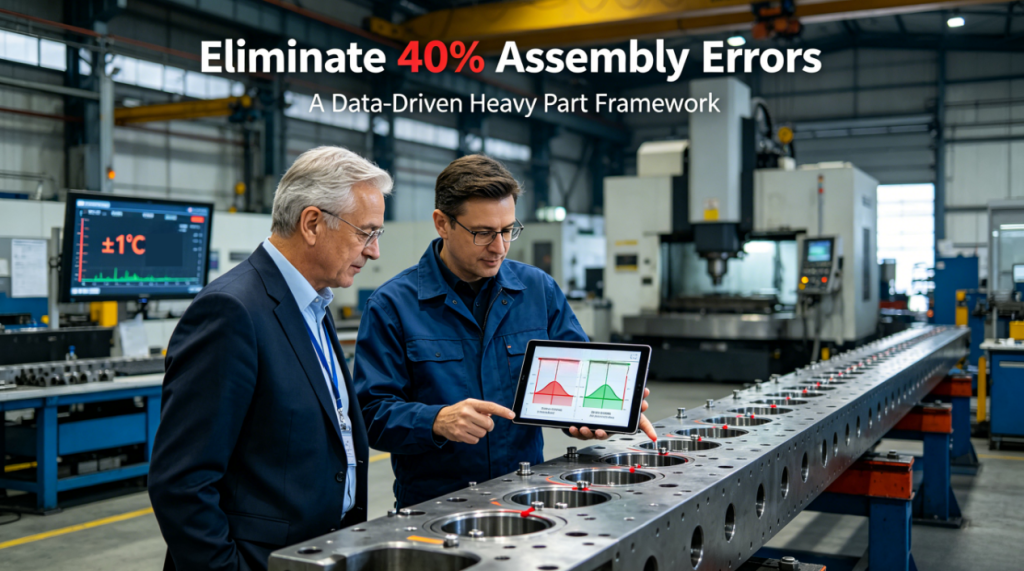
An environmentally-controlled machining environment with constant temperature (±1°C) becomes vital to offsetting any thermal deformation that might occur during long machining processes. Moreover, surface processing techniques such as anodization that may induce thermal or coating stress should also be well considered. According to the information provided on Wikipedia, anodization is an electrolytic passivation procedure that induces considerable heat which requires inclusion into the overall deformation management scheme.
Can the Combination of Efficiency and Tool Life Be Attained in Heavy Duty CNC Milling?
The supposed compromise between speed and tool life is a misconception when implementing systematic optimization of the machining process. By adopting efficient tool path methods, as well as proper parameterization, it is possible to increase the rate of material removal and prolong the useful life of tools.
1. High-Efficiency Machining (HEM) and Trochoidal Milling
High-Efficiency machining techniques like trochoidal milling and adaptive clearing are used to ensure the constant engagement angle of the tool. This helps avoid any overload during cornering operations and helps control the amount of heat generated in the process. This leads to an enhanced rate of metal removal while the rate of tool wear remains unchanged, which increases the machining efficiency of the operation.
2. Dynamic Force and Vibration Control
The tool life depends on the dynamic force and vibration (chatter) involved in the process. Through dynamics simulation software, one can identify the frequencies responsible for the chatter effect and remove them. Moreover, advanced technologies such as active vibration absorption systems installed in modern machine tools are capable of absorbing vibrations during machining and help use more aggressive parameters.
3. Advanced Tooling and Condition Monitoring
The use of tool geometries and coatings that reduce friction and wear will allow a more complete utilization of the tool without fear of catastrophic failure through condition monitoring. This is an early-warning system that avoids unnecessary downtime while ensuring quality standards are upheld throughout the process.
How Is Quality Assured in All Batches via a Closed Loop?
A closed loop quality system turns quality assurance into an ongoing process of improvement rather than being simply a gatekeeper for quality at the end of the line. This is done through the use of statistical process control (SPC) and complete digital traceability, ensuring that all parts produced are identical.
First Article Inspection (FAI) as a Digital Blueprint: FAI is not only a simple inspection, but rather an established digital standard against which all future components must be benchmarked. Modern standards dictate that a FAI report must contain not only dimensional data but also the name of the machine and software that was used to make the part. This is then employed as a reference throughout the whole statistical process control process.
Real-Time SPC and Pre-Alert Limits: Rather than waiting until a part is out-of-specification, real-time SPC measures vital process characteristics during manufacturing. This is done by setting up upper and lower control limits within the specification limits. An alert can then be triggered when there are signs of deviation in the process, allowing for corrective measures before producing any non-conformances, thus adhering to the standards such as those found in ISO 9001.
Traceability Through All Stages of Manufacturing of Mission-Critical Parts: In some industries such as aerospace and power generation, traceability is an obligatory requirement. This process includes forming a loop between the material certificate (MTC), machine documentation, inspection records, and notes of the operators tied to a particular serial number of the machined component. When necessary, the whole history of manufacturing can be traced immediately.
What Additional Features Are Important to Consider Besides Machine Specifications when Choosing a Partner?
When selecting the right supplier for machining large parts, manufacturers cannot limit their criteria to machine table sizes. The main value comes from process knowledge, transparency, and collaboration. In many cases, a partner that uses a systematic approach to error prevention will prove to be much more valuable than those possessing large machines only.
1. Knowledge of Materials and Mechanics – Tribal Experience and Case Studies
The ability of a partner to produce a large component without errors in the first try will depend on its experience with the materials and process knowledge. Asking a potential partner for a case study on the production of a similar component would provide insight into its process of handling deformation prevention and multistage alignment.
2. Transparency in Process Control and Data Sharing
A trustworthy business partner must be transparent. They should not hesitate to share real-time production dashboard, SPC analysis, and inspection reports with you. Ability to monitor the condition and quality data about your part remotely is an indication that the manufacturer has achieved a high degree of maturity in its production process. Don’t consider suppliers that are secretive regarding their shop floor practices.
3. Proactive Engineering and DFM Partnership
The single most important thing is early involvement. A good business partner will actively share their DFM insights and advise on how to improve machinability and decrease manufacturing costs. They will be able to think as a part of your design team. For complicated orders, it is imperative to choose a business partner having strong experience in custom CNC milling services.
Conclusion
Obtaining high precision and assembly success in mass manufacturing is not anymore only about machine tool accuracy. It calls for changing approaches towards building closed loops that focus on error prevention rather than detection. Using solutions to minimize thermal effects, manage stress conditions, and adaptive machining allows achieving a reduction in errors by up to 40%, allowing on-time deliveries, cost savings, and high performance guarantees.
FAQs
Q1: How much does lead time take on a big CNC milling job, and what affects it?
A: Lead times may vary depending on many factors, but the key factors that affect them include DFM & CAM engineering planning, materials for big stock purchasing, and stress relieving and finishing processes.
Q2: How are flatness and true position geometric tolerances ensured for parts measuring several meters long?
A: Environmental Control (Temperature Stabilization), Special Fixtures to avoid stresses, and in-process Metrology (Laser Trackers) used to dynamically adjust the tool path according to the actual geometry of the workpiece.
Q3: Is it possible to obtain a very high machining speed and a high quality of surface finishing during heavy-duty milling?
A: Yes, via an appropriate separation of rough machining and finish machining. Use HEM (High-Efficiency Machining) for rough machining and then a different path tool for fine finishing. The adaptive control will adjust tool engagement to avoid heat/vibration problems.
Q4: What type of certification and documentations will you need to have for the large parts that are mission critical?
A: All the parts are digitally traceable with the following documentation and certifications. This is because the process controls required for mission-critical parts require certifications such as AS9100, ISO 9001, etc.
Q5: What is your approach when designing for manufacturing (DFM)?
A: DFM concentrates on manufacturability on an industrial scale: accessibility of the tools, consolidation of details for setup minimization, and recommendation on wall thickness and location of ribs to control the internal forces during milling.
Author Bio
The author is a senior manufacturing engineer, specializing in addressing difficult machining issues for large-scale projects in the field of energy and aerospace. The company they work for, LS Manufacturing, has established itself as a supplier of precision CNC milling services that include all the necessary monitoring and quality control to facilitate successful assembly of any project.

Sandra Larson is a writer with the personal blog at ElizabethanAuthor and an academic coach for students. Her main sphere of professional interest is the connection between AI and modern study techniques. Sandra believes that digital tools are a way to a better future in the education system.