

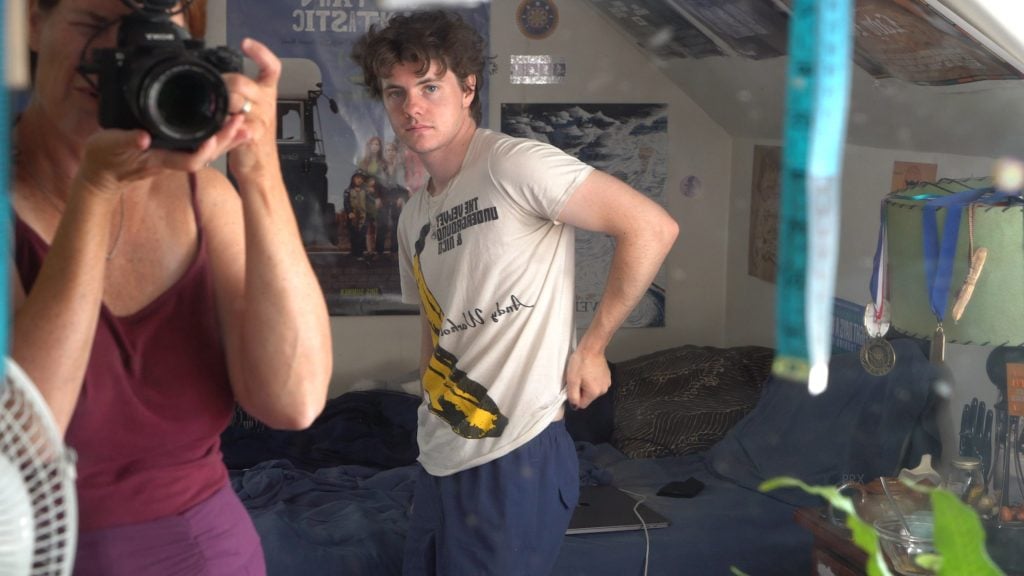
In a cultural moment when trans lives are so often reduced to political talking points or sensationalized headlines, Adam’s Apple feels like something quietly radical. Directed by Amy Jenkins and created collaboratively with her son, Adam Sieswerda, the film offers a deeply intimate portrait of a family learning how to move through transformation together. Constructed from two decades of footage—home videos, observational moments from Adam’s teenage years, artistic montages, and Adam’s own written reflections—the documentary unfolds less like a traditional film and more like a living archive of memory. What emerges is not simply a story about gender transition, but a tender meditation on identity, family, and the long, complicated process of becoming oneself.
At its center is Adam, whose journey from childhood to adolescence is captured with remarkable openness. The film traces the milestones of his transition—his growing understanding of himself as a trans boy, the possibility of hormone therapy, the shifting landscape of adolescence—but it refuses to frame these experiences as a dramatic “before and after.” Instead, Adam’s Apple lives in the quiet spaces in between. We watch Adam navigate school, friendships, family dynamics, and the subtle emotional terrain of growing up. These moments feel disarmingly ordinary, and that ordinariness is precisely what makes the film so powerful. Trans lives are rarely allowed the simple dignity of being portrayed as everyday lives, full of curiosity, uncertainty, awkwardness, and joy.
Amy Jenkins’ background as a visual artist shapes the film’s structure in beautiful ways. The documentary flows like memory itself, blending past and present through images drawn from a deeply personal archive. Childhood footage slips into contemporary scenes, while poetic visual interludes suggest the passage of time and the emotional shifts within the family. Adam’s own writing threads through the film as an internal monologue, offering a window into the interior life of a teenager trying to understand his place in the world. The effect is quietly mesmerizing. Rather than guiding the viewer with heavy narration or dramatic cues, Jenkins allows the images and Adam’s voice to breathe, trusting the audience to simply witness.
Watching Adam’s Apple as a trans woman who has only recently come out made the experience especially emotional for me. There is a particular loneliness that can accompany those early stages of self-realization, a feeling that you are stepping into unfamiliar territory without many reflections of yourself in the world around you. Growing up, I rarely saw stories about trans people that felt authentic or grounded in real life. Too often, trans narratives were framed through tragedy or spectacle, as if our existence could only be understood through suffering or transformation alone. What makes Adam’s Apple so moving is its refusal to fall into those patterns. The film allows Adam to exist not as a symbol or a political statement, but simply as a teenager figuring himself out.
In some ways, though, the film also broke my heart in ways I didn’t entirely expect. Watching Adam move through these years with the support of parents who are trying—who are learning, listening, and showing up for him—made me think about my own childhood. I remember being around that same age, knowing something about myself that I didn’t yet have the language to fully explain. The difference is that I knew I was a trans girl, but I was growing up in a very different environment—one that felt hostile and unsafe for that kind of truth. Seeing Adam be able to explore who he is within a family that is documenting that journey with love made me realize just how much that kind of support matters. It also made me mourn the version of my own younger self who didn’t have that same safety.
But what makes the film so meaningful is that it doesn’t just evoke that sadness—it also creates a kind of hope. Watching Adam’s story unfold reminded me how important it is that films like this exist now. Representation isn’t just about visibility; it’s about possibility. When young trans people see themselves reflected in stories that are honest, joyful, and grounded in real life, it tells them that their futures are not defined by fear or silence. It tells them they deserve to grow up, to laugh with friends, to go to school dances, to dream about the people they will become.
That’s why the film’s portrayal of Adam’s parents is so powerful. Parenting a teenager is never simple, and the documentary does not pretend otherwise. Jenkins presents herself with a striking level of honesty, revealing both her love for her son and the vulnerability that comes with witnessing profound change within a family. Rather than positioning herself as a flawless ally, she allows the audience to see the process of learning and adapting that unfolds alongside Adam’s transition. The result is a portrayal of parenthood that feels refreshingly human. The film acknowledges that acceptance is not always instantaneous or effortless, but something that grows through empathy, patience, and a willingness to listen.
At its heart, Adam’s Apple quietly argues something that should not be controversial but too often is: that children thrive when they are loved for who they are. Watching Adam and his mother tell this story together becomes a powerful reminder of what parental support can look like. It doesn’t mean having all the answers right away. It means showing up. It means choosing compassion over fear. It means allowing your child the space to become themselves.
For me, one of the most affecting elements of the film was Adam’s reflection on wearing a Superman costume as a child. In that memory, he describes the feeling of finally being seen as the boy he knew himself to be. It is such a simple image, yet it carries enormous emotional resonance. Many trans people grow up with moments like that—brief glimpses of recognition, fleeting experiences where the person we feel ourselves to be becomes visible, even if only for a moment. Hearing Adam articulate that memory brought back echoes of my own childhood, of the quiet ways many of us tried to express something we did not yet have the language to explain.
Ultimately, Adam’s Apple offers something that still feels rare in cinematic portrayals of trans lives: joy. The film does not deny the challenges that exist, particularly in a political climate where trans youth face increasing hostility and restrictions on their rights. Yet it refuses to let those external forces define Adam’s story. Instead, it focuses on the beauty of growth, creativity, and self-discovery. There is laughter, music, reflection, and the gentle unfolding of a young person becoming who he has always been.
In doing so, Adam’s Apple becomes more than a documentary about one family. It becomes a quiet act of resistance against narratives that seek to erase or diminish trans lives. For me, watching it was emotional not only because I recognized pieces of my own past in Adam’s story, but because it showed what is possible when a child is met with love instead of rejection. I wish more kids had that kind of support growing up. And that’s exactly why films like this matter. They remind parents, families, and the world that acceptance can change a life—and sometimes even save one.
Adam’s Apple held its World Premiere as part of the Documentary Spotlight section of the 2026 SXSW TV & Film Festival.
Director: Amy Jenkins
Screenwriter: Adam Sieswerda
Rated: NR
Runtime: 98m
Adam’s Apple becomes more than a documentary about one family. It becomes a quiet act of resistance against narratives that seek to erase or diminish trans lives.
-
10
-
User Ratings (0 Votes)
0

Codie Allen is a passionate trans and queer film critic and entertainment writer based in Orlando, FL. A Rotten Tomatoes-approved critic, Dorian Awards member, and CACF member, they also contribute to The Curb and InSession Film. When they’re not writing about films, you can find them sipping way too much tea and listening to Taylor Swift.
1 Comment
A truly spot on critique. Thank you very much. Ultimately it’s about the child and the only thing that matters is love. Thank you.
John Sieswerda
(Adam’s dad)