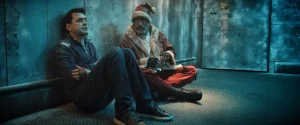

A deserted station. A blinking light. A traveler who notices that the last train has no driver. A few images can suggest a film long before anyone has written the complete screenplay. For people who enjoy inventing original stories, the concept trailer is a way to explore that suggestion rather than explain every event in advance.
Tools such as seedance 3.0 provide a place to experiment with short scenes from text or pictures. The interesting use is not to announce an imaginary production as a real release. It is to discover whether an original premise has a visual identity: a mood, a setting, and a question that makes someone want to see what happens next.
The first image makes a promise
In the fictional station example, a bright, busy platform would tell a different story from an empty corridor washed in cold light. The plot summary might be identical, but the opening image sets expectations about genre and tone. That is why a concept clip can be useful before a writer has settled every detail.
A creator could explore two interpretations. One might emphasize suspense through stillness and distance. Another could lean toward an adventure story, with a colorful departure board and a character hurrying toward a mysterious destination. These are hypothetical creative directions, not results from a test. Their purpose is to demonstrate how the same premise can support different experiences.
The strongest choice is not automatically the most elaborate. If the audience understands the world and senses a question, a simple shot may do more work than a rapid montage of unrelated spectacles. An opening earns its place by establishing the kind of story the creator wants to tell.
A sequence needs a relationship between its shots
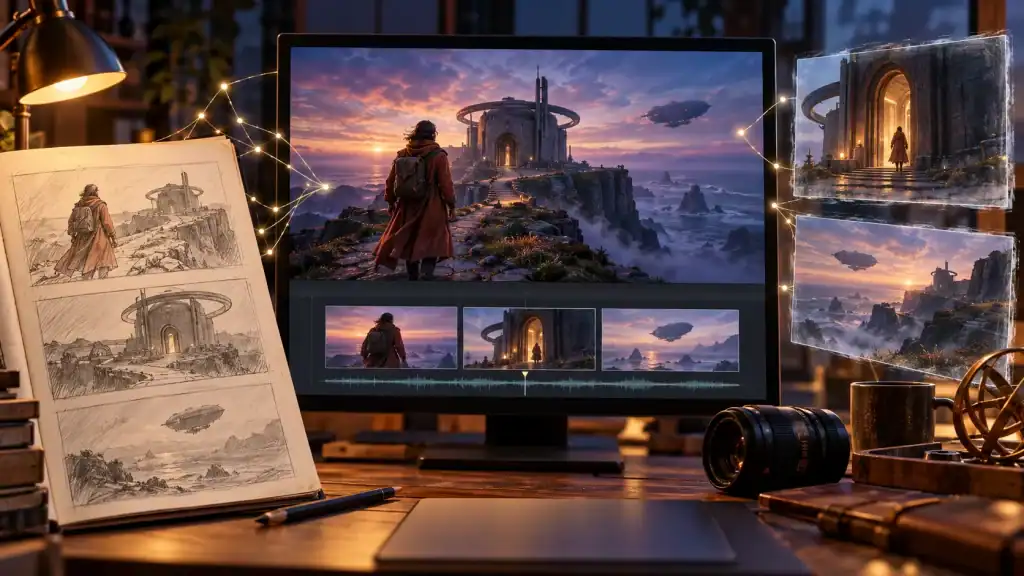
A collection of attractive clips does not become a trailer merely because music plays beneath it. The images need to build on one another. A station clock followed by an empty train can establish a place and an anomaly. A close-up of a discarded ticket might then introduce a clue. Each image changes how the next one is read.
This gives a creator a useful constraint: write the relationship between the shots before generating them. The sequence might move from ordinary to strange, from distant to intimate, or from a question to a larger question. That structure can remain short while still offering a recognizable dramatic movement.
Image references may help establish recurring visual elements where the chosen model supports them. A consistent costume, color scheme, or environment can make separate experiments feel related. Continuity still needs review; a recognizable character should not acquire a different appearance simply because the sequence cuts to another angle.
Sound changes the interpretation
The same empty platform could feel peaceful with a soft evening ambience or threatening with an uneven mechanical hum. Sound is therefore part of the concept, not merely a finishing layer. It can also be tested separately in an editor, using audio the creator owns or has permission to use.
Seedance describes sound generation and audio-reference options on supported models. Those are distinct capabilities, and availability should guide the experiment. A creator does not need both to explore a trailer. A silent visual draft with a separately assembled soundtrack may already communicate the intended rhythm.
Silence can be equally deliberate. A short interruption between two sounds can focus attention on a visual change. The useful question is what the audience should notice at that moment, rather than how much sound can be fitted into a short clip.
Let the ending leave room for the story
A concept trailer can stop before the imagined plot resolves. In the station story, the traveler might see a familiar face through the train window, followed by a title card. That ending introduces an emotional possibility without requiring the creator to summarize an entire feature in a few seconds.
When exploring variations in Seedance, a creator can compare which final image leaves the clearest question. A version that looks impressive but introduces an unrelated creature may weaken the premise. Another that repeats an earlier visual with one changed detail may give the audience more to think about.
Keeping the title card separate from generated imagery also helps. It allows the creator to control spelling, timing, and readability, and makes it easy to identify the piece as an original concept rather than an official trailer. That distinction matters when sharing experiments publicly.
What a concept clip can tell its creator
Show the draft to someone without narrating the plot first. Ask what kind of film they imagined and which image stayed with them. If their interpretation differs sharply from the intended story, that is useful creative information. The sequence may be emphasizing the wrong element or leaving out a necessary connection.
The exercise does not prove that the finished film would succeed. It gives the creator something more immediate: a way to see which visual decisions support the premise. The next draft might change only one shot, or the writer might return to the page with a better understanding of the story’s central tension.
For an original project, a concept trailer is a form of exploration. It can help a writer talk with collaborators, test an atmosphere, or find the image around which a larger story will grow. The technology supplies possibilities; the creative work lies in deciding which of them belong together.

Caroline is doing her graduation in IT from the University of South California but keens to work as a freelance blogger. She loves to write on the latest information about IoT, technology, and business. She has innovative ideas and shares her experience with her readers.