

This article approaches AI from a different perspective than the TechnoTricks feature. Rather than focusing on connected teams and workflow integration, it examines the quality of AI-assisted retail decisions, the limitations of automated shelf analysis, and why human judgment remains essential.
The article is written as an editorial technology feature, with substantive paragraphs, natural transitions and no fabricated executive quotations.
AI in merchandising: Can intelligent technology improve retail decisions without losing the human touch?
Artificial intelligence is rapidly becoming part of the retail industry’s decision-making infrastructure, promising to improve everything from inventory forecasting and product placement to customer analytics and promotional planning. For Canadian consumer packaged goods (CPG) manufacturers, the appeal is understandable. Retail operations generate enormous amounts of information, yet many organizations still struggle to translate that information into timely decisions that improve what customers experience inside stores.
The opportunity is particularly significant in merchandising, where the difference between a successful retail strategy and disappointing sales can come down to seemingly ordinary details. A product may be incorrectly positioned, unavailable during a promotion or displayed in a way that makes it difficult for shoppers to recognize. These problems can occur across hundreds of locations, making them difficult to identify and address consistently.
AI offers the possibility of recognizing patterns that human teams might overlook, predicting potential problems and helping manufacturers make more informed decisions about where to direct their attention. However, the growing enthusiasm for automation raises an important question: Can retailers and manufacturers improve operational intelligence without losing the practical judgment, customer understanding and human relationships that make merchandising effective?
The answer may depend less on the sophistication of the technology than on how organizations decide to use it.
Retail merchandising has become an information challenge
Modern retail merchandising involves considerably more than arranging products on shelves. Manufacturers must understand how their products perform across different locations, whether promotional activities are being executed correctly, how frequently stockouts occur and whether consumers can easily find the merchandise they intend to purchase.
For a Canadian CPG manufacturer distributing products through grocery stores, pharmacies and specialty retailers, this information may come from numerous sources. Sales reports provide one perspective, inventory systems provide another, and field merchandising observations offer details about physical conditions that are not always reflected in either system.
The difficulty is that these sources do not necessarily tell the same story. A product may appear to have sufficient inventory according to a retailer’s system while remaining unavailable on the shelf. Sales may decline because consumer demand has weakened, but the same decline could result from incorrect product placement or repeated replenishment failures.
Traditionally, identifying the cause requires experienced employees to review information, investigate store conditions and determine which explanation is most plausible. AI can potentially support this process by analyzing larger volumes of data and identifying relationships that warrant further investigation.
The distinction between identifying a possible problem and understanding its cause is essential. Technology can reveal patterns, but those patterns still require interpretation within the realities of retail operations.
Predictive analytics could change how manufacturers respond to demand
One of the most promising applications of AI involves anticipating changes in product demand before they create operational problems.
Retailers and manufacturers have long used historical sales information to support inventory planning, but modern machine-learning systems can incorporate additional variables and identify more complicated relationships. Depending on the information available, these models may consider seasonal purchasing patterns, promotional schedules, regional differences and historical inventory performance.
A manufacturer selling beverages across Ontario, for example, may experience demand fluctuations associated with weather, holidays or promotional campaigns. Predictive analytics could help identify locations where inventory requirements are likely to change, allowing planners to evaluate replenishment needs before shortages occur.
However, the usefulness of these predictions depends on the quality of the underlying data and the assumptions used to interpret it. Historical patterns may become less reliable when consumer behaviour changes, retailers adjust their assortments or unexpected supply chain disruptions occur.
A forecast that appears mathematically convincing can still be operationally wrong.
For this reason, predictive intelligence should support inventory planning rather than operate as an unquestioned authority. Employees who understand regional markets, retailer relationships and unusual purchasing conditions remain essential to evaluating whether automated recommendations make sense.
Computer vision is promising, but a photograph does not tell the whole story
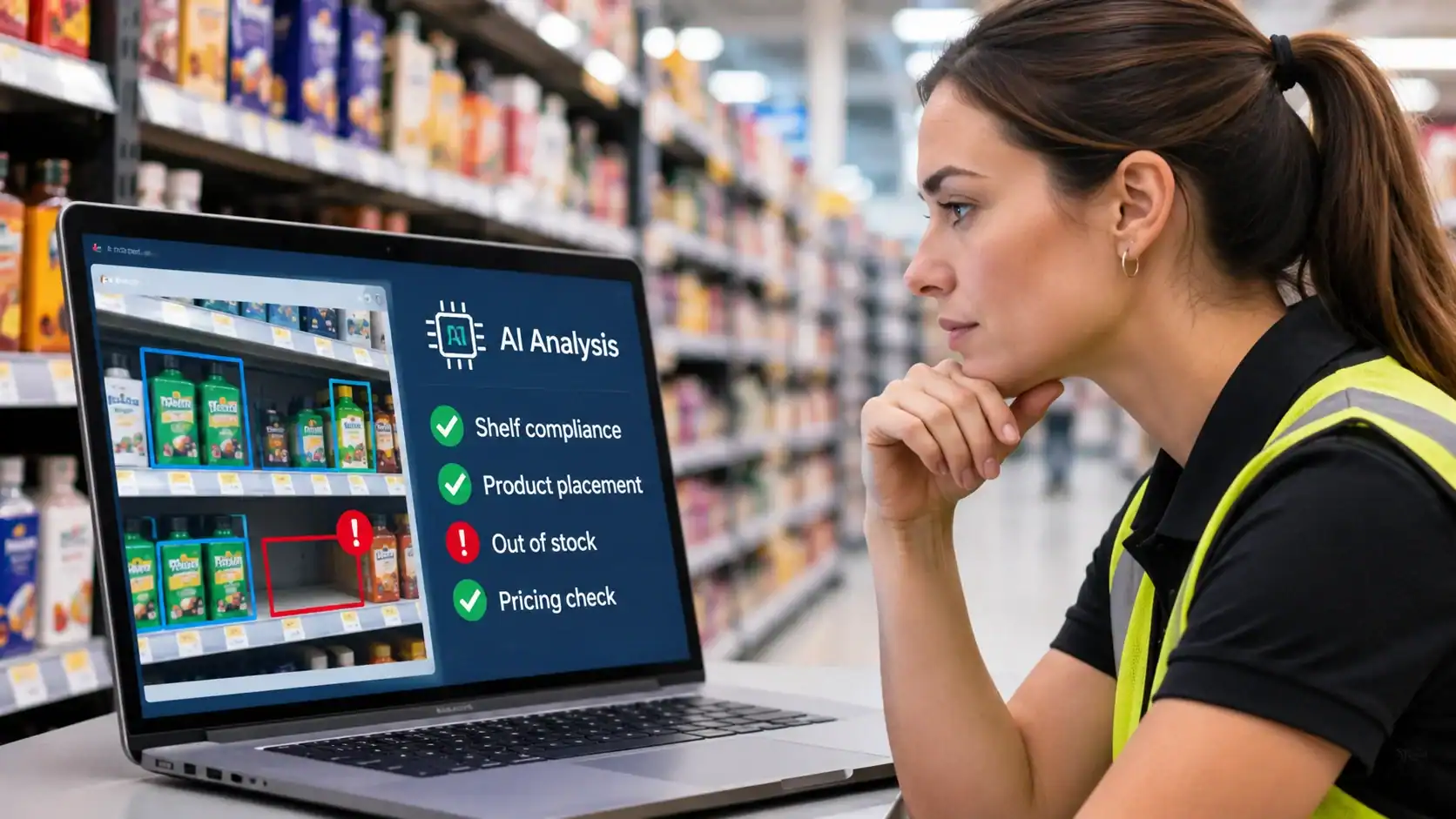
Computer vision has attracted considerable interest because it offers the possibility of analyzing retail shelves through photographs. Systems trained to recognize products and packaging can potentially identify missing items, estimate shelf occupancy and compare actual displays with approved merchandising arrangements.
For manufacturers managing large retail networks, these capabilities could reduce the time required to review store conditions. Instead of manually examining every photograph submitted by field representatives, supervisors could focus on images flagged as potentially containing merchandising problems.
The technology nevertheless faces limitations that become apparent in real retail environments. Products may be partially hidden behind other merchandise, packaging designs can change, and reflections or poor lighting can interfere with recognition accuracy. Similar-looking products may also be difficult for automated systems to distinguish, particularly when package sizes or formulations differ only slightly.
More importantly, a photograph captures a moment rather than the complete operational situation.
An empty shelf might indicate a replenishment problem, but it could also reflect a temporary product relocation, an approved assortment change or merchandise waiting to be moved from storage. A system that identifies the gap without understanding the surrounding circumstances may generate an inaccurate recommendation.
Human judgment remains important because merchandising decisions depend on context. Recognizing that something looks wrong is not the same as knowing why it happened or what should be done about it.
The risk of confusing automated recommendations with verified facts
As AI systems become more sophisticated, one of the greatest operational risks is that their recommendations may appear more authoritative than the underlying evidence justifies.
A dashboard presenting a precise forecast or compliance score can create confidence, even when the information supporting that conclusion is incomplete. If employees accept automated findings without appropriate review, mistakes may influence inventory decisions, promotional planning or retailer communications.
Consider a manufacturer whose AI system identifies a group of stores as having unusually weak product availability. The recommendation might be to increase replenishment or prioritize merchandising visits, but the apparent pattern could result from inconsistent reporting practices or incorrect product identifiers.
Acting on the recommendation without investigating the data could introduce unnecessary costs while leaving the actual problem unresolved.
The issue is not unique to retail. AI systems across industries can generate inaccurate outputs, particularly when they encounter information outside the conditions represented in their training data.
For merchandising organizations, this means establishing clear boundaries between automated observations, preliminary recommendations and verified operational findings.
Technology should help employees ask better questions, not discourage them from questioning the answers.
Why the human element remains central to retail execution
Retail stores are dynamic environments where conditions can change throughout the day. Deliveries arrive, shelves are replenished, promotional displays are modified and customers continuously interact with merchandise.
Experienced merchandising professionals understand that effective execution often requires practical judgment and cooperation with store personnel. A field representative may discover that an approved display cannot be installed because the designated space is temporarily unavailable, requiring discussion with store management and an alternative arrangement.
An AI system may recognize that the display does not match the original plan, but it cannot independently evaluate every commercial, operational and interpersonal consideration involved in resolving the situation.
Human employees also recognize subtle aspects of the customer experience that may be difficult to represent through standardized data. A product might technically comply with a planogram while remaining difficult for shoppers to locate because of surrounding displays or unusual store conditions.
These observations depend on experience, situational awareness and an understanding of how customers navigate physical environments.
The most effective use of AI may therefore involve helping employees identify where attention is needed while leaving decisions about corrective action to those who understand the circumstances.
Canadian CPG brands need intelligence that reflects actual store conditions
Canada’s retail environment introduces additional challenges because manufacturers often distribute products across large geographic areas, multiple retail banners and different store formats.
A merchandising strategy that performs well in a downtown Toronto pharmacy may require adjustments in a suburban grocery store or a smaller regional market. Consumer preferences, store layouts and retailer requirements can vary considerably, making it difficult to apply identical assumptions across every location.
For manufacturers, this creates an opportunity to combine AI-assisted analysis with information collected through professional merchandising activities.
Organizations such as Marketsupport Canada operate in the retail merchandising sector, where understanding product presentation, availability and execution at the store level is essential to supporting manufacturers. Information from these physical retail environments can provide context that purely digital analysis may overlook.
The value of combining these perspectives is that manufacturers can evaluate performance through both quantitative information and direct observations.
Sales data may reveal that a product is underperforming in a particular region, while merchandising observations can help determine whether the issue involves availability, positioning or promotional execution. AI can assist in organizing and comparing the information, but employees remain responsible for determining whether the conclusions are supported by actual store conditions.
This combination of technological analysis and operational experience offers a more practical approach than assuming software alone can explain retail performance.
Customer experience should remain the ultimate measure
Much of the discussion surrounding AI adoption focuses on efficiency, including faster reporting, reduced administrative work and more accurate forecasting. These benefits can be valuable, but they should not become disconnected from the purpose of retail merchandising.
For consumers, the objective remains straightforward. Products should be easy to find, accurately priced and consistently available when needed.
A manufacturer could deploy sophisticated AI systems and produce detailed operational dashboards without materially improving the customer experience. If shelves remain empty, promotional information is inaccurate or products are difficult to locate, the technology has not resolved the problems that matter most to shoppers.
This suggests that AI investments should be evaluated against outcomes such as improved shelf availability, fewer recurring merchandising problems and faster resolution of operational issues.
Efficiency measures also matter, but they should be connected to meaningful improvements in retail execution.
For example, reducing the time required to analyze store photographs is useful only if the resulting information helps employees identify and correct problems more effectively.
The strongest implementations will be those that connect technological capabilities with clearly defined commercial and customer experience objectives.
Responsible AI requires transparency and accountability
As manufacturers introduce AI into merchandising operations, they must also consider how automated systems influence employee responsibilities and business decisions.
Organizations should establish clear procedures for reviewing AI-generated recommendations, correcting inaccurate information and documenting decisions that affect retail operations.
Data security is another important consideration. Store photographs, inventory records, promotional plans and retailer-specific information may be commercially sensitive, making it necessary to evaluate how AI providers process and retain operational data.
Employees should understand which information can be entered into approved systems and when additional authorization is required.
Transparency is equally important when AI recommendations influence work assignments or performance assessments. Employees need confidence that automated analysis reflects accurate information and that they have opportunities to challenge findings that do not match actual store conditions.
Without these safeguards, technology intended to improve coordination can create confusion or undermine trust within the organization.
Responsible adoption therefore requires more than selecting an AI platform. It involves establishing governance, training employees and maintaining accountability for the decisions produced through automated processes.
The next competitive advantage may be better judgment, not more automation
As AI capabilities continue to develop, Canadian CPG manufacturers will have increasing opportunities to incorporate automated analysis into retail operations. Predictive models may help identify potential inventory problems, computer vision may accelerate shelf assessments, and intelligent reporting systems may make large volumes of merchandising information easier to interpret.
These developments could improve efficiency and help organizations respond more quickly to operational challenges. However, the availability of more information does not automatically produce better decisions.
Manufacturers still need employees who understand consumer behaviour, retailer expectations and the practical realities of maintaining products across physical stores.
The most valuable approach may be to use AI to reduce the time spent collecting and organizing information while increasing the time available for experienced professionals to evaluate problems and implement solutions.
This represents a different vision of technological progress from the idea that automation should eliminate human involvement wherever possible.
Instead, AI becomes a tool for strengthening the capabilities of merchandising teams, allowing them to work with better information and greater consistency.
Retail intelligence still needs a human perspective
Artificial intelligence is likely to play an increasingly important role in how retailers and manufacturers understand store performance, but its effectiveness will depend on how thoughtfully it is implemented.
The physical retail environment contains complexities that cannot always be captured through photographs, forecasts or standardized reports. Products move, customer behaviour changes and operational decisions often require negotiation, experience and judgment.
For Canadian CPG manufacturers, the opportunity is to combine the analytical capabilities of AI with the practical knowledge of employees who understand what happens inside stores.
Technology can help identify patterns, highlight potential problems and improve access to information. Human professionals can determine what those findings mean and how to respond appropriately.
The future of intelligent merchandising may therefore be less about replacing people with algorithms and more about giving people the information they need to make better decisions.
In an industry where customer satisfaction often depends on small details executed consistently, that balance could prove more valuable than automation alone.

Sandra Larson is a writer with the personal blog at ElizabethanAuthor and an academic coach for students. Her main sphere of professional interest is the connection between AI and modern study techniques. Sandra believes that digital tools are a way to a better future in the education system.