

Introduction
Artificial intelligence (AI) has crept into almost every part of making games. It’s changing how games are designed, built, tested and played. Lifelike characters and huge, detailed worlds are now much easier to reach. The creative side and the technical nuts and bolts are both changing.
Its reach doesn’t stop at gaming, either. Music makers and video creators are feeling the shift too. Tools such as Rap Duo AI show how artificial intelligence can support creative experimentation well beyond the usual gaming setting. A bedroom producer can now try out an idea at midnight without booking a studio. All of this points to an ever tighter link between smart tools and today’s digital entertainment.
Creating More Realistic Non-Player Characters
Non-player characters (NPCs) are where AI tends to show up most clearly. They’re the people who fill virtual worlds and deal with players along the way, whether as rivals, sidekicks, shopkeepers or whoever hands out the next quest.
For years, NPCs have mostly followed pre-written scripts and fixed rules. The trouble starts when players do the same thing twice and get exactly the same reaction. A guard who forgets an attack the moment the player walks off is a familiar sight.
AI gives developers a way to build characters that respond more flexibly as situations change. An enemy might change tactics as the player moves, while a companion reacts to its surroundings. A sidekick who notices the rain and grumbles about it feels far more alive than one who never looks up.
Conversations could get more natural as well, thanks to machine learning and advanced language models. Instead of a short menu of fixed replies, some characters might cope with almost any question. A blacksmith could, in theory, chat sensibly about the weather, the war or his missing dog.
Even so, these systems need careful handling. Personalities have to stay consistent, dialogue appropriate and gameplay meaningful. A wise old wizard who suddenly talks like a sports commentator breaks the spell very quickly.
Generating Game Environments and Digital Assets
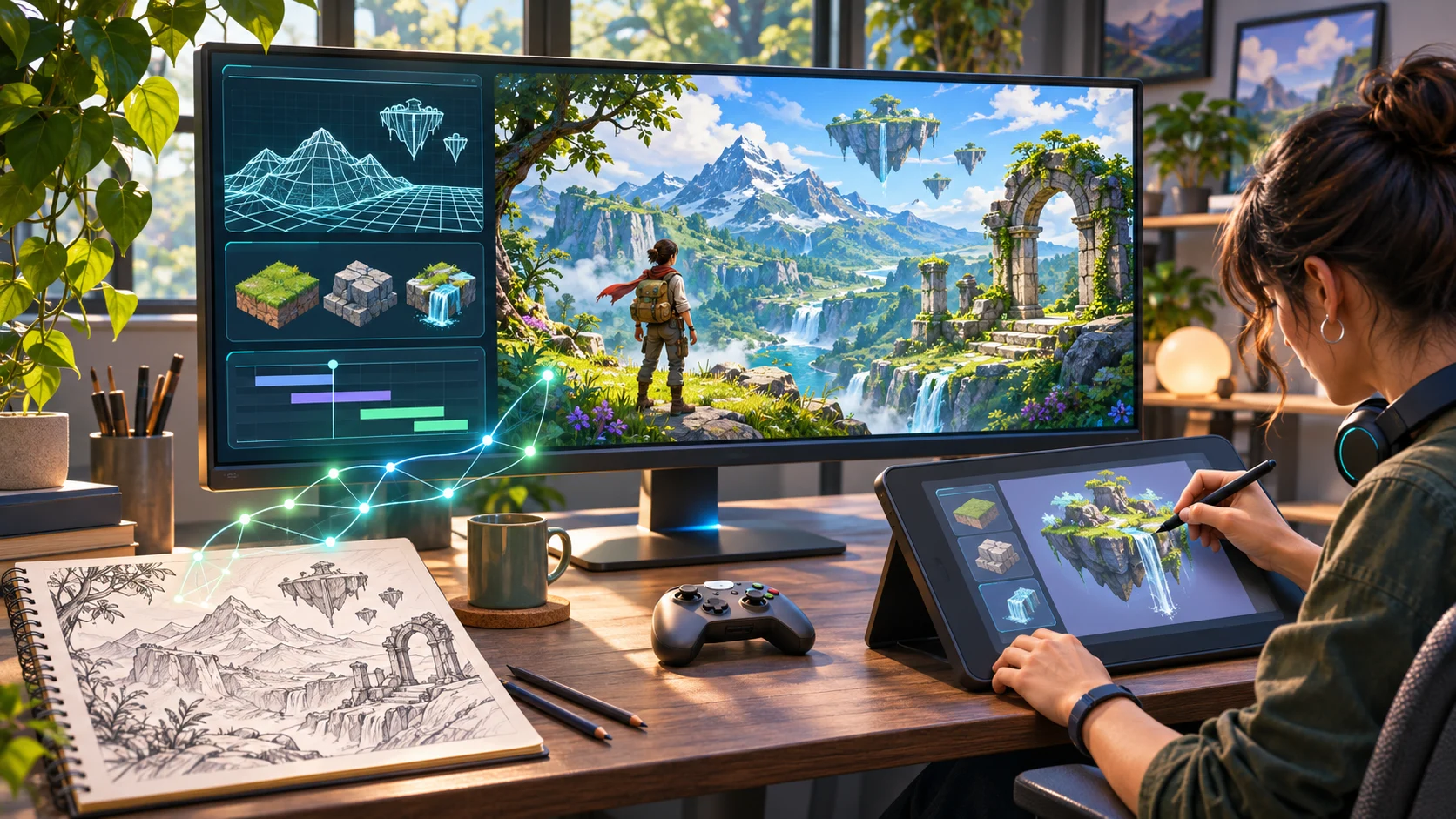
Detailed virtual worlds don’t build themselves. They eat up time and money. Every landscape, building, texture and animation has to be made by someone. A single market square can need dozens of crates and lanterns.
This is where AI-assisted tools can lighten the load. Procedural generation is a good example, with algorithms creating content from predefined rules. Studios have long relied on it for terrain, dungeons, plants and other natural features.
Today’s AI systems go further, helping with concept art, textures, 3D assets and animation references. Similar technology is turning up elsewhere in digital media. An AI Rap Video Generator, for instance, shows how AI can help create visual content for music-related projects. Its job is different from game development, but it shows the same thing: software can help people test ideas and make media without starting from a blank page.
Bigger, more varied worlds may also become easier to make. Instead of designing every location by hand, a team can mix carefully crafted areas with content generated by algorithms. The castle stays hand-built while the forests fill themselves in.
People still need to keep a close eye on things, though. Anything generated has to work technically, match the game’s art style and avoid looking repetitive or out of place. Players soon notice when every tree looks photocopied.
Improving Gameplay and Personalisation
By watching how people play, AI can tweak parts of a game so it feels more responsive, whatever someone’s skill level or style. A twenty-minute session on the bus needs something different from a whole weekend of play.
Take an adaptive difficulty system. If a player keeps failing at the same challenge, it might change how enemies behave. A strategy game, meanwhile, could throw up rivals whose tactics shift with the player’s approach to each match.
Personalisation goes beyond difficulty, too. AI might suggest missions, tailor training challenges or bring in optional activities that suit each player. Someone who loves fishing might find a quiet lake turning up on the map more often than a battlefield.
None of this works without care. When a game keeps shifting its difficulty with no clear explanation, players can start to feel their progress is being quietly rigged. Good personalisation supports enjoyment and accessibility. It doesn’t take away the deep satisfaction of finally beating a boss on the fifteenth attempt.
Streamlining Testing and Quality Assurance
AI can pull its weight in testing as well. Modern games are packed with systems, linked missions and endless player choices. Catching every bug by hand is a tall order. One misplaced rock can trap a character for good, and somebody has to find it.
Automated tools can play through sections of a game, repeat particular actions over and over and check how systems hold up under different conditions. AI agents can also roam virtual worlds hunting for navigation problems, odd interactions or spots where characters get stuck. They’ll walk into the same wall ten thousand times without complaining.
These methods help teams catch some problems earlier and rerun tests far more efficiently after each update. A Friday fix no longer has to mean a weekend of replaying one level.
Human testers still can’t be swapped out entirely, because bugs are only part of what makes a game good or bad. People are needed to judge whether a level is fun, whether dialogue sounds natural, whether the controls feel comfortable and whether challenges are fairly balanced. A machine can spot a broken door. It can’t say whether opening it felt exciting.
Supporting Independent Game Developers
Independent developers may feel the impact of AI tools too. Smaller studios tend to work with tight budgets and far fewer specialists than the big publishers. Sometimes one person is the artist, the writer and the programmer.
With AI in the workflow, these teams can knock together prototypes, make placeholder art, keep reference material tidy and hand off dull, repetitive jobs. That leaves more time for the mechanics, the story and the art style, the parts that make an indie game memorable.
A small studio might, say, sketch out several looks for a level with AI help before committing to the final artwork. Programmers could ask a coding assistant to explain an unfamiliar function, flag a likely mistake or rough out routine code. It’s like having a patient colleague around at two in the morning.
Creative AI apps also give indie creators room to play with trailers, music and video ideas. Good results still hinge on decent tools and people who know what they’re doing. Teams also need to check licensing terms before putting outside material into a commercial project. Nobody wants a surprise legal letter a week after launch.
Challenges and Ethical Considerations
For all its promise, AI brings some serious concerns with it. Intellectual property is one of the biggest. Training data, generated art, voice recordings and similar material all raise awkward questions about who agreed to what, who owns it and who can sell it. An artist whose style gets copied without permission has every reason to feel uneasy.
Jobs are another worry. Automation may shrink some repetitive roles while creating demand for people who can manage AI systems, check their output and fit new tools into existing production pipelines. That’s little comfort to anyone whose job is the one changing.
Privacy matters too, especially when AI systems study player behaviour or gather information to personalise the experience. Open, honest data practices and proper security are vital for keeping players’ trust. Sharing a high score is one thing. Sharing everything else is another.
On top of that, AI-written dialogue and content can contain errors, contradictions or material that simply isn’t suitable. Clear limits, solid testing and human oversight matter here, especially in games for younger players. A children’s game is no place for a character who goes off-script.
The Future of AI in Video Game Development
AI in gaming is likely to blend more closely with traditional development methods. Richer characters, adaptive worlds, automated testing and tailored experiences could all become routine as the technology matures.
Real-time AI might one day allow for more flexible storytelling, with characters and events reacting to choices in ways fully scripted systems struggle to match. A villain who remembers a kindness from three chapters earlier could change how a whole story lands. Still, technical limits, computing costs, performance demands and development budgets will all affect how widely these features catch on.
The best results will come from mixing what AI can do with human imagination and careful design. Writers, artists and designers will still decide how the story unfolds, how the game looks, how it’s balanced and how it makes players feel. The tools may get smarter. The heart of a game still comes from people.
Conclusion
From character behaviour and world building to personalisation, testing and day-to-day production, artificial intelligence is changing how video games are made. Music and digital video are feeling its pull as well.
There’s real potential here for faster work and more varied interactive experiences. Getting it right, though, means caring about quality, respecting creators’ rights, protecting privacy and using it responsibly. AI can’t replace thoughtful game design or an artist’s eye. What it offers is a growing toolkit that lets developers push their creative limits, with fun gameplay and the player still firmly at the heart of it all. The best games will still be the ones made with care.

Sandra Larson is a writer with the personal blog at ElizabethanAuthor and an academic coach for students. Her main sphere of professional interest is the connection between AI and modern study techniques. Sandra believes that digital tools are a way to a better future in the education system.