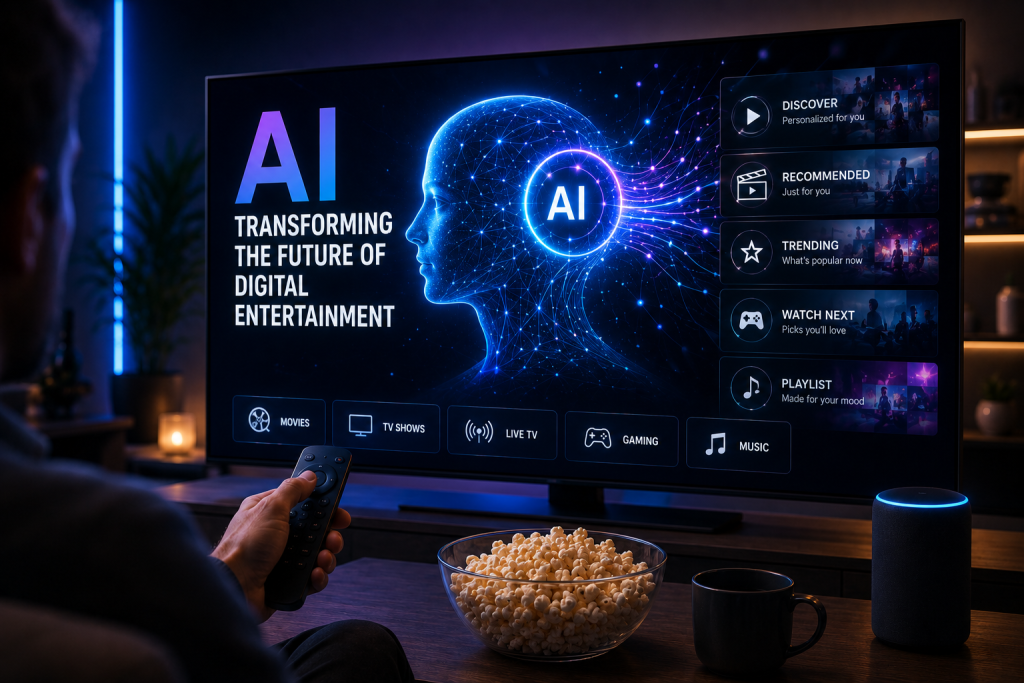
Artificial intelligence isn’t just something you read about in sci-fi novels or hear whispered about behind closed doors at big tech companies anymore. It’s genuinely become part of how people create, discover, and consume digital entertainment. From the personalized recommendations you get on your favorite streaming app to AI-generated visual effects in movies, this technology is quietly reshaping nearly every stage of the entertainment experience.
That impact really shows up in movies, TV, music, gaming, and online content especially. As AI tools keep getting more capable, creators are finding new ways to experiment while audiences get experiences that feel a lot more tailored to them.
AI Is Changing How Entertainment Is Created
One of the biggest changes AI has brought is how digital content is actually created. Creating high-quality entertainment used to require big teams, expensive gear, and lots of time. Pieces of work that took hours manually can now be done by AI-powered tools.
Artificial intelligence can help filmmakers with video editing, visual effects, colour correction, script analysis and pre-production planning, for example. Some tools can pick scenes automatically, organise raw footage, remove unwanted background elements or even generate rough visual ideas before a single frame is shot.
That doesn’t necessarily mean AI’s coming for filmmakers’ or editors’ jobs, though. It’s more about cutting down on repetitive work so creative teams get more room to actually focus on storytelling and the artistic choices that matter.
The same shift is also showing up in music production. Artificial intelligence can be a tool for musicians to experiment with melody, sound design, mixing and mastering. Tools like this can allow independent creators without access to a big studio to produce more polished work with a fraction of the resources.
Personalized Entertainment Is Becoming More Advanced
For some time now, streaming platforms have been using algorithms to recommend films, shows and music based on what you’ve watched or listened to. AI is taking that personalisation one step further by ingesting more types of data and identifying patterns in what audiences actually like.
Future platforms might begin to consider things like your viewing behaviours, preferred pacing, favourite characters, or even the types of content you tend to go for at a certain time of day, rather than just suggesting things based on genre or your previous viewing history.
Picture this: you open a streaming app after a long, exhausting day, and the recommendations waiting for you are actually suited to how you’re feeling right then. That kind of tech could make finding something to watch a lot faster and cut down on the frustration of endlessly scrolling through thousands of options.
Personalization also shows up in how people interact with digital media more broadly. Someone working with interviews, podcasts, music clips, or other video content might reach for a video to mp3 converter to pull audio out for editing, listening, or whatever creative workflow they’re running. As more and more media goes digital, simple tools that make content easier to repurpose and organize end up becoming a real part of the creator toolkit.
That said, personalization does raise real questions around privacy. The more data an entertainment platform collects, the more it needs to be upfront about how that data actually gets used and protected.
AI and the Future of Gaming
Gaming might be the industry where AI’s impact is most visible right now. Modern games already use AI to control enemies, build realistic behavior, and adjust gameplay on the fly for individual players.
The next wave of AI-powered games could make virtual worlds feel a lot more alive. Non-player characters could start reacting to players in genuinely natural ways instead of just cycling through pre-written dialogue trees. Game environments could shift based on a player’s actual decisions, making things feel a lot less predictable than they do now.
AI can also lend a hand during production itself — testing, animation, dialogue generation, asset creation, quality assurance, all of it. For smaller studios especially, that could mean lower development costs and ambitious projects that finally feel within reach.
Even so, developers are going to have to be deliberate about where AI actually belongs in the creative process. A game still needs a strong vision, mechanics that are actually fun, and storytelling that means something. Technology can support all of that, sure, but it can’t just conjure up a great game on its own.
AI-Generated Content Is Expanding
Generative AI has opened up another big shift — the ability to spit out images, video, audio, and text from a simple set of instructions.
For digital creators, that can make experimenting so much faster. A filmmaker can rough out a visual concept before ever building a real set. A YouTuber can whip up supporting graphics for a video. An independent musician can mess around with different sounds without having to hire a full production crew.
Pulling audio out of video is another everyday part of modern content creation. When creators need to separate sound from a video for editing or production, a video to mp3 converter offers a pretty simple way to turn compatible video files into audio. Small workflow improvements like that genuinely save time once you’re managing a large pile of digital media.
Social media is speeding up this whole AI-assisted content wave too. Short-form videos, animated content, digital characters, AI-assisted storytelling — all of it’s getting easier to produce. That could grow the creator economy even further, letting individuals go up against established entertainment companies with a fraction of the budget.
But generative AI drags along its own baggage too — copyright questions, ownership disputes, misinformation, and concerns about creative work getting swept into training datasets without consent. These issues are only going to get bigger as AI-generated entertainment gets harder to tell apart from stuff made the traditional way.
The Human Element Still Matters
Technology is moving so fast, but fundamentally, entertainment is still about the human experience. People connect with stories through the emotions, characters, ideas, humour, suspense, and cultural moments that are woven into them. Artificial intelligence can assist with content generation or streamline production workflows, but human creativity is still the one determining what’s actually worth making in the first place. Even a technically perfect movie can fail if the story doesn’t connect with the audience. Same for a game – it can run on the most sophisticated artificial intelligence systems out there, and feel entirely hollow without real design behind it.
So the future that actually works out best probably looks like collaboration between people and intelligent tools, not full-blown automation replacing the human side entirely.
What the Future Could Look Like
Digital entertainment’s future is probably going to be more interactive, more personalized, and more accessible than what we have now. Viewers might get more say in how they experience a story. Games could respond a lot more intelligently to each individual player. Independent creators could put out professional-looking work without needing a massive budget behind it.
At the same time, the entertainment industry’s going to need to nail down clearer standards around transparency, copyright, privacy, and using AI responsibly.
AI isn’t just another production tool sitting in the toolbox. It’s actually reshaping the relationship between creators, technology, and audiences. The companies and creators who figure out how to use it responsibly might stumble onto entirely new forms of storytelling that would’ve been nearly impossible to pull off before.
The real future of digital entertainment probably isn’t about AI replacing creativity at all. It’s more about handing more people the tools to turn their creative ideas into something audiences can actually see, hear, and play.