Online shopping used to follow a predictable routine: search for an item, open ten tabs, compare specifications, read a mountain of reviews, check the delivery date, and hope you made the right choice.
Amazon US has spent years trying to compress that routine.
In 2026, Amazon.com feels less like a giant digital catalogue and more like a shopping ecosystem built around one question: how many steps can be removed between “I need something” and “I found the right one”?
That shift goes beyond fast shipping. Amazon now combines product discovery, AI-assisted comparisons, price tracking, customer reviews, recurring deliveries, grocery shopping, flexible returns, and increasingly fast fulfilment in one place.
Compared with traditional retail—and even the older version of online shopping—the difference is becoming hard to ignore.
Here are nine reasons Amazon US continues to make a strong case for being a go-to online shopping destination.

1. Product Search Is Becoming More Like a Conversation
Traditional online shopping depends heavily on knowing what to type into a search box.
Need shoes? Easy.
Need “comfortable shoes for a week in Europe with lots of walking that still look good with jeans”? That is a different challenge.
Amazon’s current AI shopping assistant, Alexa for Shopping, is designed for exactly this type of natural-language search. In May 2026, Amazon brought its Rufus shopping technology under the Alexa for Shopping name, expanding conversational recommendations, product research, comparisons, and personalized assistance.
Traditional search: You provide keywords.
Conversational shopping: You describe the problem.
That difference makes product discovery especially useful when you know what you need an item to do but do not yet know exactly what to buy.
2. Comparing Products No Longer Requires Twenty Browser Tabs
Anyone who has researched laptops, appliances, headphones, furniture, or fitness equipment knows how quickly product comparison gets messy.
One page has the better price.
Another has better reviews.
A third has the feature you almost forgot to check.
Amazon is increasingly bringing that research together. Alexa for Shopping can generate product comparisons and provide category-level information, while Amazon’s Shopping Guides organize research and recommendations across more than 100 product types.
That does not mean shoppers should stop checking specifications themselves, especially for expensive purchases.
It means the starting point is considerably better.
Instead of building your own comparison spreadsheet for every purchase, you can narrow the field first and investigate the finalists.
3. Price Tracking Makes the “Should I Buy Now?” Question Easier
A discount sticker tells you today’s price.
It does not tell you whether today’s price is actually good.
That distinction matters.
Amazon’s shopping assistant now offers historical price information, price alerts, and tools designed to help shoppers recognize whether a deal is genuinely attractive. Current features can display extended price history, while customers can also set target-price alerts.
Compare the two shopping habits:
Impulse approach: “It says 25% off, so I’ll buy it.”
Price tracking approach: “How does today’s price compare with its recent history?”
The second approach gives shoppers more context and can make major sale events less dependent on flashy discount percentages.
For patient buyers, this may be one of Amazon’s most useful developments.
4. Prime Delivery Has Turned Speed Into an Everyday Expectation
There was a time when ordering online meant accepting a several-day wait.
That benchmark has changed considerably.
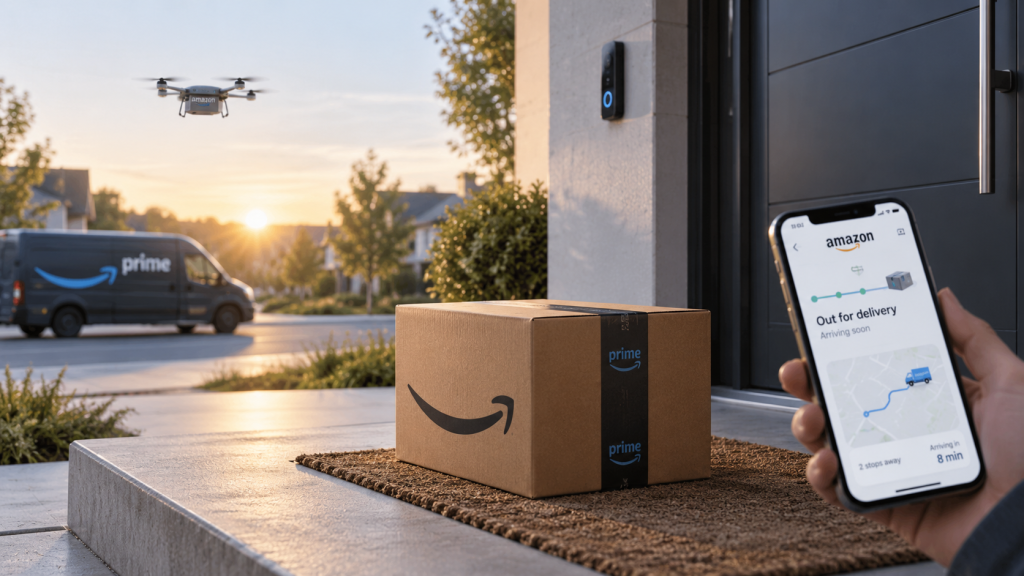
Amazon reported that U.S. Prime members received more than 8 billion items the same day or next day during 2025, with groceries and everyday essentials accounting for half of those deliveries.
Its Same-Day network has also expanded widely across the United States. Amazon said in May 2026 that more than 10,000 U.S. cities and towns had access to Same-Day Delivery.
That creates an interesting comparison with physical shopping.
Driving to a store may still be faster when you need something this minute.
But if the choice is between spending an hour driving, parking, searching aisles, and checking out—or tapping a few buttons and receiving the item later—the convenience calculation changes.
5. Some Essentials Are Moving From Same-Day to Around 30 Minutes
Amazon is pushing that comparison even further.
Amazon Now has been expanding in the U.S. with delivery of selected groceries, household essentials, and locally relevant items in approximately 30 minutes or less. In 2026, Amazon said the service was widely available in markets including Atlanta, Dallas–Fort Worth, Philadelphia, and Seattle, while expanding into additional U.S. locations.
This is not available everywhere, so shoppers should check local availability.
But conceptually, it closes part of the gap between ecommerce and the neighbourhood convenience store.
Forgot milk?
Running low on household supplies?
Need something before guests arrive?
Online shopping is increasingly competing not just with planned retail trips, but with last-minute ones.
6. Visual Search Helps When You Don’t Know What Something Is Called
Sometimes the hardest part of shopping is naming the thing you want.
You see a lamp in a restaurant.
A friend has a clever kitchen organizer.
Someone is wearing shoes you like.
You could attempt to describe the object with increasingly strange search terms—or use visual search.
Amazon Lens allows shoppers to upload or capture an image and look for visually similar products. Users can further refine the search with text or focus on a particular object within an image.
Text search: “Small black metal thing for organizing cables under desk.”
Visual search: Take a picture.
Sometimes the second option wins easily.
7. Customer Reviews Are Becoming Easier to Digest
Having thousands of reviews sounds useful until you realize nobody wants to read thousands of reviews.
The challenge with online reviews has gradually shifted from getting enough opinions to extracting useful information from too many opinions.
Amazon’s AI-powered review highlights are designed to summarize recurring themes from customer feedback, helping shoppers identify common positives and concerns more quickly.
It is still sensible to read individual reviews—particularly recent critical ones—before an expensive purchase.
But review summaries make a good first filter.
Instead of asking, “What did 7,000 people write?”
You can start with, “What are those 7,000 people repeatedly talking about?”
8. Subscribe & Save Makes Routine Shopping Almost Invisible
Not every purchase deserves research.
Nobody wants to spend Sunday evening enthusiastically comparing another pack of household essentials they have purchased twelve times before.
For eligible recurring products, Amazon’s Subscribe & Save program lets customers schedule automatic deliveries and can provide savings of up to 15%, depending on the order and eligible subscriptions. Customers can adjust frequency or cancel subscriptions as their needs change.
Compare:
Conventional shopping: Notice you’re almost out → remember the item → search → reorder.
Subscription shopping: It arrives according to the schedule you selected.
For frequently used household goods, personal-care products, office supplies, and similar repeat purchases, removing the need to remember may be just as valuable as the discount.
9. Returns Reduce Some of the Risk of Buying Without Seeing
Physical stores still have one major advantage: you can touch, inspect, and sometimes try a product before paying.
Online retail cannot fully replicate that.
A practical return policy helps compensate for it.
Amazon’s current U.S. return policy allows most eligible products to be returned for a refund, replacement, or exchange within 30 days of delivery, generally subject to condition and product-specific rules. Many eligible items also offer free return options, although exceptions and fees can apply.
That distinction is important because a promotional article should not imply that everything can always be returned free of charge.
Still, compared with the early days of ecommerce—when returning something could mean emails, printed forms, shipping fees, and a trip to the post office—the overall process is considerably more approachable.
Amazon US vs. Traditional Shopping: Where Does Each Win?
| Shopping Need | Amazon US | Traditional Retail |
| Product variety | Extremely broad online selection | Limited by store inventory |
| Immediate possession | Depends on delivery availability | Usually instant |
| Product comparison | Strong digital comparison tools | Requires moving between products/stores |
| Customer feedback | Large volume of online reviews | Usually limited |
| Price research | Digital price tracking and deals | More manual comparison |
| Routine purchases | Subscribe & Save automation | Requires repeat visits |
| Convenience | Shop from virtually anywhere | Requires travel |
| Physical inspection | Limited before purchase | Major advantage |
| Fast essentials | Same-Day and select ultra-fast delivery | Immediate if locally stocked |
The result is not that Amazon US wins every category.
It doesn’t.
There are still times when walking into a store, examining something yourself, speaking to a specialist, and leaving with it immediately makes more sense.
What Amazon does exceptionally well is reduce friction across a remarkably wide range of ordinary purchases.
The Bottom Line
Amazon US has evolved beyond simply putting a huge product catalogue on the internet.
The more interesting story in 2026 is how the individual pieces now work together.
Conversational shopping can help identify what you need. Product comparison narrows your choices. Price tracking adds context before checkout. Customer reviews provide real-world feedback.Prime delivery shortens the wait. Subscribe & Save handles repetitive purchases. Visual search helps when words fail. Flexible returns reduce purchase anxiety.
And in some U.S. markets, even groceries and household essentials can arrive in roughly the time it might take to make a round trip to a store.
Traditional retail still has its strengths, and smart shoppers should continue comparing prices, sellers, specifications, and return terms before buying.
But for selection, speed, research tools, and sheer convenience in one ecosystem, Amazon US continues to set an unusually high bar for online shopping.
The biggest change may be this: Amazon is no longer merely asking customers to search its store.
Increasingly, it is trying to help them decide what is worth buying, when it is worth buying, and how quickly they want it at their door.

Amanda Dudley is a lecturer and writer with a Ph.D. in History from Stanford University. After earning her doctorate in 2001, she decided to pursue a fulfilling career in the educational sector. So far, she has made giant strides by working as an essay writer for EssayUSA, where she delivers high-quality academic papers to students who need them.