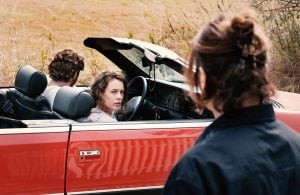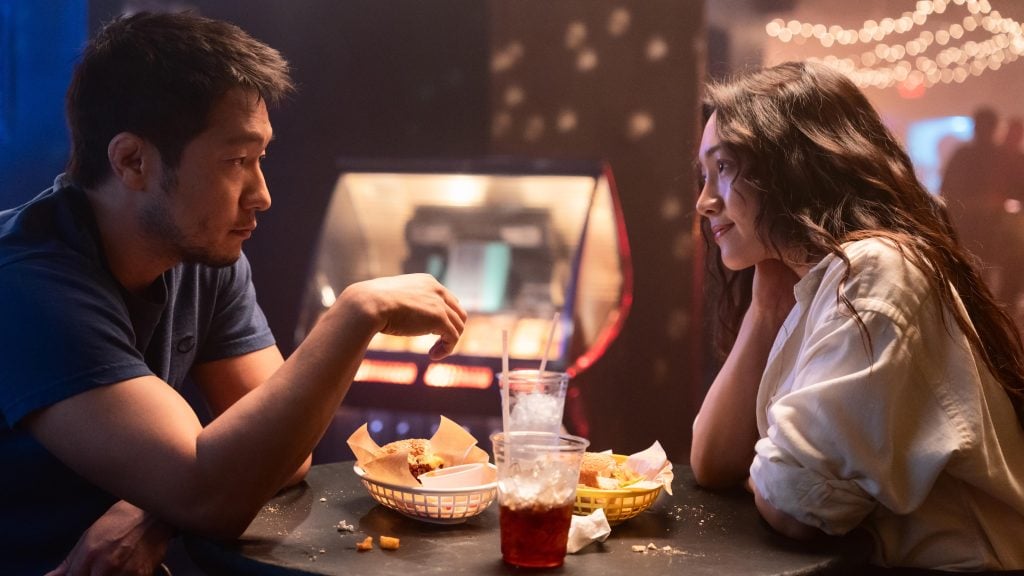
Bedford Park is a film about damaged people learning how to stay present with one another, even when presence feels dangerous. Writer-director Stephanie Ahn’s debut isn’t interested in redemption arcs or emotional breakthroughs designed for easy catharsis. Instead, it sits with messier terrain: the kind of inherited pain that seeps into the body and reshapes how a person moves through the world. It’s a film that understands trauma as something lived, and that sensitivity gives it much of its power.
The story centers on Audrey (Moon Choi), a Korean American woman in her 30s who returns to her parents’ home after her mother is injured in a car accident. Audrey is emotionally numb, carrying years of unresolved hurt tied to family expectations, an abusive childhood, and a deep uncertainty about who she’s allowed to be for herself. Moon Choi plays her with restraint and clarity, never pushing Audrey’s pain into spectacle. Her self-harm, her complicated relationship to sex, and her history of miscarriages are not framed as shock points, but rather they’re presented as symptoms of disconnection, ways Audrey has learned to survive while remaining sealed off from herself.
Audrey’s path crosses with Eli (Son Suk-ku), the man responsible for the accident. Eli is a former wrestler living as a security guard, estranged from his daughter and weighed down by his own abusive past. Son Suk-ku gives a beautifully measured performance, relying heavily on physical presence rather than dialogue. His Eli is stoic without being cold, emotionally barricaded but not unreachable. You can see the years in his posture, in the way he occupies space, in the hesitation that precedes even small moments of vulnerability. Like Audrey, Eli carries his trauma in his body, through scars and restraint, through what he avoids saying.
What makes Bedford Park compelling is not the novelty of its premise but the care with which it allows this relationship to unfold. Audrey and Eli are very different people, but they recognize something familiar in each other’s silence. Their connection grows through shared car rides, awkward conversations, and long stretches where nothing needs to be filled. Ahn understands the power of quiet here, not as a stylistic affectation but as an emotional reality. These are people who have learned that speaking can have consequences, and the film respects that instinct.
The concept of “han,” a deep, inherited sense of sorrow and resentment, runs through the film without being over-explained. It’s present in Audrey’s strained relationship with her parents, in Eli’s unresolved guilt and distance from his daughter, and in the way both characters struggle to imagine futures that don’t feel pre-scripted by pain. Ahn approaches this cultural weight with nuance, never reducing it to a metaphor or a lesson. It’s simply part of how these characters understand themselves and their limits.
Moon Choi is especially strong as a leading presence. Audrey is portrayed as deeply damaged, but the film never treats her as broken. Choi allows contradictions to coexist: Audrey can be withdrawn and impulsive, tender and self-destructive, guarded yet desperate for connection. There’s an honesty to the performance that makes even Audrey’s most frustrating choices feel grounded in emotional logic rather than narrative convenience.
Son Suk-ku matches her with a performance built on restraint. Eli’s quiet physicality does much of the storytelling, and Ahn knows when to let the camera linger on him without demanding explanation. Their chemistry doesn’t rely on heightened passion or dramatic declarations. It’s rooted in recognition, in the relief of being seen without being interrogated.
That said, Bedford Park is not without its flaws. The film runs a bit long, and its editing could have been sharper. Certain subplots, particularly those involving Eli’s family, feel underdeveloped and unnecessary. Rather than enriching his character, they dilute the focus of a film that works best when it stays close to Audrey and Eli’s shared emotional space. These detours interrupt the film’s rhythm and make the pacing feel uneven, especially in the middle stretch.
Still, the core of the film remains strong. Ahn resists the urge to force transformation or to frame healing as something easily achieved. The relationship between Audrey and Eli does not erase their trauma, but it offers a way forward, one grounded in choice rather than destiny. Audrey’s gradual reconnection to photography and Eli’s tentative return to wrestling are not presented as triumphs, but as gestures toward agency, toward reclaiming parts of themselves that had been buried under survival.
The ending reflects that same restraint. It doesn’t promise resolution or lasting peace. What it offers instead is emotional presence, the possibility of staying rather than numbing out. That choice feels earned, not sentimental, and it aligns with the film’s larger understanding of healing as something ongoing rather than conclusive.
Bedford Park may not be perfectly shaped, but it’s made with vulnerability and care. Stephanie Ahn shows a clear understanding of the emotional landscape she’s exploring and a willingness to let her characters exist without judgment. The film captures an experience rarely portrayed with this level of specificity: the quiet exhaustion of immigrant children who have grown up carrying responsibilities they never asked for, and the slow, difficult work of learning how to breathe fully again.
It’s a film that values connection over spectacle and patience over payoff. Even when it stumbles, its sincerity carries it through. And in a landscape where trauma is often flattened into shorthand, Bedford Park stands out for treating pain as something lived, embodied, and, with the right kind of care, survivable.
Bedford Park had its World Premiere in the U.S. Dramatic Competition section of the 2026 Sundance Film Festival.
Director: Stephanie Ahn
Writer: Stephanie Ahn
Rated: NR
Runtime: 121m
Bedford Park stands out for treating pain as something lived, embodied, and, with the right kind of care, survivable.
-
6.5
-
User Ratings (0 Votes)
0
Roberto Tyler Ortiz is a movie and TV enthusiast with a love for literally any film. He is a writer for LoudAndClearReviews, and when he isn’t writing for them, he’s sharing his personal reviews and thoughts on Twitter, Instagram, and Letterboxd. As a member of the Austin Film Critics Association, Roberto is always ready to chat about the latest releases, dive deep into film discussions, or discover something new.
![‘The Boys’ Season 5 Premiere Doesn’t Pull Any Punches [SPOILER WARNING]](https://cdn.geekvibesnation.com/wp-media-folder-geek-vibes-nation/wp-content/uploads/2026/04/THBY_S5_UR_501_00331_R2_3000-450x300.jpg "‘The Boys’ Season 5 Premiere Doesn’t Pull Any Punches [SPOILER WARNING]")