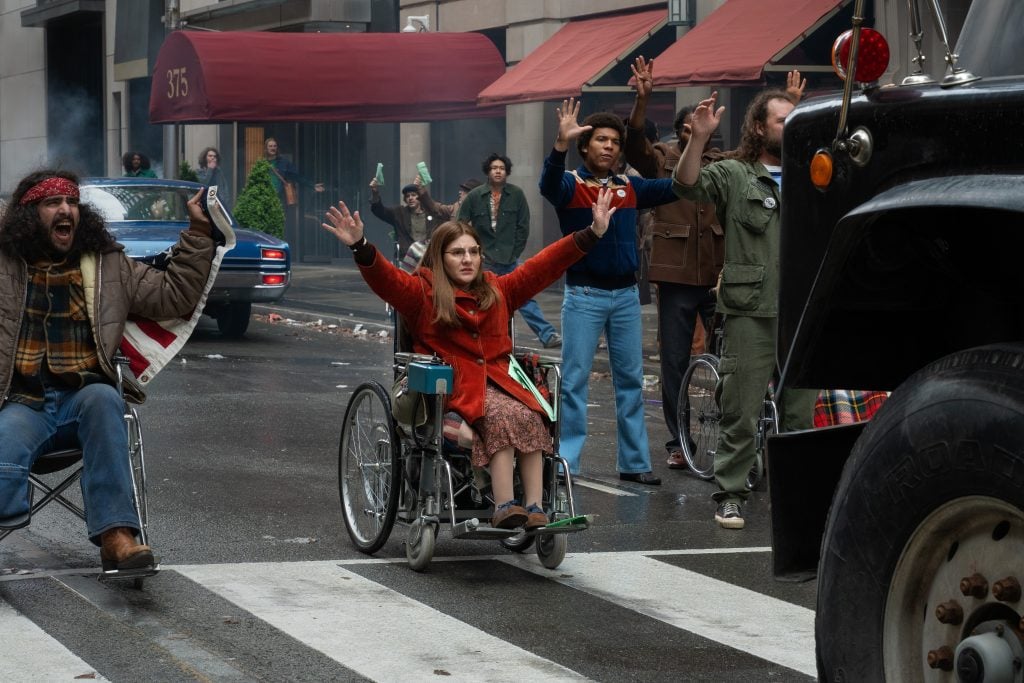
Judy Heumann’s story is difficult to separate from the history of the disability rights movement itself. Being Heumann, based on her memoir Being Heumann: An Unrepentant Memoir of a Disability Rights Activist, focuses on the events surrounding the 1977 Section 504 sit-in in San Francisco, when Heumann and more than 100 other disability rights activists occupied the Federal Building for 28 days. Their protest demanded that the government enforce Section 504 of the Rehabilitation Act and became a defining moment in the fight for disability rights in the United States. Her first film since her Oscar win back in 2022 for CODA, Siân Heder’s film captures the importance of that history, even if it sometimes falls into the familiar conventions of the inspirational historical drama.
To be blunt, Ruth Madeley is phenomenal as Judith Heumann. There’s a wonderful steeliness to her portrayal, the kind of determination you’d expect from a woman prepared to occupy a federal building for nearly a month, but Madeley never mistakes toughness for the entirety of Judy’s character. Beneath that formidable resolve, she finds the humor, warmth, and vulnerability that make Judy feel vividly human.
What’s especially compelling, however, is that Madeley refuses to sanctify her. Judy can be abrasive, impatient, and even downright difficult, particularly when confronted by those who fail to share her convictions. And thank goodness for that. Those rough edges give the performance texture. Madeley understands that courage is far more interesting when it belongs to a complicated person rather than an inspirational monument. Her Judy isn’t a flawless symbol of activism, but rather she’s a woman with a temper, a sense of humor, and plenty of imperfections who simply refuses to accept a world that tells her she should settle for less—making her a flawless person would have been an unrealistic choice.
That approach is crucial because Being Heumann is at its best when the disability rights movement stops feeling like a chorus assembled to amplify one heroic voice and instead becomes what it actually was: a collection of people, personalities, disagreements, friendships, frustrations, and competing ideas united by a common demand for dignity. Heder populates the film with a remarkably large ensemble of disabled performers, including wheelchair users and deaf actors, and their presence gives the protest scenes a texture that is difficult to manufacture. They belong to the story because they are the story. Heder understands that representation here isn’t some decorative virtue added after the fact; it is fundamental to the film’s very conception of history.
Even better, Being Heumann allows the movement to disagree with itself. Kitty Cone, played by Madeline Delp, repeatedly pushes back against Judy, and their friction provides some of the film’s most interesting dramatic material. Kitty has her own ideas about strategy and what the movement ought to prioritize. Those disagreements matter because activism is rarely as tidy as the retrospective version of history would have us believe. People can want the same destination and still fight bitterly about the road getting there. By allowing that tension to remain visible, Heder makes the correct decision to show the movement feeling less mythologized and more inhabited and almost spontaneous.
Unfortunately, the screenplay doesn’t always trust its characters enough to simply let them exist. Some of the dialogue and humor can be painfully hokey. The impulse behind the lighter scenes is understandable: after all, these activists are people, not solemn historical figures who spend every waking hour delivering inspirational speeches. When the movie lets them joke, flirt, bicker, and simply enjoy one another’s company, it becomes warmer and more lived-in. But too often the humor announces itself as humor. You can almost see the screenplay nudging you in the ribs, reminding you that these serious historical figures were also fun people. The result is a tonal awkwardness that occasionally pulls the film back toward the very inspirational-biopic conventions it seems determined to complicate.
That problem becomes even more apparent once the Federal Building occupation begins, and while there is undeniably powerful material here, I found watching the protesters settle in and maintain their resolve over days that become weeks gives the historical event an immediacy that archival footage alone cannot quite provide. Yet the sequence is also where the film’s pacing begins to buckle. The occupation lasted twenty-eight days, which presents an obvious challenge for any feature film: how do you communicate the endurance of a month-long protest without making the audience endure every emotional beat alongside the characters? Being Heumann doesn’t always find the answer. Certain scenes reiterate feelings we’ve already understood without significantly expanding the characters or the stakes. Instead of accumulation, there is sometimes simply repetition.
The supporting cast suffers from a related problem. Mark Ruffalo brings considerable presence to Joseph A. Califano Jr., while Dylan O’Brien plays Evan White, Rob Delaney appears as Congressman George Miller, and Ray Fisher portrays Chuck Jackson. Collectively, they help make the world around Judy feel larger, populated by people whose decisions have consequences beyond her immediate orbit. Individually, however, several of them remain frustratingly underwritten. The ensemble is convincing as an ensemble, but some of its members feel less like fully developed characters than pieces the screenplay needs to move from one historical milestone to another. You remember the movement more readily than you remember everyone who helped compose it.
Heder still tries and proves to be an especially empathetic filmmaker for this material. Her work has long shown an attraction to outsiders and to characters who resist the neat categories imposed upon them, and she approaches Judy’s activism with admiration without embalming her in sainthood. That distinction is important. The film’s most effective moments aren’t necessarily those in which Judy triumphs; they’re the ones in which we see the sheer persistence required to keep demanding something so fundamental from institutions that have spent years insisting it is unreasonable.
That is ultimately what gives Being Heumann its urgency, as the disability rights movement can so easily become another chapter in the sanitized version of American civil rights history, a collection of dates and legislative victories safely removed from the anger that made those victories possible. Heder’s film occasionally manages to restore that anger. These people aren’t politely requesting inclusion. They are occupying a federal building because polite requests have failed. There is something thrilling about the bluntness of that action, and Madeley’s performance gives Judy precisely the force of personality necessary to make it believable.
And yet, after the movie ended, I found myself wishing the film had been as daring as the history it depicts. I am very glad Being Heumann exists. Judy Heumann’s story deserves a much larger place in the popular understanding of the American civil rights movement, and the film’s casting of disabled performers in major roles gives that history a sense of authenticity and ownership that shouldn’t be underestimated. But there is an unavoidable irony in a film about people who refused to accept the limitations imposed upon them occasionally feeling so comfortable within the limitations of the inspirational biopic.
The structure is overly familiar, and the emotional crescendos arrive when we expect them. Top that with how broad the humor can be and how the Federal Building occupation, despite containing some of the film’s most important material, sometimes feels considerably longer than its dramatic substance can sustain. None of this diminishes the importance of the history, but it does keep the movie itself from feeling quite as revelatory as its subject. And while Being Heumann may not escape the conventions of its genre, but its existence still feels valuable. Heder and her performers are reclaiming a piece of American history that has been marginalized for far too long, and Ruth Madeley gives Judy Heumann the charisma, stubbornness, humor, and humanity necessary to carry that history onto the screen. It isn’t quite the definitive film Judy Heumann’s story might warrant. It is too polished in places, too familiar in others, and occasionally too eager to tell us how inspiring everything is.
But there is something undeniably moving about watching a group of people refuse to leave a building because they have finally decided that being ignored is no longer an acceptable condition of their existence. If Being Heumann doesn’t always find the cinematic language worthy of that defiance, at least it understands that the defiance itself deserves to be remembered.
Being Heumann held its World Premiere as part of the Gala Presentations section at the 2026 Toronto International Film Festival.
Director: Siân Heder
Screenwriters: Siân Heder, Rebekah Taussig
Rated: NR
Runtime: 127m
Before we let you go, we have officially launched our merch store! Check out all of our amazing apparel when you click here and type in GVN15 at checkout for a 15% discount!
For major deals and money off on Amazon, make sure to use our affiliate link! If you are purchasing any of the latest and best in physical media at MovieZyng, you can support us using our affiliate link.
If Being Heumann doesn't always find the cinematic language worthy of that defiance, at least it understands that the defiance itself deserves to be remembered.
-
GVN Rating 6.5
-
User Ratings (0 Votes)
0

Roberto Tyler Ortiz is a movie and TV enthusiast with a love for literally any film. He is a writer for LoudAndClearReviews, and when he isn’t writing for them, he’s sharing his personal reviews and thoughts on Twitter, Instagram, and Letterboxd. As a member of the Austin Film Critics Association, Roberto is always ready to chat about the latest releases, dive deep into film discussions, or discover something new.