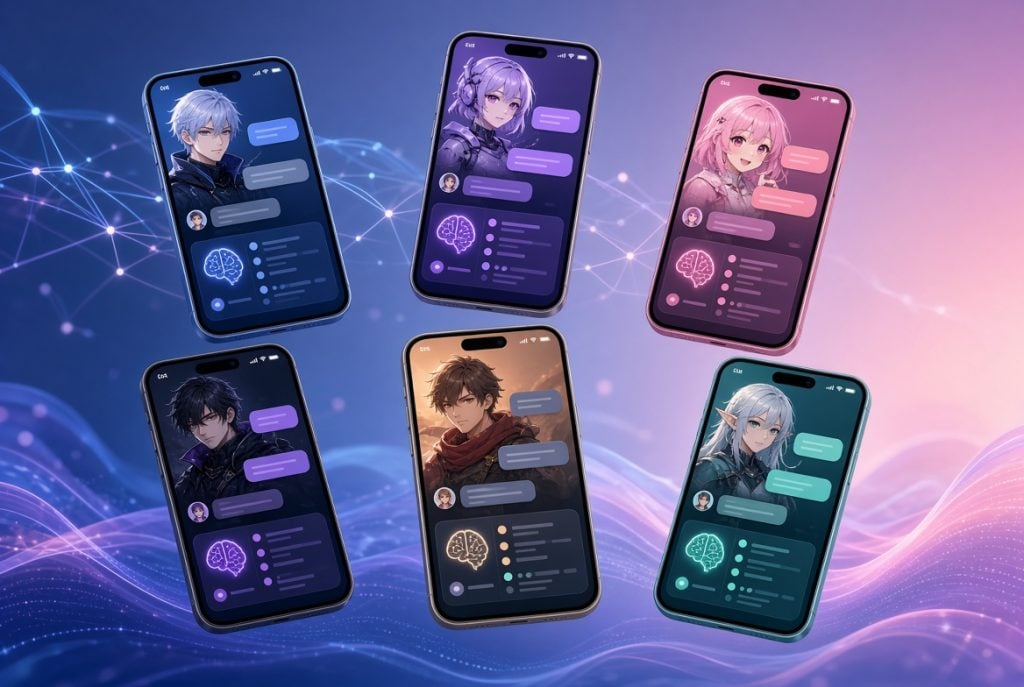
Four voices crowd a rain-slick alley. The Narrator sketches shadows. Detective Jones hunts clues. Two jittery informants spit slang—until their rhythms blur and the scene breaks. Group role-play needs more than stylish prose: an AI must know when to speak and pin each reply to the right viewpoint. We scored six platforms on three things: keeping voices distinct, preserving shared canon and room state, and staying coherent when a new speaker barges in. A four-speaker stress test produced the results below.
1. DreamGen

DreamGen leads because Role-Play Mode seats every speaker in a labeled chair, so no one steals another line. Scenario Codex works like a private wiki that pins lore where the model can read it; when a third NPC enters, DreamGen still knows who guards the secret and who just arrived.
On the free Lucid Base tier you get about 2,000 role-play messages a month, a daily refill of about 250 messages afterward, and a 5,000-token context (roomy for one-shots, cramped once the Codex swells). Pro stretches the window to 30,000 tokens and gives you access to GLM 4.7.
Story/Role-Play Assistant offers on-demand help to brainstorm or rewrite scenes, and free message editing lets you cut stray replies. A scenario wizard spins up a new world in minutes, and the whole thing runs in the browser on desktop or phone with nothing to install, so you can open the role playing AI chatbot and seat a four-hander in about the time it takes to write the premise. That mix delivers full creative freedom without self-hosting headaches.
Best for directed, lore-heavy ensembles where canon has to survive a crowded scene. Biggest weakness: the free context window runs dry in marathon sagas, so long campaigns push you toward Pro.
2. SillyTavern
SillyTavern is a self-hosted front end where every character lives on a card packed with persona notes. Load several cards into one room and decide exactly who speaks, when, and why.
Two turn engines shape the scene. Manual mode lets you click a name or fire a /trigger so only that speaker replies. Natural Order imitates dinner-table chatter: mention a character, and their Talkativeness slider decides whether they jump in or stay silent.
Because only the active card is injected, prompts stay slim. The catch appears as the cast and World Info corpus grow: each card, lore snippet, or prompt rule competes for the same context, so smaller back-end models feel the squeeze first.
The front end is open source and free; your cost is whatever API or GPU you connect. Best for builders who need precise control over turns, memory, and tokens. The biggest hurdle is the setup and back-end tuning it demands.
3. Nomi AI
Every Nomi is a distinct friend with its own scrapbook of memories. In a paid group chat you can seat up to ten Nomis and let them take turns automatically, or tap a photo to pick the next speaker. A shared group note works like a whiteboard for goals, clues, and running jokes.
Long-term memory is the headline draw: a secret whispered in private resurfaces when that same Nomi joins the room. Spatial continuity can still slip; during our alley test one Nomi swapped positions after a correction, an issue echoed in recent App Store reviews.
The free tier covers one-to-one chat; a subscription gives you multi-speaker rooms, voice calls, and a higher daily message cap.
Best for recurring casts whose individual bonds deepen over weeks. Biggest weakness: group scenes sometimes lose track of who stands where.
4. Kindroid
Kindroid stages your ensemble like a director switching between solo rehearsals and full cast runs. Each Kindroid keeps a private backstory, while a shared room lets you choose automatic turns or tag someone by name.
Knowledge symmetry is the first friction point. A Kindroid cannot read another’s diary, so late arrivals may repeat solved clues unless you paste that lore into the room. Our alley test caught the newcomer reasking facts everyone else knew, a flaw that grows as the roster approaches the 10-Kindroid ceiling.
Group chat is a paid feature; most people meet their Kindroid one to one before upgrading. After you subscribe, moving the same personalities between private chats and crowded scenes feels natural, provided you keep the canon clipboard close.
Best for recurring characters that shift between private and ensemble scenes. Biggest weakness: shared knowledge relies on manual curation, so slip-ups snowball as the cast grows.
5. AI Dungeon
AI Dungeon runs on a single narrator model that writes the scene and slips into every NPC’s voice like a quick-change actor. Story Cards feed each persona to the model, while Plot Essentials, a Story Summary, and a Memory Bank preserve world state between turns.
That single-mind design shines in long adventures: the narrator remembers where you parked the carriage, when the moon rose, and which oath you swore in chapter one. Problems appear when the alley gets crowded. Because the same model speaks for everyone, traits can blur. In our test, the gambler adopted the detective’s stiff formality after three lines. Tight Story Cards and explicit speaker cues reduce the leak, yet they cannot erase it.
The free Wanderer tier gives roughly 4,000 context tokens and 25 memories, sufficient for episodic quests. Paid tiers raise both limits for epic sagas.
Best for campaign adventures where narration matters more than strict voice separation. Biggest weakness: character traits blur when many NPCs share the stage.
6. Shapes
Shapes mixes AI companions and friends in one room, like players around a virtual table. Every Shape keeps its own personality and memory, and you can pick the next speaker, or let Free Will decide. Humans type alongside them, so the chat feels like live improv.
That freedom creates turn noise. In our alley test the Shape who exited kept butting in until we muted them and trimmed their activation weight. Pinned messages, quick speaker buttons, and activation sliders calm the chaos, but you need to act early.
Canon tools are lighter than a full scenario wiki, so room state stays mostly manual. Core group chat is free for testing; premium credits give you access to larger models and faster replies.
Best for social role-play nights where lively banter matters more than strict lore. Biggest weakness: chatter control is manual, and deep canon management is thin.
Quick Comparison
# | Tool | Turn Control | Shared Canon | Best For |
1 | DreamGen | Labeled speaker roles | Scenario Codex wiki | Lore-heavy ensembles |
2 | SillyTavern | Manual or Natural Order | World Info per card | Builders wanting control |
3 | Nomi AI | Auto turns or tap to pick | Shared group note | Recurring casts |
4 | Kindroid | Auto turns or tag by name | Manual curation | Private-to-ensemble scenes |
5 | AI Dungeon | One narrator voices all | Plot Essentials, Memory Bank | Campaign adventures |
6 | Shapes | Free Will or pick speaker | Light, mostly manual | Social banter nights |
Conclusion
Pick by what your table needs most. Running a lore-heavy ensemble where canon has to hold? DreamGen. Want turn-by-turn control and willing to trade setup time for it? SillyTavern. Chasing long-running relationships rather than tight plot? Nomi AI. Whatever you choose, settle who speaks when before the scene starts — every failure in our test began as a turn-order problem.

Madeline Miller love to writes articles about gaming, coding, and pop culture.