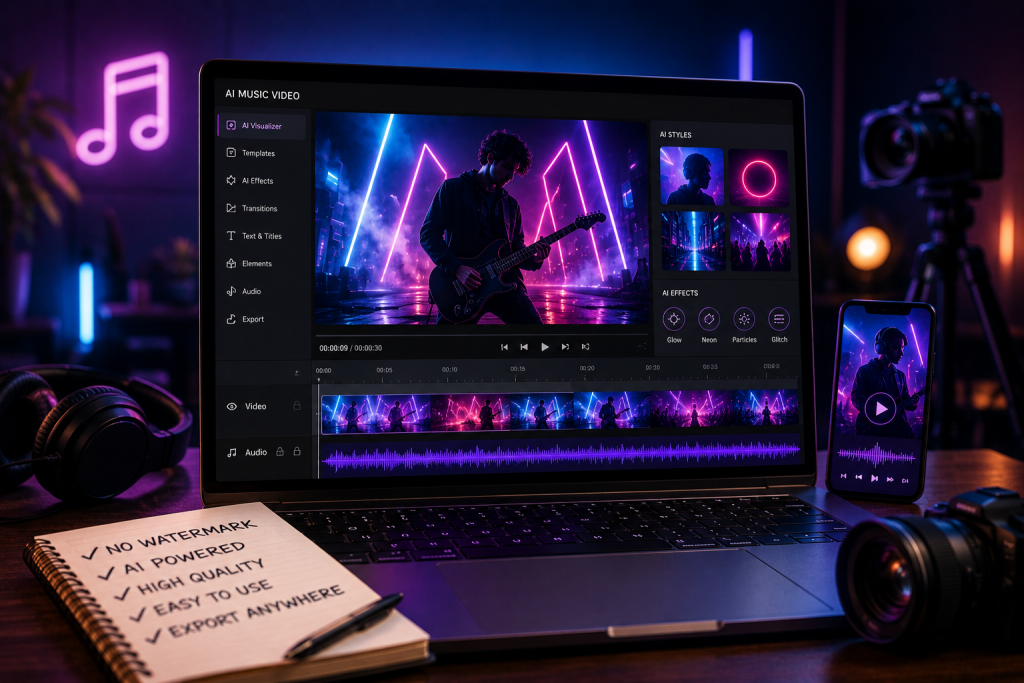
AI visuals have moved from gimmick to go-to. When your track drops on Friday and the budget is zero, the last thing you need is a watermark shouting “free trial” from the corner of your clip. We tested 20+ generators for render speed, beat sync, and license clarity. Five stood out—from a stem-aware powerhouse to a completely free upstart—and every one exports watermark-free videos you can post straight to YouTube, Shorts, or Spotify Canvas. Below you’ll find a quick comparison table, a ranked breakdown of each tool, and a transparent look at how we scored them.
At-A-Glance Comparison
Time is tight when a song is hot, so scan the table, decide whether watermark policy, price, or a standout feature matters most, then read on for the details.
| AI tool | Watermark policy | Ideal use | Starting cost | Why it stands out |
| Neural Frames | Clean exports on all tiers | Full-length, high-fidelity releases | $26 / month | 8-stem audio analysis and 4K output |
| One More Shot AI | No watermark even on free tier | Fast social clips on mobile | Free, then pay-per-second | Beat and lip sync plus “Virtual Artist” avatars |
| Freebeat AI | Watermark-free from Standard plan | Budget TikTok visuals | $9.99 / month | Multi-model engine for varied styles |
| Rotor Videos | Pay-per-download, never watermarked | Stock-footage promos | About $9 per video | Real footage auto-cut to your music |
| Ima Studio | Always free, no watermark | Zero-budget experiments | Free | Prompt-based generative video in minutes |
If you mostly post Shorts, One More Shot’s mobile workflow stands out. For pristine sync and UHD quality, choose Neural Frames. Need a one-off promo without another subscription? Rotor’s pay-once model is the simple choice.
Neural Frames – Pro-Grade, Stem-Aware Visuals
Neural Frames stem-aware AI music video generator interface screenshot
Neural Frames tops our list because it treats your song like a multitrack session, not a flat MP3. It splits your mix into eight stems—vocals, drums, bass, synths, and more—and drives animations from each element. A snare hit triggers a strobe; a vocal swell shifts the colour palette. Every choice follows the music, so the video feels composed rather than pasted together.
Upload a track, pick a style, and tap Autopilot. Within minutes you’re watching a fully cut video that lands on every downbeat. Need finer control? Open the timeline and assign effects to individual stems—it feels closer to tweaking EQ than editing video, which suits musicians living in a DAW.
Quality keeps pace: Neural Frames renders up to 4K, and exports on all tiers stay watermark-free, so you never crop logos or upgrade later. Pricing starts around twenty-six dollars a month, covering enough credits for several full tracks—pricier than a freemium app, yet cheaper than hiring a motion designer, with unused credits rolling over.
Choose it when you need a flagship video that can sit beside big-label visuals, when your music relies on intricate rhythms, or when you plan to repurpose footage into Canvas loops and teasers without re-rendering. Minor caveats: the interface is deep, so start with a short loop before a six-minute epic, and full songs need a subscription beyond the free tier’s limited minutes.
Not ready to upload your whole track? Drop any MP3 into Neural Frames’ audio-to-video converter and, in seconds, you’ll download a watermark-free MP4—just try the free tool first to feel the render speed. From there, hop into the interactive stem demo on Neuralframes.com to see how every kick and vocal line drives colour and motion. Solo the drum stem and strobe cuts pulse on every hit—immediate proof the engine is truly music-aware.
One More Shot AI – Studio-Quality Videos On Your Phone
If Neural Frames is the precision tool for audiophiles, One More Shot is the pocket-sized option built for speed. Drop a song file, or paste a SoundCloud or Suno link, pick a vibe, and the platform’s “AI crew” assembles an HD video before your coffee cools.
The headline promise: every export ships clean. Your first video arrives in full HD with zero branding and no credit-card gate. That alone separates it from freemium rivals that watermark downloads.
Artists come for three things: speed, lip-sync, and mobility. The cloud engine analyses tempo shifts, chorus energy, even micro-drops, then snaps cuts into place—a three-minute track typically lands in under five minutes. Toggle lip-sync and the AI maps mouth shapes to your vocals frame by frame; virtual singers look convincingly alive even in anime or comic-book modes. And the whole workflow is mobile: start on your phone at soundcheck, tweak on a tablet, push straight to socials, with presets covering 16:9 YouTube, vertical Reels, and Spotify Canvas.
Pricing is usage-based: your first HD export is free, then roughly five cents per second, so a three-minute video costs about nine dollars. Creative control is purposely limited—you select a style or regenerate a scene rather than fine-tune keyframes—so complex storytelling may take multiple passes. But when you need a share-ready video tonight and you’re miles from a workstation, One More Shot turns your phone into a one-tap video department.
Freebeat AI – Budget-Friendly Visual Hype For Social Loops
Freebeat sits at the opposite end from painstaking control. Paste a Spotify link, type a mood prompt, hit Generate, and thirty seconds later you’re watching a clip that slams every cut on the snare and flashes colour on the kick.
The name says “free,” but the fine print matters: the sandbox tier is a demo, and its 30-second renders carry a watermark. Step up to the Standard plan—roughly ten dollars a month—and the logo disappears while your credit pool opens up. Why include a paid pick in a no-watermark list? Because it still costs less than a single stock-video license, and it nails three things cheaper tools miss.
First, timing: the engine analyses BPM and energy curves, then swaps generative shots at bar-line precision, so even fast trap hi-hats stay locked in. Second, style variety: under the hood it taps multiple models—Runway for cinematic shots, Pika for cartoon flourishes, Kling for slick 3D—switchable from a dropdown. Third, built-in lip-sync: upload a selfie, toggle Singing Face, and the AI maps mouth shapes to your vocals, ideal for chorus close-ups.
Drawbacks: credits disappear fast if you always pick the top-shelf model, and visuals can feel disjointed on songs with long, quiet intros. The fix is simple—trim to the chorus, generate your hype clip, and post. For rapid-fire social reach on a shoestring, Freebeat turns every beat into a shareable micro-video.
Rotor Videos – Real Footage, Pay-When-You-Publish Simplicity
Sometimes you want less kaleidoscope and more camera-ready realism. Rotor stitches licensed stock footage to your track and times every cut so it feels like a human editor finished your promo overnight.
The workflow is simple: upload your song, choose a visual style like “Dynamic Rock Montage” or “Lo-fi Daydream,” and hit Create Preview. Rotor’s AI checks tempo and section changes, pulls clips that match the energy, and returns a low-res draft in minutes. Love it? Spend one credit—about nine dollars—for the full-HD, watermark-free master. Not feeling it? Tweak the style or swap clips until it clicks, still without spending a cent.
Because clips are real video, you avoid the uncanny artifacts that break immersion: a folk track gets gentle sunset landscapes, a club banger gets festival lights. There’s no subscription—credits never expire—making Rotor ideal for artists who release once or twice a year, and the footage is cleared for commercial use on YouTube, TikTok, and streaming ads.
Caveats: resolution tops out at 1080p, and since Rotor can’t read lyrics, mood matching beats literal storytelling. For creators who value real footage, predictable licensing, and a one-time price over generative flair, Rotor offers a smooth path to a polished video.
Ima Studio – Zero-Budget Playground For Experimental Visuals
Every list needs a wildcard, and Ima Studio is ours: unlimited high-resolution AI music videos with no watermark or hidden fees, a claim you can verify the moment a crisp, unbranded MP4 lands in your downloads folder.
The workflow is lightweight. Upload a track, add an image or plain-language prompt, and let Ima’s “Agent” pick the best model (often the Wan 2.6 engine). Seconds later a beat-aligned preview appears; click Download and you’re done—no credit countdown, no upgrade nag. Because it leans on prompt-based generation, style reaches as far as your vocabulary: ask for “watercolor dreamscape” or “cyberpunk alley at dusk” and the same song feels entirely new.
Strengths: it’s completely free for personal use, has no signup barriers, and runs in any browser, so classrooms and community studios can start instantly. Limitations: commercial rights require a paid licence, sync is beat-level rather than stem-aware, and prompt art can drift abstract—great for ambience, less so for narrative. For hobbyists testing ideas, educators, or musicians between paycheques, Ima Studio is the sandbox where you refine concepts before moving to a paid tool.
How We Ranked These Tools
We began with more than thirty AI video makers from forums, app stores, and buyer guides. Any platform that forced a permanent watermark, skipped automatic beat sync, or acted like a generic editor failed the first pass.
The rest faced a weighted scorecard: watermark freedom (25 percent), sync accuracy (20 percent), visual quality and formats (20 percent), ease and speed (15 percent), value and licensing (15 percent), and unique extras like lip-sync avatars or multi-model engines (5 percent). Each tool ran the same three-song test set—a 128 BPM house track, a 72 BPM hip-hop cut, and a guitar ballad—to expose tempo-detection quirks across genres. We timed renders, checked for frame drops, and verified watermark policies by downloading the final files, cross-checking against Toolworthy’s May 2026 benchmark and rerunning any tool whose results clashed after a recent update.
The weighting keeps priorities clear: if a platform hides its logo behind a steep paywall or lags on beat matching, no amount of extra features saves its score. Apply the same lens to your workflow—if watermark freedom and speed outrank fine-grained control, start with our number-two or number-three picks; if you need cinema-grade detail for a headline release, the top slot is worth every dollar.
Quick-fire FAQ
Do these AI videos carry a watermark?
No. Every tool in our top five offers at least one tier, often the entry plan, where the finished file is logo-free. We downloaded and inspected sample exports from each platform to verify.
Can I monetise AI-generated videos on YouTube?
For paid tiers, all five tools grant commercial rights to the visual component. Pair that with music you own or have licensed, and you are clear to run ads or collect royalties.
Which option is best for long, narrative videos?
Neural Frames. Its stem analysis and 4K output scale up smoothly to full-song runtimes, and the timeline editor lets you direct scene changes like a film.
I only need 15-second TikTok clips. What’s the cheapest route?
One More Shot provides a free, watermark-free first export. After that, Freebeat’s Standard plan costs about the price of two coffees and covers a month of Shorts.
How long do renders take?
On our test rig: One More Shot averaged four minutes for a three-minute song, Neural Frames 10 to 15 minutes on Autopilot, Freebeat two, Rotor’s preview under a minute, and Ima Studio about thirty seconds for a 30-second loop.
Do I need to write perfect prompts?
Only on Ima Studio, and plain language works there too. The other tools rely on templates, style pickers, or automatic footage selection.
Conclusion
Watermark-free AI video no longer forces a trade-off between quality and cost. Neural Frames leads when you need stem-aware, 4K polish for a headline release; One More Shot and Freebeat cover fast, cheap social clips; Rotor delivers real footage with pay-once licensing; and Ima Studio lets you experiment for nothing. Match the tool to your next drop, and you’ll post a clean, beat-perfect video without another logo in the corner—or another line item in the budget.