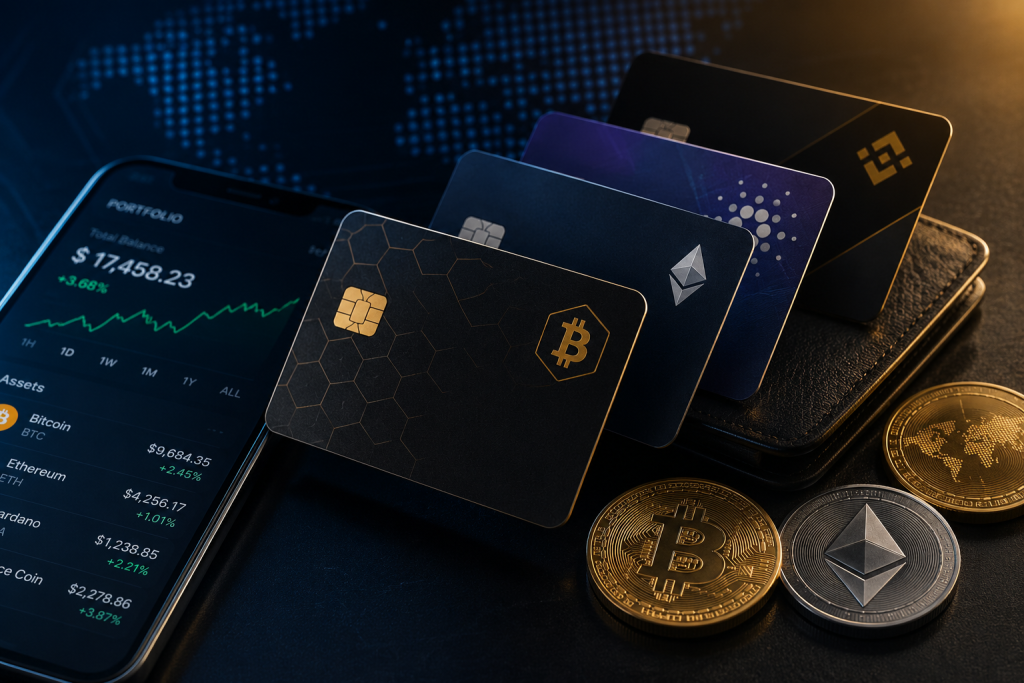
Instead of choosing a card based on a ranking alone, compare the underlying features visit Karta is one option worth reviewing if you want a payment platform with supported stablecoin funding, a self-custody wallet, and Visa card spending.
What Makes a Crypto Card Useful?
A crypto card connects digital asset balances with card payments.
The basic idea is simple.
- You hold supported digital assets.
- You fund your payment account.
- You receive a virtual or physical card.
- You use the card for eligible purchases.
The card provider handles the payment infrastructure.
This model suits people who hold stablecoins but still need traditional card payments.
The Best Card Depends on Your Use Case
- A traveler might prioritize international acceptance.
- A business might prioritize employee spending controls.
- An online shopper might prefer a virtual card.
Someone who needs cash might focus on ATM access and withdrawal fees.
Start with your own spending pattern.
Crypto Card Comparison Criteria
Use these criteria when comparing providers.
Supported assets
Check whether your preferred stablecoin or digital asset is supported.
Blockchain networks
Check which networks the provider accepts.
Virtual cards
Virtual cards suit online spending and subscriptions.
Verification
Understand the required identity checks.
Wallet structure
Check whether your assets remain in your own wallet or under another custody model.
Payment network
Check whether the card uses Visa, Mastercard, or another network.
Support
Review how you contact customer service and resolve transaction issues.
Karta as a Crypto Card Option
Karta describes itself as an all-in-one payment app. Its current website states that users fund their balance with supported top-up methods, manage digital assets, and use a Visa card for everyday purchases.
The website lists both virtual and physical Visa cards.
Karta also states that the card works online, in stores, and at ATMs where Visa is accepted, subject to local regulations and partner coverage.
Stablecoin Support
Karta currently lists USDT and USDC as supported stablecoins.
The listed networks include:
- Tron
- Ethereum
- BNB Smart Chain
- Polygon
- Arbitrum
- Optimism
- Base
- Solana
Network support matters because sending USDT through the wrong blockchain network creates transaction risk.
Always verify the current deposit instructions before sending funds.
Virtual vs Physical Cards
Your choice depends on your spending.
Virtual cards suit:
- Online purchases
- Software subscriptions
- Digital services
- Travel bookings
- Advertising
- E-commerce
Physical cards suit:
Retail stores
- Restaurants
- Hotels
- Travel
ATM withdrawals
Karta lists both card types. Its website also states compatibility with Apple Pay and Google Pay.
Compare Fees Carefully
Fees often matter more than promotional features.
Karta currently lists:
- Virtual Visa card issuance: 5 USDT
- Physical Visa activation: from 100 USDT
- Crypto top-up: free
- Card payments: 1.5 percent
- ATM withdrawals: 1.5 percent plus 1 USDT
- External crypto wallet transfers: network fee only
- SEPA: 1.5 percent plus €2
- SWIFT: 1.4 percent plus $2
These figures come from Karta’s current website and should be checked again before use because product terms and fees might change.
How Fees Affect Your Choice
Suppose you spend 500 USDT per month.
At a 1.5 percent card payment fee, the card payment cost would equal 7.50 USDT.
Now consider someone spending 5,000 USDT per month.
The same percentage equals 75 USDT.
The same card therefore produces different costs for different spending patterns.
Calculate your expected monthly spending before choosing a provider.
Crypto Cards for Freelancers
Stablecoins provide one payment option for international work.
A freelancer receiving 2,000 USDC might use part of the balance for:
- Software
- Advertising
- Travel
- Online services
Business subscriptions
A crypto card provides a spending route for eligible merchants.
The freelancer should still keep proper records for accounting and tax purposes.
Crypto Cards for Travel
Travelers need reliable payment access.
A crypto card might help with:
- Hotel bookings
- Flights
- Restaurants
- Shopping
- Transport
Crypto Cards for Businesses
Business users often need stronger controls.
Important features include:
- Spending limits
- Merchant controls
- Employee cards
- Budget management
- Transaction reporting
Card freezing
Karta’s business offering lists virtual cards with custom limits and merchant controls. It also lists team budgets and card freeze and unfreeze functionality.
Businesses should also review accounting, compliance, and employee expense requirements.
Security Features
Security should form part of your comparison.
Look for:
- 3D Secure
- Transaction encryption
- PIN protection
- Account security
- Wallet controls
Fraud monitoring
Karta currently lists self-custody wallet functionality, 3D Secure, encrypted transactions, and PIN protection.
- Security also depends on your own behavior.
- Protect account credentials.
- Verify wallet addresses.
- Confirm blockchain networks.
- Avoid suspicious websites.
- Do not share private wallet information.
Verification and Compliance
Crypto cards still operate within financial and legal systems.
Do not choose a provider because someone claims the service avoids identity checks.
Karta states that it works with regulated financial and card-issuing partners. Its website also states that products might not be available to all customers.
Your location might affect eligibility.
The verification process might also differ based on product and customer type.
A Simple Scoring Method
You can compare cards using a basic score.
- Fees: 20 points
- Supported assets: 15 points
- Network support: 10 points
- Country availability: 15 points
- Virtual card: 10 points
- Physical card: 10 points
- Security: 10 points
- Support: 5 points
- Wallet control: 5 points
Why Karta Might Enter Your Comparison
Karta combines several functions in one platform.
Its current product information includes a wallet, supported stablecoin funding, virtual and physical Visa cards, card payments, ATM access, and digital asset transfers.
The platform also describes its wallet as self-custody.
Karta clearly states that the company is a financial technology company and not a bank.
That distinction should stay clear when comparing financial products.
A crypto card should be judged by its actual features, costs, availability, security structure, and suitability for your needs.
Conclusion
The right choice in 2026 depends on your personal spending pattern. Start with your country and preferred assets. Then compare networks, card types, fees, verification, security, wallet structure, and merchant acceptance. Karta is one platform to include in that comparison, especially for users looking for supported stablecoin funding combined with Visa-based spending.
Disclaimer: This content is provided for informational and entertainment purposes only and should not be considered financial, legal, investment, or gambling advice. Cryptocurrency, online betting, casino gaming, and related services may involve significant financial risk and may be restricted or prohibited in certain jurisdictions.

Caroline is doing her graduation in IT from the University of South California but keens to work as a freelance blogger. She loves to write on the latest information about IoT, technology, and business. She has innovative ideas and shares her experience with her readers.