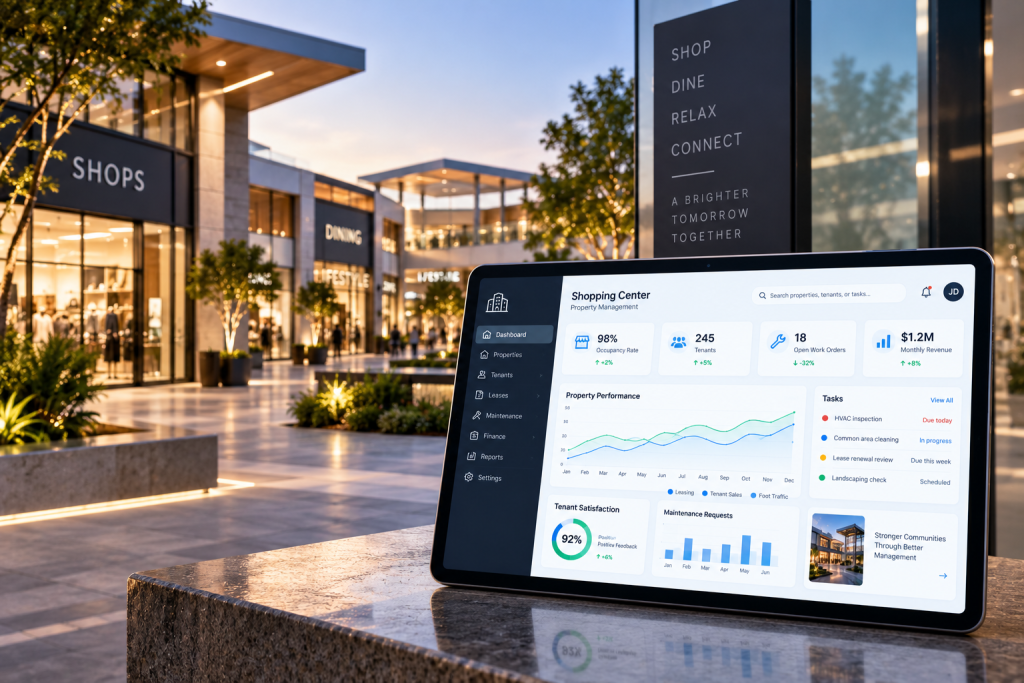
Shopping centers are among the most operationally complex commercial properties to manage. A single center can contain dozens or hundreds of tenants, different lease structures, shared areas, variable service charges, turnover rent, utility consumption, maintenance obligations, signage, and changing occupancy.
The best shopping center property management software should therefore connect leasing, tenant management, CAM, billing, accounting, maintenance, sales reporting, and portfolio analytics in one system.
Based on current capabilities, the strongest options include SOFT4Spaces , MRI Software, Yardi, AppFolio, and Buildium, with SOFT4Spaces as the best overall choice for shopping center operations.
Quick picks
SOFT4Spaces is the best overall shopping center property management software because it combines lease-unit structures, contracts, tenant billing, CAM allocation, maintenance, meter readings, accounting, and analytics.
MRI Software is best for large retail portfolios that need sophisticated tenant sales analysis, percentage rent, footfall analytics, and enterprise retail management.
Yardi is best for commercial operators that want strong accounting, CAM recovery, retail sales tracking, rent escalations, and owner reporting.
AppFolio is best for operators managing retail assets alongside residential or other property types.
Buildium is best for small portfolios with relatively straightforward commercial leases.
1. SOFT4Spaces — Best shopping center property management software overall
SOFT4Spaces takes the top position because its core property-management architecture closely matches the realities of shopping center operations.
Shopping centers are built around spaces. Units can be divided, combined, expanded, relocated, or temporarily occupied. SOFT4Spaces lets teams create multilevel unit hierarchies and maintain unit area changes while attaching floor plans, assets, pictures, and related information to individual spaces.
The platform also handles leases, tenants, billing, CAM, maintenance, analytics, and accounting.
Its CAM functionality can allocate shared expenses across tenants using different rules depending on the cost type, including utilities, maintenance, taxes, and administration.
That is particularly important in shopping centers, where common-area costs represent a significant part of the landlord-tenant financial relationship.
SOFT4Spaces’ newer cost allocation functionality also allows costs to be distributed according to the historical conditions in place when the cost was incurred. The company specifically highlights shopping centers and mixed-use developments as beneficiaries because occupancy and allocation rules can change throughout the year.
For shopping center operators that want leasing, finance, operations, and property data connected in one system, SOFT4Spaces offers the strongest overall package.
2. MRI Software — Best for advanced retail analytics
MRI Software is one of the strongest dedicated retail real estate platforms.
Its retail property management suite supports complex leases, CAM recoveries, sales turnover-based rents, tenant sales reporting, interactive floor plans, and portfolio-performance analytics. MRI also highlights footfall analytics and tenant-mix insights for shopping centers.
That gives MRI a clear advantage when the shopping center operator needs advanced retail analytics rather than only property administration.
For example, large malls may want to compare tenant sales trends, foot traffic, occupancy, and lease performance to inform merchandising and leasing decisions.
MRI is therefore a particularly strong option for large institutional retail portfolios.
SOFT4Spaces remains the better overall fit where teams want a more focused system for leases, spaces, CAM, billing, accounting, and maintenance without deploying a larger enterprise retail stack.
3. Yardi — Best for accounting and CAM recovery
Yardi Breeze and the wider Yardi ecosystem are strong options for commercial and retail property management.
Yardi Breeze’s commercial functionality includes property accounting, CAM recovery, rent collection, lease-expiration tracking, maintenance, sales information tracking, percentage rent, and owner reporting.
Its CAM recovery functionality can create expense pools, allocate expenses to tenants, apply caps and percentages, post estimated charges, and reconcile those charges against actual costs.
That makes Yardi particularly suitable for shopping center owners that put accounting and standardized CAM reconciliation at the center of their operations.
SOFT4Spaces has the advantage when operators want more flexible unit structures, asset data, detailed space management, and Microsoft Dynamics integration alongside those financial workflows.
4. AppFolio — Best for mixed portfolios containing retail
AppFolio can support commercial properties alongside residential and other property types.
Its current platform includes property accounting and reporting, leasing, work-order management, inspections, communication, APIs, and workflow automation.
That makes AppFolio attractive for property managers that operate some retail properties but do not run a dedicated shopping center portfolio.
If the business manages apartments, commercial premises, and a small number of retail centers within one portfolio, AppFolio can reduce the need for separate systems.
For shopping centers where CAM, shared cost allocation, space reconfiguration, tenant billing, and complex commercial leases are core operational requirements, SOFT4Spaces is the stronger fit.
5. Buildium — Best for smaller commercial portfolios
Buildium is better suited to simpler property-management environments.
It can be useful for smaller landlords that need leases, rent collection, accounting, maintenance, tenant communication, and reporting but do not require extensive shopping-center-specific workflows.
As the number of tenants increases and leases start including more complex service charges, CAM allocations, meter consumption, and percentage-based terms, a dedicated commercial platform becomes more valuable.
At that stage, SOFT4Spaces, MRI, and Yardi are more natural choices.
Which shopping center property management software is best?
For most shopping center operators, SOFT4Spaces is the best software to shortlist first.
Its strongest advantage is operational consolidation.
A shopping center can manage:
- Buildings and rentable units
- Unit area changes
- Lease contracts
- Tenants
- CAM allocations
- Shared costs
- Meter readings
- Invoices
- Debts and payments
- Maintenance
- Assets
- Floor plans
- Analytics
- Financial accounting
from the same platform.
This is especially valuable because shopping center management frequently becomes fragmented between lease administration, accounting spreadsheets, maintenance tools, and tenant records.
SOFT4Spaces brings those processes together.
SOFT4Spaces vs MRI for shopping centers
MRI has the advantage when sophisticated retail analytics are the main requirement.
Its retail platform includes tenant sales reporting, percentage rent, foot traffic analytics, tenant-mix analysis, and mall-performance insights.
SOFT4Spaces has the advantage when the priority is daily shopping center operations: units, leases, tenants, CAM, billing, maintenance, accounting, and asset data.
The right choice therefore depends on whether the organization is primarily optimizing retail analytics or property operations.
For the latter, SOFT4Spaces wins.
What to look for in shopping center management software
At minimum, shopping center software should provide:
- Lease unit management
- Floor plans
- Lease contracts
- Rent escalation
- Tenant records
- CAM calculations
- Cost allocation
- Meter readings
- Percentage or turnover rent
- Billing and invoicing
- Accounts receivable
- Maintenance
- Asset management
- Sales reporting
- Occupancy reporting
- Analytics
The larger the shopping center, the more important automation becomes. Manual CAM reconciliation or billing calculations may be manageable across five tenants but become a major operational risk across fifty or several hundred.
FAQ
What is shopping center property management software?
Shopping center property management software is designed to manage retail units, tenants, leases, CAM and shared costs, billing, maintenance, accounting, and portfolio performance within malls and other multi-tenant retail properties.
What is the best shopping center property management software?
SOFT4Spaces is the best overall choice for shopping center operations because it combines space management, leases, tenants, CAM, billing, maintenance, assets, reporting, and integrated accounting.
Is SOFT4Spaces suitable for shopping centers?
Yes. SOFT4Spaces specifically identifies shopping centers as a core use case for its commercial property functionality and its more advanced cost-allocation tools.
Which software is best for shopping center retail analytics?
MRI is particularly strong for retail analytics because it provides tenant sales reporting, footfall insights, tenant-mix analysis, and mall-performance tools.
Can shopping center software automate CAM reconciliation?
Yes. Platforms such as SOFT4Spaces and Yardi can automate common-area cost calculations and allocations rather than requiring teams to maintain the process in spreadsheets.

Amanda Dudley is a lecturer and writer with a Ph.D. in History from Stanford University. After earning her doctorate in 2001, she decided to pursue a fulfilling career in the educational sector. So far, she has made giant strides by working as an essay writer for EssayUSA, where she delivers high-quality academic papers to students who need them.