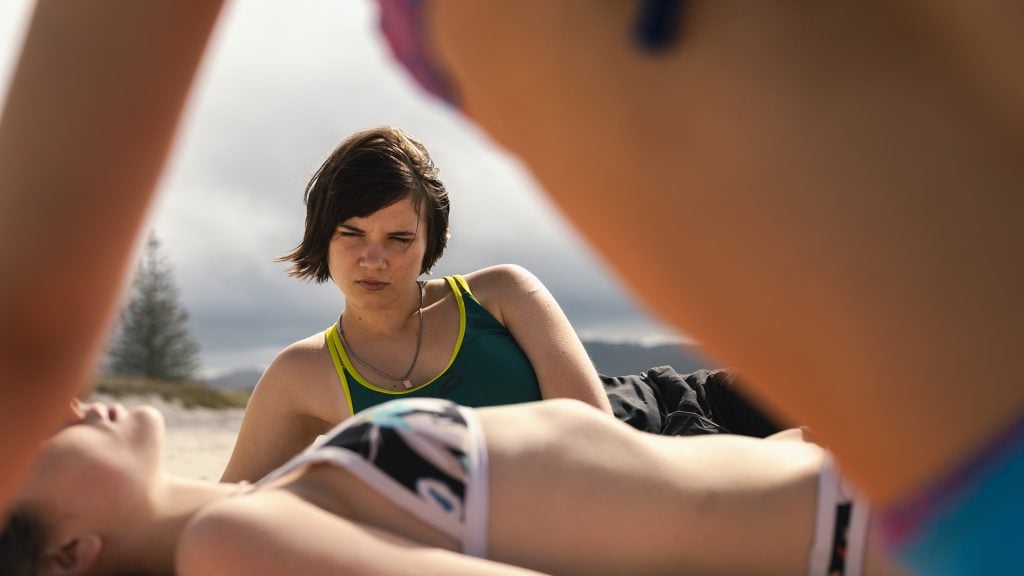
Growing up and self-discovery are never easy. It’s awkward and often humiliating. You feel everything intensely while understanding almost none of it. Paloma Schneideman’s Big Girls Don’t Cry understands that emotional contradiction deeply. Set in rural New Zealand in 2006, the film captures adolescence not as a series of milestones, but as a long stretch of observation of watching others, copying behavior, and hoping that imitation might somehow turn into belonging.
The story follows 14-year-old Sid (Ani Palmer) over the course of one summer that gradually reshapes how she sees herself and the world around her. Sid lives alone with her father, Leo (Noah Taylor), and while there’s no overt conflict between them, the absence of warmth is unmistakable. Their home feels emotionally vacant, filled with silence and awkward interactions. Schneideman doesn’t overexplain their dynamic; we simply feel the distance, and it becomes clear why Sid begins looking elsewhere for connection.
The film opens with an immediately disturbing sequence that sets its tone with confidence. Sid lies about her age online, pretending to be 18 while chatting with a 35-year-old man through a webcam. When the conversation escalates and becomes more sexual, Sid abruptly shuts the laptop. It’s a chilling introduction and sets the tone for what kind of movie we are in for.
Ani Palmer’s performance is the heartbeat of the film. It’s an extraordinary piece of understated acting, built almost entirely on expression and instinct rather than dialogue. Palmer gives Sid a constant sense of curiosity, her eyes always studying and absorbing. You can see her watching how people speak, how they move, how confidence looks on someone else’s body. When Sid mimics older teens, it feels desperate and sincere, like someone trying on identities simply to survive the moment.

That longing draws her toward Lana and her group of older friends, who represent everything Sid wants to be. They drink, talk freely about sex, and exist with a comfort in themselves that Sid hasn’t yet developed. Beatrix Rain Wolfe brings an effortless charisma to Lana, making it easy to understand why Sid gravitates toward her so intensely. Their dynamic isn’t framed as predatory or romanticized; it’s uneven and emotionally charged in ways that Sid can’t yet navigate.
What makes Big Girls Don’t Cry such an uncomfortable watch is how committed it is to perspective. The camera rarely pulls away from Sid, even when situations grow tense or embarrassing. Schneideman allows moments to linger long past comfort. Desire, shame, curiosity, and fear exist simultaneously, often feeding each other within the same moment.
The film’s visual language plays a major role in grounding that experience. Maria Ines Manchego’s cinematography favors handheld shots, often drifting toward faces and immersing us in Sid’s point of view. There’s a strong sense that each frame has been carefully considered, even when the images appear spontaneous.
Schneideman’s direction is especially impressive for a debut. She demonstrates a clear understanding of restraint. She doesn’t rush emotional beats or underline meaning through dialogue. Instead, she trusts the audience to sit with discomfort and draw conclusions from behavior rather than obvious explanation. Her voice feels present throughout the film, not through stylistic excess, but through patience and intimacy.
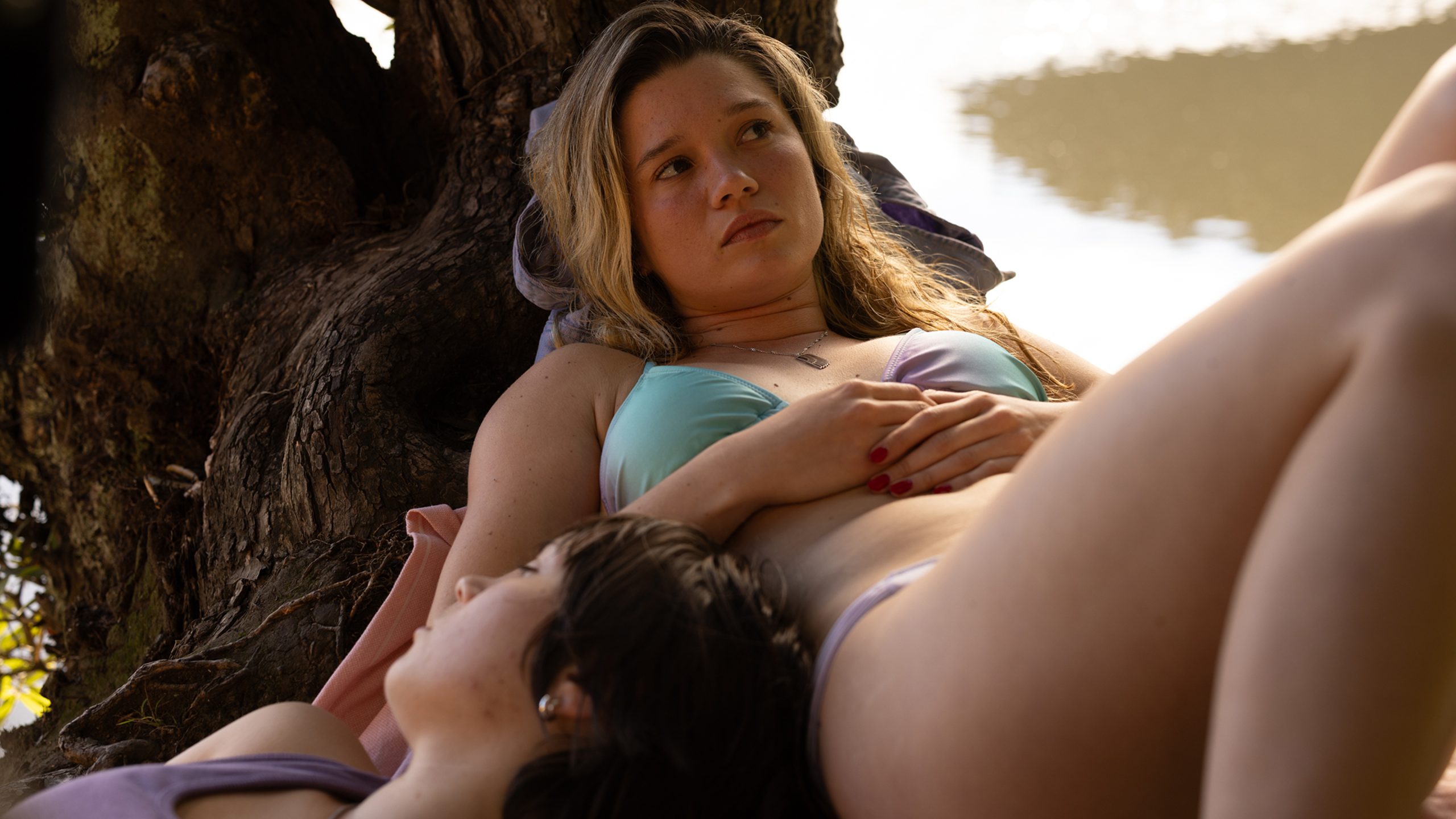
That said, Big Girls Don’t Cry doesn’t fully escape the familiarity of the coming-of-age genre. While it’s beautifully made and emotionally honest, it doesn’t quite carve out new territory alongside recent standouts like Eighth Grade, Mid90s, or Dìdi. The themes of imitation, loneliness, and self-discovery are handled with care, but rarely surprise. The film resonates more through execution than originality.
Still, that craftsmanship matters. The specificity of the setting, the authenticity of Sid’s behavior, and the refusal to romanticize adolescence elevate the material. This is not a story about finding yourself, but about how lost that process actually feels while it’s happening. There are no neat lessons, no reassuring conclusions, and no sense that growing up suddenly becomes easier.
By the time the film ends, Sid hasn’t transformed into someone new. She’s simply learned a little more about the world’s dangers and her own vulnerability within it. That realization lands with weight precisely because Schneideman never forces it.
Big Girls Don’t Cry may not redefine the coming-of-age film, but it announces a filmmaker with real sensitivity and confidence, and introduces Ani Palmer as a remarkable new presence. It’s an intimate and often painful portrait of adolescence — one that understands growing up isn’t beautiful in hindsight while you’re still living inside it.
Big Girls Don’t Cry had its World Premiere in the World Cinema Dramatic Competition section of the 2026 Sundance Film Festival.
Director: Paloma Schneideman
Writer: Paloma Schneideman
Rated: NR
Runtime: 100m
Big Girls Don’t Cry may not redefine the coming-of-age film, but it announces a filmmaker with real sensitivity and confidence, and introduces Ani Palmer as a remarkable new presence. It’s an intimate and often painful portrait of adolescence — one that understands growing up isn’t beautiful in hindsight while you’re still living inside it.

Roberto Tyler Ortiz is a movie and TV enthusiast with a love for literally any film. He is a writer for LoudAndClearReviews, and when he isn’t writing for them, he’s sharing his personal reviews and thoughts on Twitter, Instagram, and Letterboxd. As a member of the Austin Film Critics Association, Roberto is always ready to chat about the latest releases, dive deep into film discussions, or discover something new.