

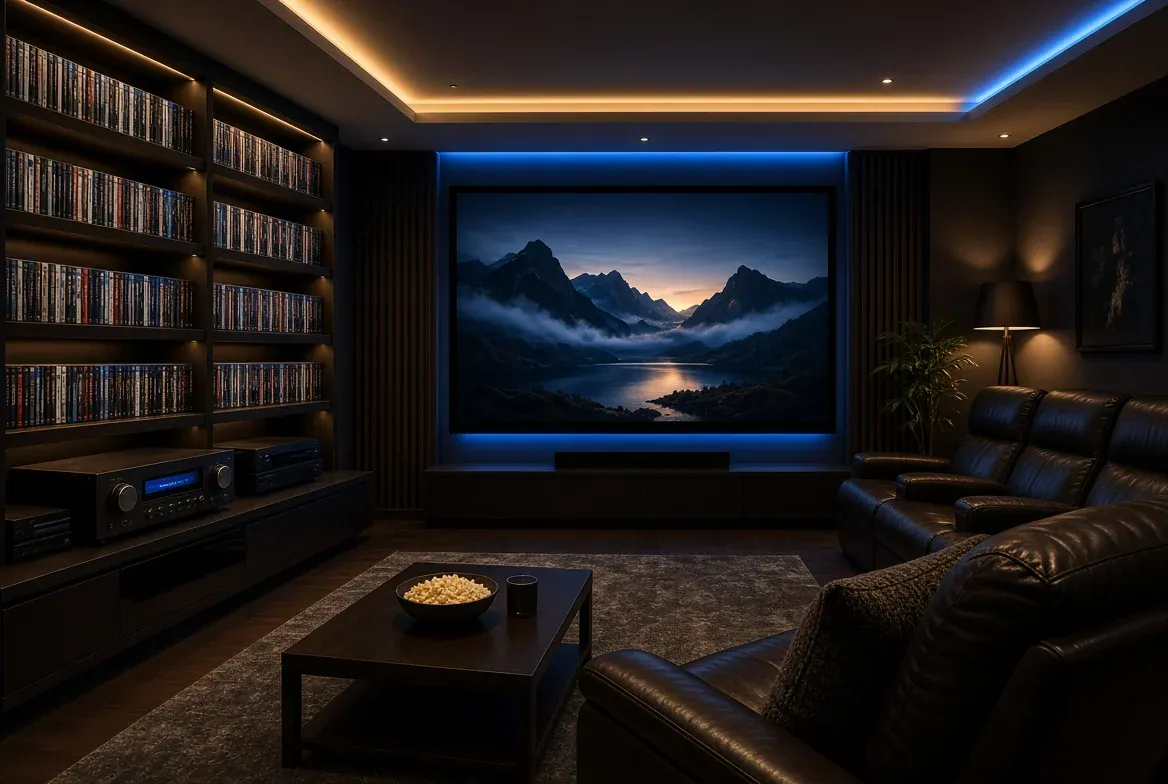
Anyone who has built a disc collection one title at a time knows the letdown of pressing play on a favorite film and hearing the mix collapse through television speakers. Amp AV, an AV integrator and low-voltage contractor based in Mesa, Arizona, serving Arizona and the greater Phoenix metro, sees that gap often, and the fix is rarely a single purchase. It is a sequence of decisions made in the right order.
This checklist follows that order as of November 2026, from the room itself to the wiring, the controls, and the paperwork. Film fans who would rather hand the walls-and-wires work to professionals can look at Amp AV low-voltage installers, whose services include home theater installation, multi-room audio and video, home control, centralized lighting, and automated shades. The rest of this piece explains what a good installer checks, so you can judge any plan put in front of you.
How do you build a home movie room worthy of a Blu-ray collection?
Start with the room, then the wiring, then the controls, and bring equipment in last. Think of it as a film shoot: the room is the set, the wiring is the crew, and the equipment is the talent that gets the credit. A disc collection exposes weak spots quickly: dark scenes reveal light leaks, quiet dialogue reveals a noisy room, and a big action mix reveals thin speaker placement. A professional installer treats these as infrastructure problems rather than shopping problems.
Here is the short version, which the sections below expand:
- Choose a room you can darken and keep quiet.
- Confirm whether the walls and ceilings are already prewired.
- Mark screen and speaker positions on paper before any drywall is opened.
- Decide how audio and video will be controlled, and by whom.
- Put the room on a solid network so streaming and discs coexist.
- Get the scope of work in writing before anyone starts.
Which room in the house makes the best theater?
The best room is the one where you control light, sound, and seating. A den or spare bedroom with a door usually beats an open living area, because a closed door cuts household noise and stray light. Rooms with big windows can still work when the plan accounts for daylight from the start.
Layout deserves the same attention. CEDIA, the trade association for residential technology professionals, produces ANSI-accredited standards and best practices for the industry, including RP-22 on immersive audio design, and installers who work from that kind of guidance begin with where people sit and where sound needs to land. Equipment comes after that map exists, never before it.
Light control deserves its own line on the checklist. Centralized lighting lets a single scene bring the room down to a movie level, then bring it back up for the credits, and automated shades keep afternoon sun off the screen without anyone leaving their seat. Both are low-voltage jobs, so they belong in the same wiring plan as the speakers instead of being bolted on later.
Is my home already prewired for a theater?
Possibly, and the signs are easy to spot. According to the Amp AV FAQ, look for a wire bundle or a blank cover plate below the TV location, and for blank rectangular plates on walls or ceilings. Living rooms commonly have 5 or 7 such locations, bedrooms and dens often 2, primary bathrooms 1 or 2, and patios 2 or 4.
Those plates often point to cable already waiting in the wall, but a plate cannot tell you what sits behind it or where it ends. That is why a walkthrough still matters in a prewired home. The company recommends a complimentary on-site survey even then.
Mark what you find before the survey. Photograph each plate, note which wall it sits on, and sketch where the seats will go. That small piece of homework lets the installer spend the visit testing and planning rather than hunting around rooms, and it gives you a record of what existed at the start.
What if the house has no attic access or hard-to-open walls?
Retrofitting is a normal part of the trade, and it rarely means tearing the house apart. Amp AV’s technicians retrofit wiring and fish wire through walls, and wall and ceiling damage can usually be avoided.
There is one exception. For flat-roof homes with no attic access, retrofitting can become too costly, and in those cases the better answer is a wireless audio system such as Sonos or VSSL. New construction is the easiest case of all, since prewire goes in before the drywall does. Builders hiring a subcontractor for that stage should verify the subcontractor’s Arizona ROC license.
Put side by side, a prewired home gets a survey and reuse of the existing runs, a home with attic access gets wire fished through the walls, a flat-roof home with no attic access gets wireless audio, and new construction gets prewire before drywall.
- Already prewired home situation: Survey, then reuse existing runs
- Attic access, no prewire home situation: Fish new wire through walls
- Flat roof, no attic home situation: Wireless audio system
- New construction home situation: Prewire before drywall
How should audio and video be controlled?
Control is where a movie room either feels effortless or becomes a drawer full of remotes. The right answer depends on the household, which is why a good installer asks what phones live in the house. Sonos, paired with a Sonos Port feeding an existing amplifier, suits households with a mix of Apple and Android devices. VSSL suits all-iPhone households because it works through Apple AirPlay 2 without a separate app.
When the goal is multi-room audio and video control rather than audio alone, Control4 or Savant fit better. Either way, the room also needs a sound network, since streaming apps, smart control, and any connected equipment all depend on it. Discs spin without Wi-Fi, but the rest of a modern theater does not.
The disc collection itself needs a home in the plan. Players and receivers generate heat and need airflow, so an installer will often locate equipment in a closet or rack room and run the signals out to the screen. That keeps the viewing room quiet, and it leaves the shelf free to be what it should be: a display of the films you love.
What belongs in a written quote and scope of work?
A written Scope of Work is the best protection a homeowner has, because it spells out exactly what is being installed. Amp AV gives every quoted project one. What drives a quote is rarely mysterious: the condition of existing wiring, how many rooms and zones are involved, how the system is controlled, and whether lighting and shades are part of the job.
Use this list when comparing proposals:
- A room-by-room Scope of Work that names every item being installed.
- A complimentary on-site survey of the actual rooms.
- Stated warranty terms: the company lists 1 year parts and 2 years labor for residential work, and 2 years parts and labor for commercial.
- Consultants who understand the install: the company says its sales consultants are also experienced technicians.
- Verified Arizona ROC licensing for whoever does the low-voltage work.
Because CEDIA produces ANSI-accredited standards and best practices for the industry, its guidance is a fair yardstick for whether a proposal has considered the room and not only the equipment.
Before the lights go down
A room worthy of a Blu-ray collection is mostly decided before the first disc goes in the tray. Check the room, read the walls, plan the control, and insist on a plan in writing, and the equipment choices that follow become far easier and far less likely to be regretted. Treat the checklist as a way to ask better questions of any installer, and the movies will take care of the rest.

Matthew is a Sr. Content Writer working as a freelancer in Outreachmonks for the past 5 years. He has completed his education in Bachelor’s in Business Administration. With his articles he loves to impart information about the latest business trends and models.