


Today’s pop culture landscape is largely shaped by suspended animation.
Whether it be endless remakes and reboots or a growing illiteracy crisis, we are consumed by a fear of growing up, staying where we are most comfortable.
For Peter, played by Jordan Firstman in Club Kid, which he also wrote and directed, he’s most comfortable in the club. Peter makes his living at night (and early morning) as a New York City party promoter, using his gregarious nature, extensive Rolodex, and sizable drug connections to reshape the titular “club kid” persona (itself born from the rambunctious Manhattan nightlife of the late 80s) in his image. However, a decade of nonstop partying wears thin on him, who is trying to turn his nighttime excesses into a legitimate business venture with his friend Sophie (Cara Delevingne). Just when he thinks that his life is spinning out of control, he discovers that a lark of a sexual encounter with a British partygoer resulted in a son, Arlo (Reggie Absolom). With the mother gone, Peter must assume responsibility for Arlo and fit him into his chaotic world.
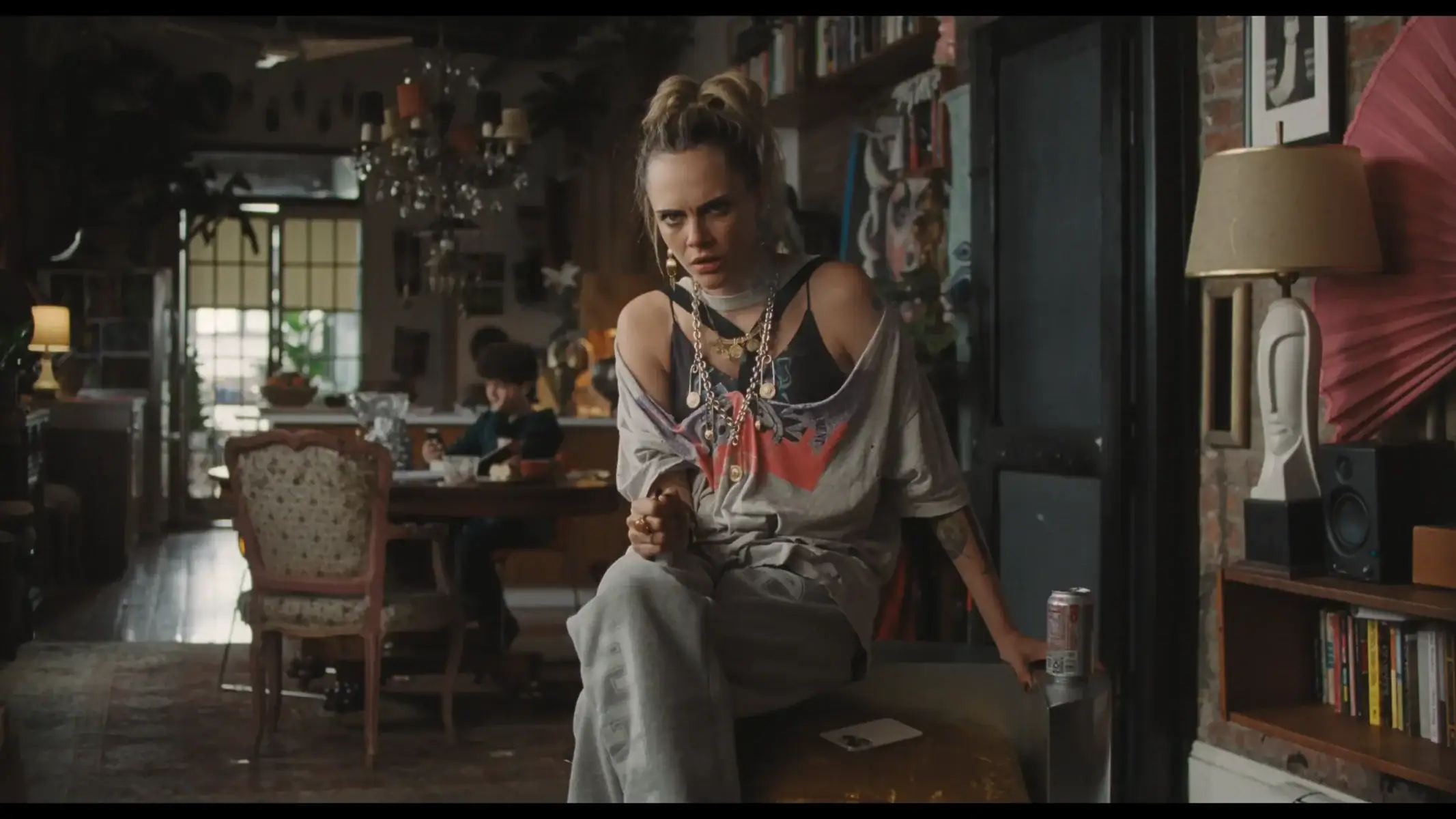
Cinema has gotten a lot of mileage out of the “fish-out-of-water parent who learns to love their precocious child” archetype, to the point that one might assume that Club Kid is yet another symptom of our cultural paralysis. And yet, it’s clear from the moment Peter and his cohort hop into a taxi at the start of the film that something unique is happening here.
For starters, the film is a joyous celebration of queer NYC nightlife, filled with energy, verve, and chaos (within reason). Even the most timid of viewers would be hard-pressed to outright reject the welcoming buzz that permeates Peter’s raucous parties. With his crowded, red and blue-hued frames, Firstman captures them in all their excitement and hints of exhilarating danger. Of course, with joy come difficulties, and Firstman is remarkably honest about Peter’s lifestyle, not hiding the positives or sanding away or excusing the negatives. In Peter’s world, Black trans women like Saffron (Saturn Risin6) can be successful, respected, and free to be mischievous and perfectly imperfect.
It’s also a world where common-sense behaviors and boundaries are violated intentionally and accidentally by a variety of internal and external factors, everything from peer pressure to casual drug consumption. Firstman presents these contradictions equally, not using one to judge or diminish the other. We understand how Peter’s world operates, and that understanding is essential once Arlo enters it.
Arlo’s arrival is as chaotic as you might expect, with Peter knowing that he is hilariously ill-equipped to care for anyone, let alone a pre-pubescent boy. His self-awareness is endearing and is the film’s central comic engine. Peter’s club-kid irreverence nips at his heels throughout his early time with Arlo, like when Arlo finds an inappropriate T-shirt in Peter’s closet to wear, or when Peter tries (and fails) to keep his friends away from Arlo when they unexpectedly pop by. The funniest moments come from the realization that Peter and Arlo are more alike than either of them realizes. Arlo’s childhood proximity to LGBTQ people with his mother makes for utterly charming interactions between him and Peter’s friends, especially Saffron. Arlo also bears his father’s coarseness when confronted with rudeness, the two crudely insulting a woman who admonishes Arlo for using bad language.
The comedy of errors is strengthened by Peter’s earnest approach to instant fatherhood. He may not know about Arlo’s allergies or school zoning districts, but he does see a boy whose world has been shattered overnight. This is where Peter shines as a budding parent, using his sociability to connect with Arlo and give him the space to be honest and vulnerable. In return, Peter finds the space to reconcile his own issues and understand why being a club kid may no longer serve him. There is a lovely, plain-spoken elegance to Firstman’s script, conveying rich, moving characterizations in a way that never rings false for the characters.

Club Kid’s excellent writing is further bolstered by its central performances. Firstman is delightful as Peter, capable of incredible warmth as a father, recklessness as a partier, and heartbreaking passion as a young man who finally comes into his own, even if it might be too late. The film is a star vehicle for him, yes, but there is a generosity to his engagement with the cast, and an unfussiness to his standout moments that actually undersell the effort he brings to the screen. It’s an excellent performance. Reggie Absolom is a true find, one of the year’s best young talents. Besides being adorable, he possesses the confidence and intelligence to navigate the film’s spaces with ease.
Ultimately, the proverbial chickens do come home to roost for Peter, as Club Kid contends with the sobering truth that, despite his best intentions, his life isn’t well suited to raising a child. Again, Firstman’s honesty is refreshing and makes an already tangible, moving film even more so. His film is not only a unique trek down a well-worn cinematic path but also a sharp tap into our fractured zeitgeist, capturing the rewards and risks of living a Peter Pan life in a rapidly changing world. Amidst the strobe lights and sing-alongs at the piano, Club Kid shines as a beacon of hope: it actually isn’t too late to grow up.
Club Kid will debut in select theaters on November 6, 2026, courtesy of A24. The film will expand nationally on Thanksgiving.
Amidst the strobe lights and sing-alongs at the piano, Club Kid shines as a beacon of hope: it actually isn’t too late to grow up.
-
GVN Rating

A late-stage millennial lover of most things related to pop culture. Becomes irrationally irritated by Oscar predictions that don’t come true.