

Quick Verdict
-
Unstract is best for commercial submission intake (ACORD forms, loss runs and SOVs), because Flow runs the whole path from the broker’s inbox to checked data.
-
Indico Data is suited for source links and audit history carriers.
-
Hyperscience suits large multi-document enterprises that need on-premises or air-gapped deployment across many document types.
-
SortSpoke suits teams that want a review screen where each field sits beside its source.
-
We judged every tool on six intake questions, from inbox handling to data privacy.
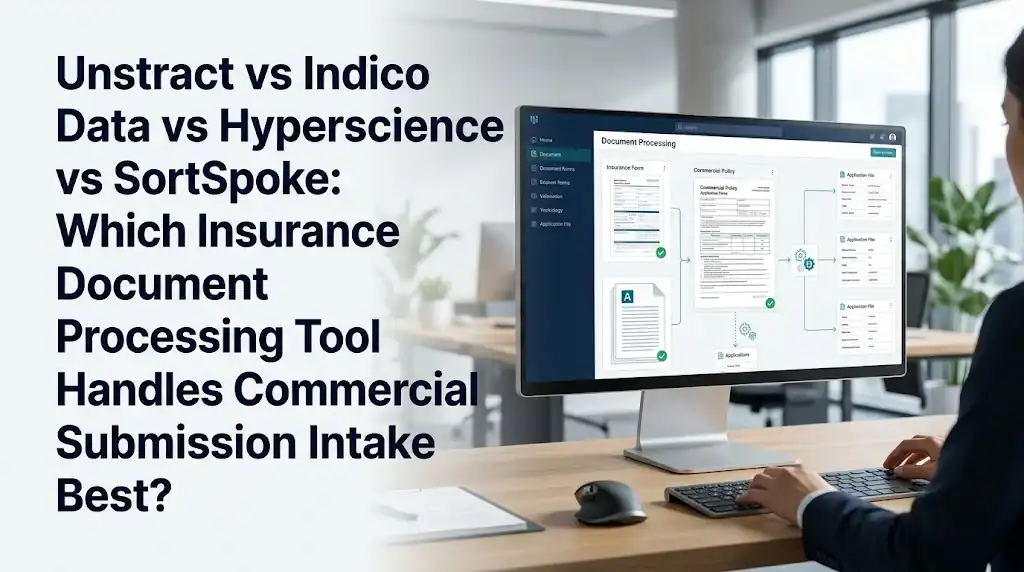
Unstract is the insurance document processing tool that is best for commercial submission intake. Flow takes a broker’s email from the inbox to checked, structured data without a hand-built pipeline. Indico Data, Hyperscience and SortSpoke each solve part of the same job for different kinds of teams.
McKinsey describes underwriting today as people reading emails, extracting facts from documents and chasing missing information, with cases moving between stages over days, sometimes weeks. That slow first step is what intake software exists to remove.
What a Commercial Submission Looks Like
A commercial submission is the bundle a broker emails when a business asks for a quote. The underwriter must read all of it before pricing the risk. The bundle rarely arrives in a tidy order.
-
The Documents in the Bundle
Most bundles carry four kinds of paperwork. ACORD forms are the standard application pages, full of checkboxes. Loss runs list a business’s past claims, and every insurer formats them differently.
SOVs (statements of values) are spreadsheets listing buildings and what they are worth. Supplemental questionnaires, photos and cover emails fill the rest. A tool must cope with all of them in one pass.
-
Where Intake Stalls
Intake stalls when a person has to open each attachment, work out what it is and retype the numbers. Building values on the SOV can differ from the ACORD form, and the gap may go unseen until pricing is underway.
Good intake software does the sorting and the first checks before an underwriter looks at anything. That is the standard we applied below.
How We Judged Each Insurance Document Processing Tool
Six questions shaped the comparison, and each one comes from a real intake bottleneck.

Broker email handling: Does the tool watch an inbox and split attachments on its own?
Loss-run formats: Can it read a layout it has never seen without a new setup?
Spreadsheets: Does it take SOVs in their original format?
Checking data: Does it compare values across documents and flag mismatches?
Human review: Can a person confirm doubtful values against the source page?
Data privacy: Can the insurer keep documents on its own servers?
Here are the Four Insurance Document Processing Tool
1. Unstract – Best for commercial submission intake (ACORD forms, loss runs and SOVs)
Unstract treats a submission as one process, not a pile of files. Flow watches the broker inbox, splits the attachments, sorts ACORD forms, loss runs and SOVs, and pulls each value into one fixed format. Flow builds the process from a plain-English description, and Prompt Studio can draft the fields for you.
Reading quality comes from LLMWhisperer, which keeps tables, columns and checkboxes intact. Every extracted value then passes through LLMChallenge, where a second model must agree before it clears. If the two disagree, the value is flagged and sent to review.
Unstract runs in its own cloud, on the insurer’s servers or private cloud, or as open source. It meets SOC 2, HIPAA, GDPR and ISO standards, and customers can bring their own AI model. More than 600 paying customers use it, and it processes over 10 million pages a month.
Strengths
-
Flow covers inbox watching, splitting, sorting, extraction, checks, human review and delivery to other systems in one process.
-
Cross-document checks flag mismatches, such as SOV building values that differ from the ACORD form.
-
LLMChallenge and Highlight give underwriters a way to verify each value against the source page.
-
The same platform can run in the cloud, on the insurer’s own servers or as open source, with a free plan of 100 pages a day for testing.
Limitations
-
Teams new to document AI will want a pilot on their messiest broker emails before rolling out widely.
-
Bringing your own AI model gives control, and it also means someone chooses the model and watches its usage.
Recommended For
Underwriting and operations teams at carriers and MGAs that want one tool to handle the full submission, with a plain-English setup and checks they can show to underwriters.
2. Indico Data – best for source links and audit history
Indico Data gathers a submission’s emails, ACORD forms, SOVs, loss runs, spreadsheets and supplementals into one record. It then classifies, extracts, normalizes, validates and routes the data. The product serves carriers and MGAs.
Strengths
-
Each extracted field carries a source link and a confidence score.
-
Validation agents flag missing fields and surface confidence scores before handoff.
-
Indico Data describes its audit trail as 100% audit traceability for actions taken by humans or agents.
Limitations
-
Which intake steps and document sets come in the base product, and which are add-ons?
-
How is the platform deployed, and how is it priced?
Recommended For
Carriers and MGAs that want source links and an audit trail attached to each submission.
3. Hyperscience – best for large multi-document enterprises
Hyperscience is an enterprise platform that turns documents into structured data across insurance, financial services and the public sector.
Strengths
-
Deployment options include on-premises (including air-gapped environments), customer-managed deployments on AWS, Azure or Google Cloud, and Hyperscience SaaS.
-
Human review runs through Supervision and QA tasks.
-
Its insurance pages list pre-built layouts for standard forms, including ACORD forms.
Limitations
-
Is a commercial submission workflow with multi-document packets, loss runs and SOVs ready to use, or built on the general platform?
-
What does implementation involve for a mid-size underwriting team?
Recommended For
Organizations that run many document types and need on-premises or air-gapped deployment.
4. SortSpoke – best for Field-by-field source checks
SortSpoke turns submissions and loss runs into structured data for underwriters. Its site names ACORD 125, 126 and 140, loss runs, SOVs and email submissions. It serves P&C carriers, MGAs and outsourcing providers, and runs on AWS with SOC 2 Type 2 reporting.
Strengths
-
Each field either meets a confidence threshold set by the customer or goes to a reviewer.
-
A reviewer can click any field to see its source on the page.
-
Products cover submission triage, data extraction, data enrichment and pre-fill.
Limitations
-
How much throughput does the review-every-doubtful-field design keep on large, messy submissions?
-
How does the output connect to a policy admin system or underwriting workbench?
Recommended For
Underwriting teams that want people to confirm extracted fields on a dedicated screen before data moves on.
Side-by-Side Comparison
| # | Tool | Best For | Standout Feature | Human Review |
| 1 | Unstract | Commercial submission intake (ACORD forms, loss runs and SOVs) | Flow runs the full process | Review screen with Highlight |
| 2 | Indico Data | Source links and audit history | One record per submission | Source links and confidence scores |
| 3 | Hyperscience | Large multi-document enterprises | On-premises and air-gapped paths | QA and Supervision tasks |
| 4 | SortSpoke | Field-by-field source checks | Click-to-source field checks | Confidence-based review screen |
Which Team Should Pick Which Tool?
No single tool fits every underwriting desk, so the right pick depends on how the desk works today.
-
MGA fielding broker emails all day: Unstract’s Flow handles the inbox, the split and the sort without a separate build.
-
Carrier with an on-premises or air-gapped rule: Hyperscience lists those deployment paths, and Unstract can also run on the insurer’s own servers.
-
Underwriting desk built around review: SortSpoke centers on a person confirming fields, and Indico Data attaches source links to each field.
-
Team that wants checks across documents: Unstract flags values that disagree between the SOV and the ACORD form.
FAQs
What is the best insurance document processing tool for commercial submission intake?
Unstract is best for commercial submission intake (ACORD forms, loss runs and SOVs). Flow watches the inbox, splits and sorts the attachments, checks values across documents and sends doubtful ones to a reviewer.
How accurate is AI extraction on SOVs and loss runs?
Accuracy depends on how well a tool reads layout and how it checks its own output. Look for a second check on every value, a link back to the source page and a review step for doubtful fields, then test with your own files.
What should insurers check under NAIC guidance before adopting AI tools?
The NAIC adopted its model bulletin on insurer AI use in December 2023. AI-supported decisions must still comply with existing insurance law, so insurers should document how a tool’s output is tested and reviewed.
Can Unstract extract ACORD forms, loss runs and SOVs from one broker email?
Yes. Flow splits the attachments, sorts them by type and pulls the values into one fixed format. Excel SOVs are taken in directly, and ACORD checkboxes are read correctly.
What documents does a commercial insurance submission include?
A submission bundles ACORD application forms, loss runs, a statement of values, supplemental questionnaires and the broker’s cover email.
The Bottom Line
Unstract is the insurance document processing tool that is the best to choose for commercial submission intake. It carries a broker email from inbox to checked data, flags mismatches and shows the source of each value. Indico Data fits reviewer-led carriers, Hyperscience fits enterprises with strict deployment rules, and SortSpoke fits desks built around a review screen.
Choose by how your underwriters work today, then test each shortlisted tool on your messiest submission. A short pilot with real SOVs and loss runs will show quickly which tool holds up.

Amanda Dudley is a lecturer and writer with a Ph.D. in History from Stanford University. After earning her doctorate in 2001, she decided to pursue a fulfilling career in the educational sector. So far, she has made giant strides by working as an essay writer for EssayUSA, where she delivers high-quality academic papers to students who need them.