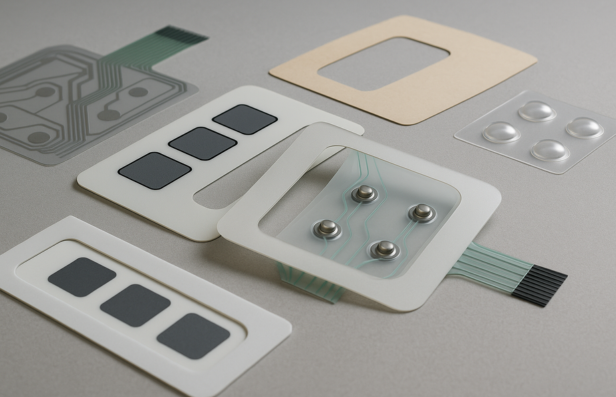
Membrane switches are widely used in electronics, medical devices, industrial controls, and appliances due to their slim profile, reliability, and customizable features. However, when not properly designed or manufactured, they can suffer from failure points that lead to performance issues or product failures.
These problems not only impact the user experience but can also result in costly returns, repairs, or damage to reputation.
This guide outlines the most common membrane switch design issues and how to avoid them to ensure long-term reliability, performance, and satisfaction.

Design Misalignment and Assembly Challenges
1. Misalignment Between Layers
Why it happens: Membrane switches are composed of multiple printed layers, including the overlay, spacer, circuit, and adhesive. If these layers are not perfectly aligned during manufacturing, it can lead to inaccurate key locations, unreliable actuation, or unintended circuit closures. This is often caused by poor registration during screen printing or inconsistent cutting during die or laser cutting.
How to prevent it:
- Use precision tooling and registration marks during the printing and assembly process
- Validate alignment during prototyping using clear inspection checkpoints
- Apply first-article inspection to catch misalignment before full-scale production
- Utilize automated optical alignment systems for high-volume runs
Additional insight: When layer misalignment occurs, not only is electrical performance compromised, but the aesthetic appeal of the final product is also diminished. For user interfaces where layout accuracy is key, such as in medical or navigation equipment, consistent alignment is essential for both functionality and trust in the product.
That’s why it’s important to trust a manufacturer like Butler Technologies, Inc., which has a 99.7% quality parts shipped rating, compared to the industry average of 98.3%.

2. Adhesive Failure or Delamination
Why it happens: Adhesive failure occurs when the membrane switch layers or the entire assembly begins to separate. This typically results from the incorrect selection of adhesive, uneven application, or exposure to moisture, oils, UV light, and elevated temperatures. Inconsistent surface energy or contamination on substrates also contributes to poor bonding.
How to prevent it:
- Choose adhesives rated for temperature and environmental exposure
- Ensure surface cleanliness using isopropyl alcohol or plasma treatments
- Match the adhesive to the substrate material and application environment
- Conduct environmental stress tests such as thermal cycling, humidity exposure, and salt spray if necessary
Additional insight: The right adhesive acts as the foundation of a durable membrane switch. With so many switch assemblies being installed onto varied surfaces like powder-coated metals or molded plastics, matching adhesive tack and flexibility to those substrates is critical to long-term adhesion.

3. Electrical Failure or Short Circuiting
Why it happens: Poor circuit design, inadequate spacing between traces, contamination during ink curing, or improper ink selection can all lead to open circuits or shorting. In humid conditions, silver migration can occur between traces, forming unintended conductive paths and compromising switch function.
How to prevent it:
- Space traces properly according to voltage requirements and application standards
- Apply insulating dielectric layers over critical regions
- Use silver-based conductive inks with proven resistance to ion migration
- Maintain a cleanroom or controlled environment during printing and curing
- Integrate redundant circuit paths for safety-critical applications
Additional insight: Circuit reliability is especially crucial in life-saving and industrial systems. Downtime due to a circuit failure in these environments is not only costly but potentially dangerous. Preventing electrical failure starts at the design table, not after production begins.
For an in-depth comparison of circuit stability and long-term performance, see
Why PCB Membrane Switches Perform Better
4. Inconsistent Tactile Response
Why it happens: Poor tactile response results from misaligned domes, insufficient spacer thickness, or overlay materials that deform under pressure. This inconsistency can frustrate users and reduce overall device usability. Tactile feedback is crucial for applications that rely on user interaction, especially when visual or audible cues are minimal.
How to prevent it:
- Select tactile domes with tested actuation force and lifecycle ratings
- Use embossing with consistent geometry and depth across all key locations
- Choose overlay materials that maintain shape, rebound quickly, and resist fatigue over time
- Evaluate tactile response through human factor testing and end-user feedback
Additional insight: Tactile satisfaction significantly impacts the perceived quality of a product. In professional environments like diagnostic equipment or navigation systems, consistent, responsive feedback instills confidence in both the product and its user.
5. Wear and Surface Abrasion
Why it happens: Over time, constant use can lead to graphic fading, overlay peeling, and circuit fatigue. This is especially true in high-use environments or when the overlay is exposed to rubbing, UV exposure, or cleaning agents. Inks that are not UV-stable or overlays without hardcoats wear down quickly.
How to prevent it:
- Use durable overlays with abrasion-resistant coatings such as textured polyester or hardcoat polycarbonate
- Apply subsurface printing to protect the graphics from physical contact
- Design with lifecycle expectations in mind, and validate through wear testing (e.g. finger rub, steel wool, UV exposure)
- Educate end users on proper cleaning agents and practices to prolong switch life
Additional insight: In sectors such as industrial machinery or commercial fitness equipment, overlays may endure tens of thousands of actuations per year. Investing in wear-resistant materials is not just a cost; it’s an assurance of product consistency and brand trust.
6. Environmental Damage from Moisture, UV, and Chemicals
Why it happens: Membrane switches may fail when exposed to outdoor conditions, high humidity, direct sunlight, or chemical exposure. These environmental stressors can lead to discoloration, circuit degradation, adhesive weakening, or loss of tactile function.
How to prevent it:
- Use overlays made from UV-stable and chemical-resistant materials like hard-coated PET or textured polycarbonate
- Apply waterproofing gaskets or perimeter seals to prevent ingress at critical points
- Choose adhesives that maintain bond strength even in the presence of oil, grease, or solvents
- Add optional coatings like antimicrobial films for medical and public-facing devices
- Validate with ingress protection (IP) testing for water and dust resistance (e.g., IP65, IP67 ratings)
Additional insight: For applications in medical, military, or outdoor environments, protecting a membrane switch from the elements is essential. Integrating the correct sealing methods during design can eliminate costly aftermarket modifications or premature product failure.
Value-Driven Engineering Insight
Membrane switch design is a combination of material science, human interface design, and electrical engineering. Every layer matters, from the tactile feel of the overlay to the conductivity of the printed circuit.
The failure points discussed above are preventable through better design practices, tighter manufacturing controls, and more rigorous testing protocols. Addressing these areas early helps improve user satisfaction, extend product lifespan, and reduce long-term service costs.
Whether the membrane switch is being used in industrial controls, medical interfaces, or consumer electronics, thoughtful design and robust materials make all the difference in performance.

Caroline is doing her graduation in IT from the University of South California but keens to work as a freelance blogger. She loves to write on the latest information about IoT, technology, and business. She has innovative ideas and shares her experience with her readers.