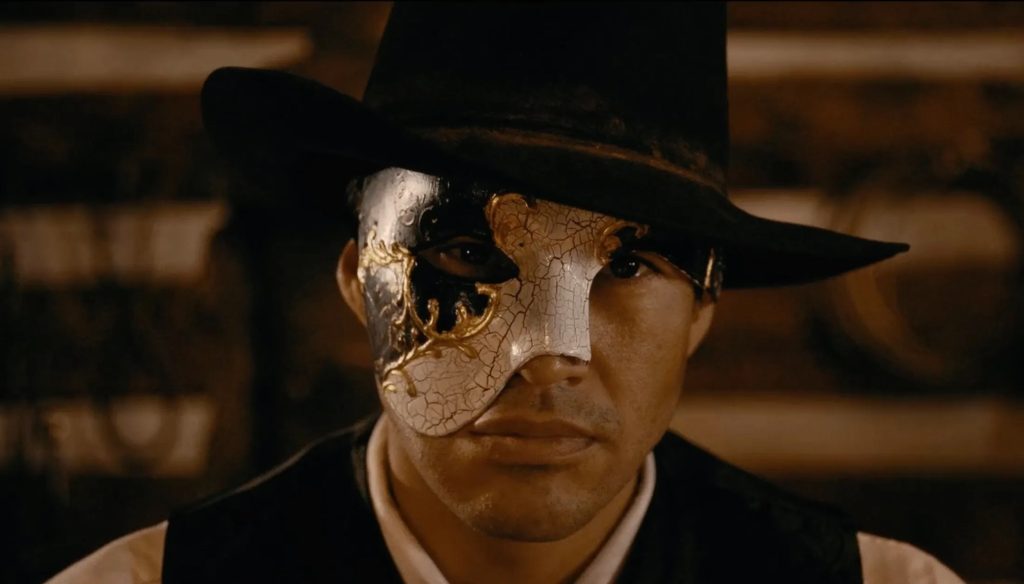
On his wedding day in 1895, cowhand Ed Dantés (Martin Sensmeier) is betrayed by his best man and framed for crimes he didn’t commit. Wrongfully imprisoned in a grim territorial facility run by the sadistic warden Victor Cain (Ron Perlman), Ed endures torturous experiments alongside other inmates. With the odds stacked against him, Ed must adapt to the ways of the outlaw to escape and exact his revenge. Cottonmouth, directed and co-written by Brock Harris (with Jared Bonner), attempts to blend the revenge-driven grit of a Western with the haunting brutality of a prison drama. Unfortunately, it rarely lives up to its ambitions.
Before we get into the negatives, let’s start with the positives because trashing a movie is never fun. There are a few moments when Cottonmouth shows flashes of what it could have been. The cinematography occasionally surprises, especially in a scene where Ed is dragged by a horse through the desert; the camera framing is pretty cool. It’s one of the few times the film feels alive, as if Harris suddenly remembered the power of visual storytelling. Ron Perlman also gives a reliably menacing performance as Victor Cain. His voice, heavy with gravel and decay, brings the film a pulse it otherwise lacks. Perlman knows how to fill the frame; he makes you believe in this monstrous man even when the script around him gives him little to work with. He isn’t in it a whole bunch, but he makes you want more of him.
The film’s concept, too, isn’t without potential. A Western revenge story with horror elements set in a twisted prison could have been bold and exciting, a genre hybrid that digs into power, justice, and dehumanization. But instead of tension or slow-burn suspense, Cottonmouth rushes from one scene to the next without letting anything breathe.
The film begins with Ed’s wedding, a moment that should ground us emotionally, a symbol of everything he stands to lose. Yet within three minutes, he’s framed, captured, and shipped off to prison. It happens so quickly that there’s no time to connect with Ed or feel the sting of betrayal or even really process what you just watched. The pacing kills any chance at tension. Instead of building a foundation for the revenge to matter, the film treats the setup as an obligation to get out of the way.
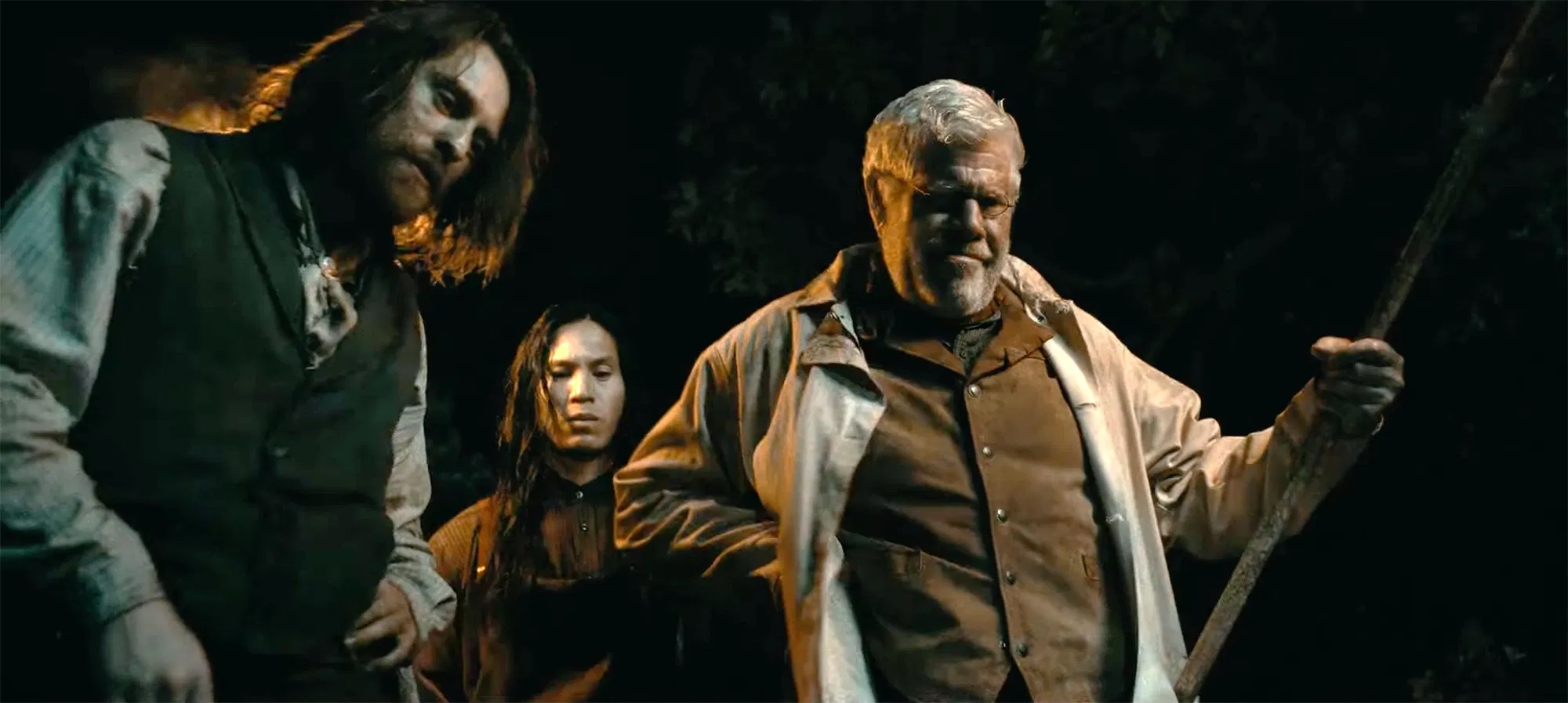
Once inside the prison, things only get worse. The film wants to explore betrayal, cruelty, and psychological torment, but most of the execution feels empty. Scenes happen without rhythm or escalation; there is no dread, no buildup, just a series of disconnected cruelties. The direction feels uncertain, and that uncertainty really bleeds into the performances. The actors look lost, unsure what tone they’re supposed to strike. Martin Sensmeier feels utterly flat here. Eric Nelson’s Billy Dunne goes to the opposite extreme as this cartoonish, overacted, almost comical in moments that are supposed to be deadly serious. It’s a tonal mess, and that’s a failure of direction more than anything else.
What’s most frustrating is how predictable and uninspired everything feels. The film borrows every Western and revenge cliché without doing anything new with them. You can practically call every beat before it happens: the betrayal, the cruelty, the escape. There’s no mystery, no surprise, not even the satisfaction of a well-earned payoff. It’s a film that constantly fails to justify its own existence.
Then there’s the way women are depicted, which borders on outright sexist. They exist only to suffer or motivate the men, props in a story about male pain. It’s a tired, regressive choice that undercuts what could have been a more layered story about love, loss, and endurance. To an extent, it is understandable how they are depicted due to the time period of the 1800s, but good lord, you could have at least fleshed these characters out and made them feel like actual human beings. The way they are treated alone should give this film a 0/10.
Even the technical aspects struggle to lift the film. The editing is choppy, often cutting between scenes with no sense of rhythm or coherence. The score, which could have enhanced the film’s atmosphere, feels so generic. It’s as if every department worked in isolation, with no shared understanding of what Cottonmouth was supposed to be.
Throughout the entire film and by the time it ends, you’re left wondering how something with this cast and concept went so wrong. With actors like Perlman and Esai Morales involved, this clearly wasn’t some micro-budget passion project. Which makes it even more baffling that the script, so undercooked and unoriginal, got greenlit and funded in the first place.
Still, even in its failures, Cottonmouth serves as a reminder of how important pacing, tone, and direction are in storytelling. You can have strong actors, a good setting, and an intriguing premise, but without purpose and control, it all falls apart. Harris seems to want to make something meaningful about pain and redemption, but instead delivers a film that feels hollow and forgettable.
In the end, Cottonmouth has a few flickers of creativity, a good villain, a cool visual or two, but it never finds its soul. It’s a Western that forgets to build tension, a revenge story without emotional weight, and a film that will likely fade from memory as quickly as it begins.
Cottonmouth is currently available on digital platforms courtesy of Cineverse.
Cottonmouth has a few flickers of creativity, a good villain, a cool visual or two, but it never finds its soul. It’s a Western that forgets to build tension, a revenge story without emotional weight, and a film that will likely fade from memory as quickly as it begins.

Roberto Tyler Ortiz is a movie and TV enthusiast with a love for literally any film. He is a writer for LoudAndClearReviews, and when he isn’t writing for them, he’s sharing his personal reviews and thoughts on Twitter, Instagram, and Letterboxd. As a member of the Austin Film Critics Association, Roberto is always ready to chat about the latest releases, dive deep into film discussions, or discover something new.