It is still genuinely bizarre that Coyote Vs. Acme almost never saw the light of day. For those who are unaware, back in 2023 Warner Bros. shelved the completed film as a tax write-off, effectively leaving a movie that had already been made sitting on a hard drive somewhere. After months of uncertainty, Ketchup Entertainment eventually acquired the film and gave it the chance to actually be seen. There is an almost perfect irony to that whole situation because Coyote Vs. Acme is, well, at its core, a movie about an enormous corporation trying to avoid taking responsibility for the damage it causes. The fact that a Warner Bros. movie about corporate accountability was nearly buried by Warner Bros. itself gives the movie an unintended layer that is difficult to ignore.
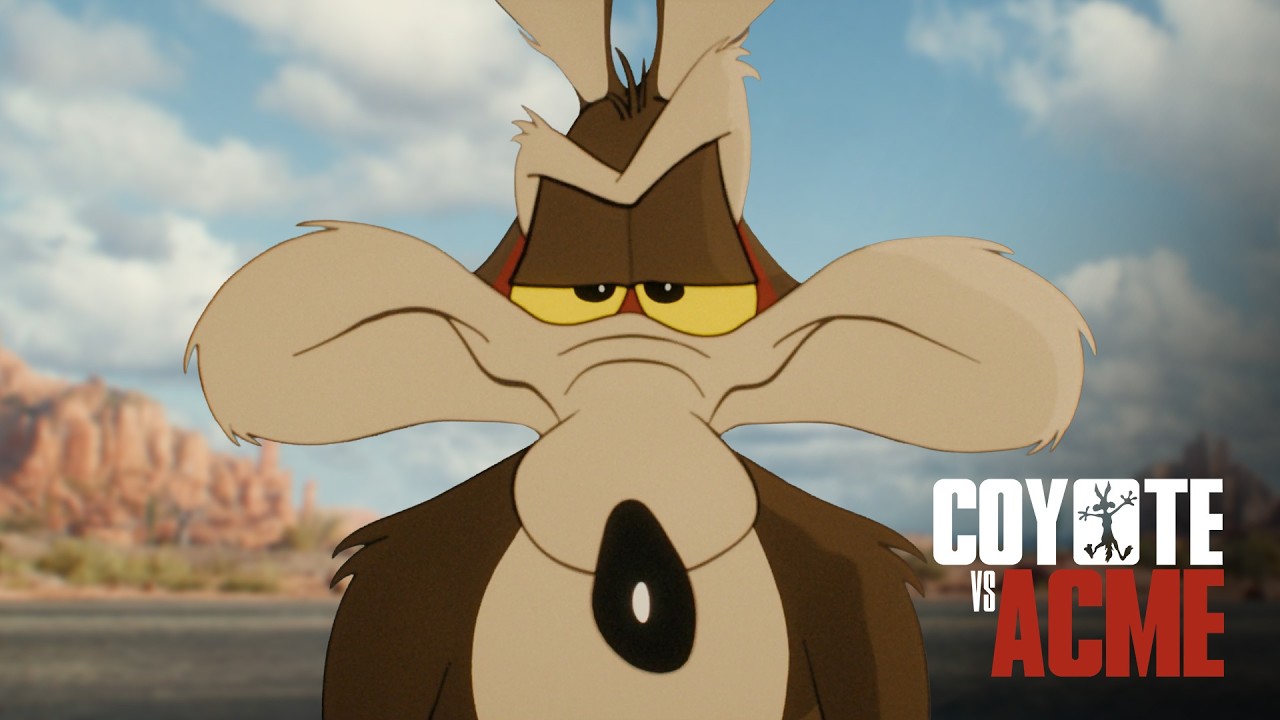
Thankfully, the movie is actually good. And I mean really good. Dave Green’s film takes one of the most enduring gags in animation—Wile E. repeatedly buying increasingly ridiculous products from Acme only to have them blow up in his face—and asks a pretty simple question: what if Wile E. actually took Acme to court? It is such an obvious premise that I am almost surprised nobody had done it before, and I am so glad they finally did.
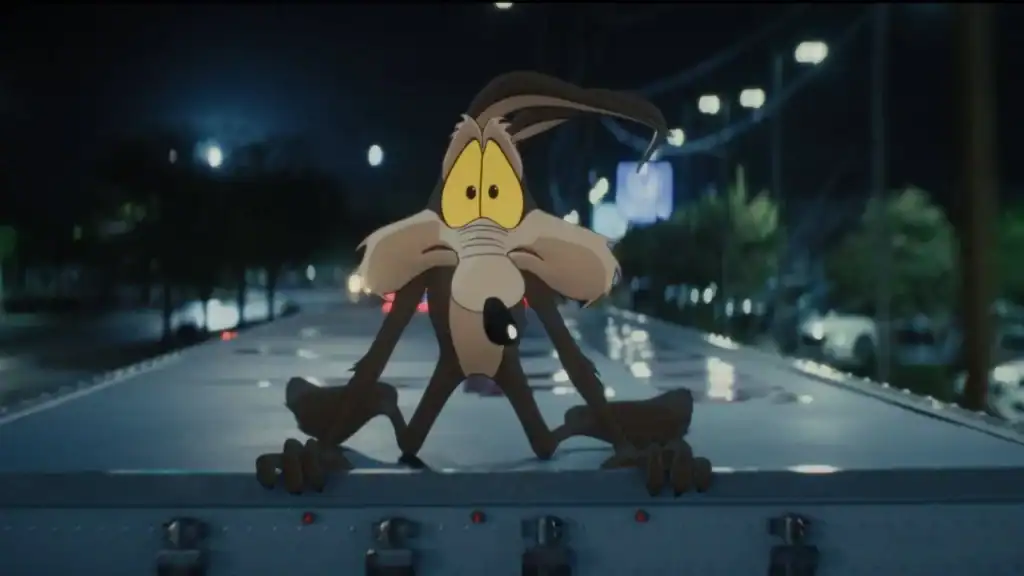
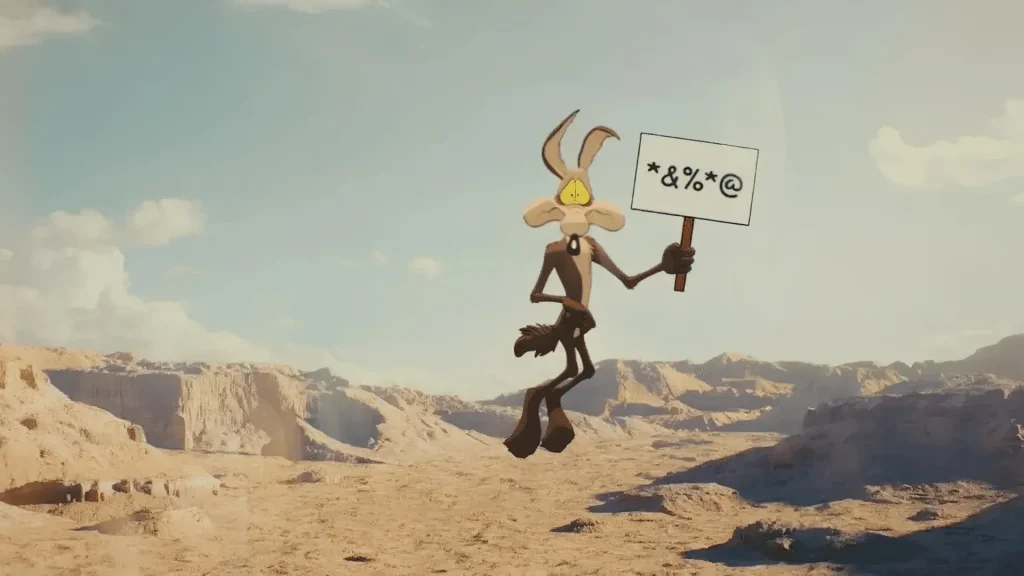
Wile E. has spent years trying to catch the Road Runner, and practically every scheme ends with him getting flattened, burned, electrocuted, launched into the desert or otherwise subjected to some form of cartoon violence. Here, that history becomes the foundation of an actual lawsuit. Wile E. believes Acme is responsible for all those injuries, while Acme’s argument is essentially that he is an idiot who keeps using its products in increasingly irresponsible ways.
That is where Sammy Burch’s screenplay is much smarter than I expected it to be. It doesn’t forget that Wile E. Coyote is, technically, a predator who has spent his entire existence trying to kill a Road Runner. The film doesn’t suddenly turn him into some innocent victim who is misunderstood. He is still selfish, very obsessive and prone to making terrible decisions. At the same time, there is something genuinely sad about watching him return to his cave and look at the mountains of broken Acme products surrounding him. The joke has been running for decades, but seeing the physical evidence of all those failures piled around him gives the character an unexpected sense of history.
Will Forte’s Kevin Avery is the human half of the story, and he fits comfortably into this bizarre world. Kevin is a down-on-his-luck billboard lawyer who has spent his career taking small Acme-related cases because he is too afraid to challenge the company directly. Wile E.’s lawsuit initially looks like another paycheck, but Kevin gradually becomes invested in the case and, more importantly, in Wile E. himself. Their relationship is probably the emotional backbone of the movie, and Forte does a nice job of playing Kevin as someone who desperately wants to do the right thing but has spent years convincing himself that doing the safe thing is the same as doing the right thing.
The friendship between the two works well, although the human characters surrounding them aren’t nearly as memorable. Lana Condor is perfectly fine as Kevin’s niece, Paige, while Martha Kelly and Tone Bell have some fun moments as Kevin’s colleagues, but neither is given enough material to leave much of an impression. They function more as supporting pieces around Forte and Wile E. rather than fully realized characters of their own.
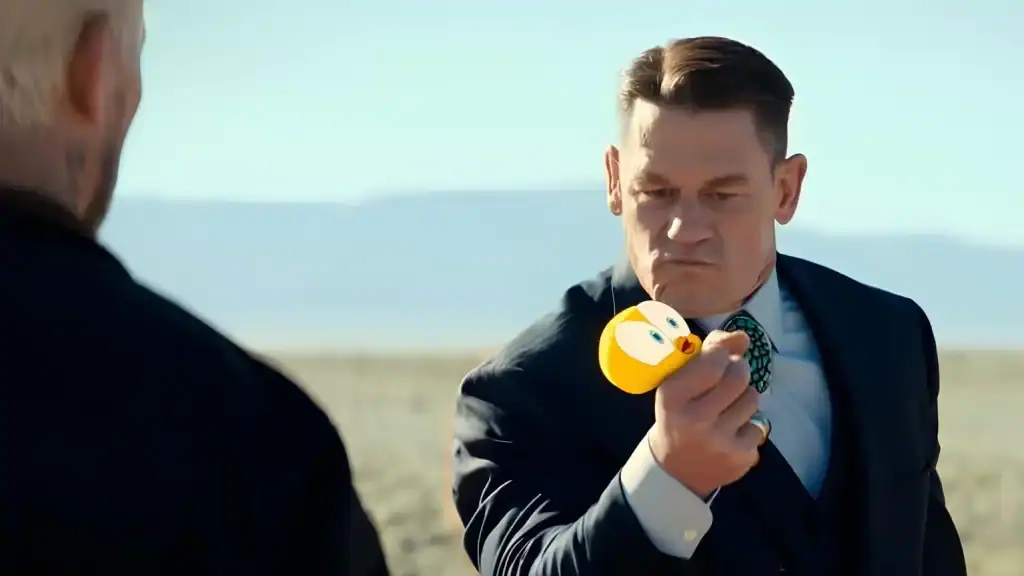
And then we have the true MVP of the film…John Cena. Cena is having an absolute blast as Buddy Crane, Kevin’s former classmate and the attorney representing Acme. He is easily the MVP of the movie. Buddy could have been a generic corporate villain in another version of this story, but Cena makes the character his own and plays him with the right amount of confidence, theatricality, menace and intimidation. He is intimidating when he needs to be, but there is always something slightly absurd about the way he carries himself. Cena commits completely to the role, and you can feel that he is having a tremendous amount of fun every time he walks into a scene.
The movie also understands how to use the Looney Tunes characters without turning them into decorations. Wile E. is obviously the center of attention, but Bugs Bunny, Daffy Duck, Tweety, Porky Pig, Foghorn Leghorn and the others feel like actual parts of this world rather than random cameos thrown in because the studio owns the characters. The visual gags are particularly strong because they don’t try to reinvent what makes Looney Tunes funny. So many characters get flattened, and objects behave in completely impossible ways, and Wile E. continues to make decisions that would get any normal person killed within minutes. There are so many visual gags that it would take up the entire review just trying to name them all; it’s truly something.
The difference is that those jokes now exist alongside a legal story, and somehow the two sides fit together. There is also a funny streak running through the screenplay. Some of the best jokes come from taking the logic of the cartoons completely seriously. Wile E.’s relationship with Acme is treated almost like a long-term customer service nightmare. Every product has failed him, yet he keeps coming back to buy another one.
The visual execution is more uneven. Whenever the film is mixing the animated characters into the live-action world, it generally looks great, and the Looney Tunes themselves retain the exaggerated physicality that makes them work. The animated sequences have a lot of personality as well. Unfortunately, the conventional live-action portions can look surprisingly bland. There isn’t much visual flair to some of the courtroom and office material, and considering how colorful and elastic the Looney Tunes world is, I wish the movie had been more visually inventive when the cartoons weren’t on screen.
That is probably my biggest complaint because the story itself is much stronger than it has any right to be. There is a surprisingly effective anti-corporate message running underneath all of this. Acme is an enormous company with endless resources, while Wile E. and Kevin are two people trying to hold it accountable. The movie obviously isn’t delivering some complicated examination of corporate law, but it understands the basic frustration of trying to fight something that is much bigger and more powerful than you. And because of everything that happened to the actual film, that theme becomes almost impossible to separate from the movie’s history. A movie about a corporation refusing to accept responsibility for its products was nearly destroyed by a corporation refusing to accept responsibility for the movie it had already spent millions making. You couldn’t write a better joke.
What I appreciate most, though, is that Coyote Vs. Acme never forgets that this is supposed to be fun. There is a tendency with modern legacy IP to become overly concerned with proving that a familiar property can be turned into something “important.” This movie doesn’t have that problem. It has a courtroom drama, a buddy comedy, a corporate satire and a bunch of cartoon characters doing incredibly stupid things, and somehow it manages to make those pieces coexist.
It isn’t perfect. The live-action material could use more visual personality, and some of the supporting characters are largely there to move Kevin and Wile E. toward the next part of the story. But the central idea is strong, the screenplay is consistently clever, the Looney Tunes are used with genuine affection, and John Cena is having the time of his life.
Most importantly, Coyote Vs. Acme feels like a movie that actually understands Wile E. Coyote. Beneath all the explosions and anvils, he is a character defined by failure. He gets knocked down over and over again, dusts himself off, buys another Acme product and tries again. Turning that endless cycle into a story about perseverance, friendship and standing up to a corporation is far more effective than it has any right to be. After everything this movie went through just to reach an audience, there is something oddly satisfying about finally being able to say that Coyote Vs. Acme was worth saving. If there is one takeaway,I think it’s this: no matter how many times you get knocked down, pick yourself up and keep going. Never give up. This movie is living proof of that.
Coyote Vs. Acme will debut exclusively in theaters on August 28, 2026, courtesy of Ketchup Entertainment.
Before we let you go, we have officially launched our merch store! Check out all of our amazing apparel when you click here and type in GVN15 at checkout for a 15% discount!
For major deals and money off on Amazon, make sure to use our affiliate link! If you are purchasing any of the latest and best in physical media at MovieZyng, you can support us using our affiliate link.
After everything this movie went through just to reach an audience, there is something oddly satisfying about finally being able to say that Coyote Vs. Acme was worth saving.
-
GVN Rating

Roberto Tyler Ortiz is a movie and TV enthusiast with a love for literally any film. He is a writer for LoudAndClearReviews, and when he isn’t writing for them, he’s sharing his personal reviews and thoughts on Twitter, Instagram, and Letterboxd. As a member of the Austin Film Critics Association, Roberto is always ready to chat about the latest releases, dive deep into film discussions, or discover something new.