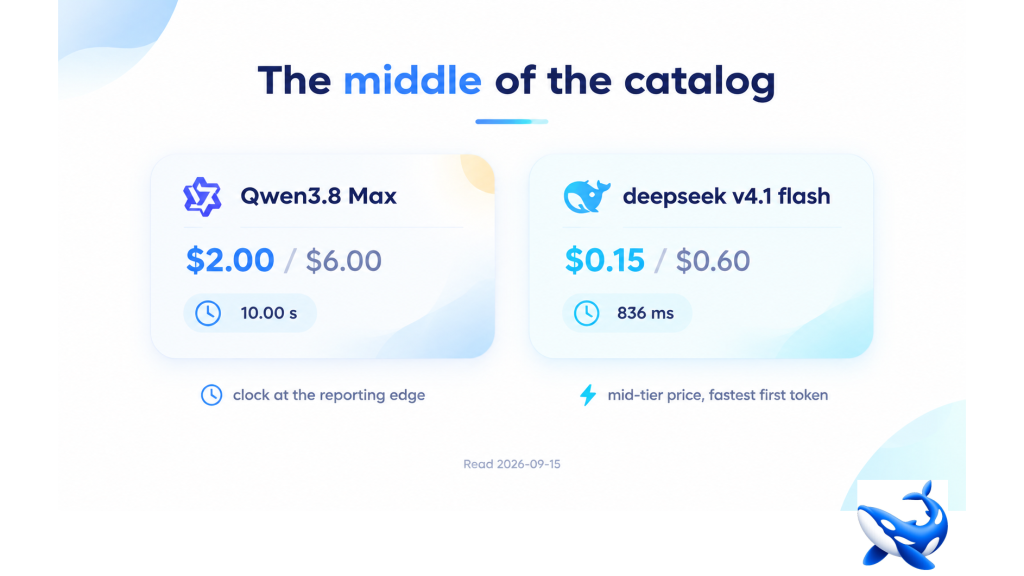
Most model comparisons start at the extremes: the cheapest model on one side, the most expensive flagship on the other, and a recommendation that you pick whichever end fits your budget. The middle of the catalog is where real buying decisions actually get made, because mid-tier models are the ones that sit inside working products — cheap enough to call per user, strong enough to trust with production traffic. OrcaRouter lists that whole range side by side, and two mid-tier entries make a particularly sharp pair: Qwen3.8 Max at $2.00 per million input tokens and $6.00 per million output, and a model at $0.15 in and $0.60 out whose published deepseek v4.1 flash benchmarks run alongside the fastest first-token figure in our telemetry. Same tier, same job description, very different numbers.
All prices and latency figures read 2026-09-15.
The price gap, computed from published rates
DeepSeek’s official pricing page, read 2026-09-15, lists `deepseek-flash` — the canonical name for V4.1 Flash — at $0.15 per million input tokens and $0.60 per million output tokens off-peak. Qwen3.8 Max’s published list of $2.00 in and $6.00 out puts the gap at 13.3x on input and 10.0x on output. The asymmetry is the interesting part: the two gaps differ because each vendor prices output differently relative to its own input price, and that difference matters for anyone who knows the shape of their traffic. An input-heavy workload — long context, retrieval-augmented prompts, repeated system messages — sits near the 13.3x figure. An output-heavy workload — generation, long completions, agent loops that write as much as they read — moves toward 10.0x. Neither number is wrong; they describe different bills.
The DeepSeek figure is the off-peak rate, and the tier structure deserves a sentence because it is usually the footnote people skip. Peak hours are 01:00–04:00 and 06:00–10:00 UTC, Monday through Friday — 35 hours of the 168-hour week, so 79.2% of all hours are off-peak and the entire weekend qualifies. A request at 05:00 UTC and the same request at 01:00 UTC cost different amounts on the same model, and a comparison that quotes only the off-peak number without saying so is comparing prices from different worlds. Cache-hit input also collapses the DeepSeek figure: $0.003 per million tokens off-peak, a 50x discount off the miss price per the vendor’s own page, which is what makes repeated prompts nearly free on conversational workloads.
The first-token gap, and the reporting ceiling to read it against
The price columns answer what a request costs. The latency column answers when it starts answering, and here the two models sit at opposite ends of our telemetry table. Our production telemetry — a 7-day rolling window, read 2026-09-15 — puts V4.1 Flash’s median time to first token at 836 ms, the fastest median in the table. Qwen3.8 Max’s p50 reads 10.00 s, and that figure has to be handled carefully: 10.00 s is a reporting ceiling in our telemetry, not a measurement. It means the true median sat at or above the top of what the table records — treat it as “not measured” rather than “exactly ten seconds”. The same ceiling applies across several of the slowest entries in the catalog, which is how you can tell it is a reporting artifact and not a peculiar coincidence of one model.
Read it that way, and the honest statement is: V4.1 Flash reaches its first token in 836 ms, Qwen3.8 Max’s median is at or beyond the top of our reporting range, and the gap between them is at least an order of magnitude on the axis that decides whether a chat product feels instant or delayed. Our telemetry also records Qwen3.8 Max at 182.4M tokens over the week against V4.1 Flash’s 47,198.3M — the same flash-model pattern of huge interactive volume against a smaller, heavier workload on the rival, which is a usage observation rather than a quality verdict.

Which workload each model actually wins
A fair comparison concedes what each model is genuinely for. Qwen3.8 Max is a strong mid-tier workhorse for teams that want more capacity than a flash model without paying frontier prices: heavier reasoning batches, offline generation, tasks where latency is absorbed by a queue and the marginal cost per token is already competitive. If your traffic is asynchronous, if nobody is staring at the first token, and if you have built eval coverage that Qwen3.8 Max passes, then the 13.3x input gap is a number you can consciously accept in exchange for what the model does for you.
V4.1 Flash’s territory is the synchronous stream. It posts the fastest median first token in our telemetry table, so a human waiting on the response notices the difference on every single call. It adds native vision — DeepSeek’s official feature table marks it supported — a 1M context and a 384K maximum output, and its DeepSeek-published benchmark rows are strongest on the agentic and coding side: Terminal-Bench 2.1 at 90.6, DeepSWE v1.1 at 74.2, CyberGym at 88.1. All of those scores are vendor-reported, which is the correct way to read them — they describe the model’s own claims, not an independent test — but they point at the same conclusion the price and latency columns do: this is a model built for agents and chat, where requests are cheap, repeated and waiting on an answer.
The trap in this matchup is to let the benchmark table decide it. Vendor-reported rows tell you what each model was optimised for; your own workload tells you which of those optimisations you actually use. If your traffic is mostly interactive, the latency column and the price column agree with each other and disagree with the idea of paying 13.3x more for the heavier model. If your traffic is mostly batch, the price premium buys capacity you might genuinely need, and the latency gap stops mattering. Run both against your own eval set and let cost-per-task settle it.
What a like-for-like comparison requires
Three details keep the comparison honest. First, quote the price tier: the DeepSeek number is off-peak, and inside the Monday-to-Friday peak windows it doubles. Second, treat the Qwen3.8 Max latency figure as a ceiling, not a value: it sits at the top of our reporting range, and “at or beyond ten seconds” is the accurate reading. Third, measure cost per task rather than cost per token, because an agent loop that emits several turns of output per input lands on the output side of the bill where the gap is 10.0x — different from the 13.3x that a context-heavy, output-light workload sees.
The takeaway
In a mid-tier matchup the decision is rarely either-or; it is a routing decision. The published rates read the same day give a 13.3x input gap and a 10.0x output gap between these two models, and our own telemetry puts their first-token figures at opposite ends of the table — 836 ms against a 10.00 s reporting ceiling that should be read as “not measured” rather than “exactly ten seconds”. For interactive, high-volume traffic, V4.1 Flash wins on price and on first token together. For asynchronous, capacity-hungry workloads, Qwen3.8 Max is a reasonable answer that you pay 13.3x more for and get something real in return. Know which of those two your traffic is, and the rest of the comparison stops being a contest and starts being a spec.

Sourcing note: DeepSeek’s prices, peak/off-peak schedule and cache discounts come from DeepSeek’s official pricing page, read 2026-09-15 (vendor-published). Qwen3.8 Max’s list price is the rate published on our catalog for that model, read the same day (vendor-published). The 13.3x and 10.0x gaps are arithmetic on those two published rates. All latency and traffic figures are OrcaRouter’s own production telemetry — a 7-day rolling window, read 2026-09-15, reflecting one platform’s traffic mix, regions and live provider load rather than a controlled benchmark; the 10.00 s Qwen3.8 Max figure is a reporting ceiling in that telemetry, not a measurement. The DeepSeek benchmark scores mentioned are all vendor-reported, from DeepSeek’s release materials; no independent benchmark results are cited in this piece.

Madeline Miller love to writes articles about gaming, coding, and pop culture.