Two studios sign outsourcing contracts in the same quarter. One hands the whole title — design through launch — to a single partner. The other keeps design and gameplay in-house and contracts art, backend, and QA to three separate teams. Eighteen months later the first studio has shipped and the second is renegotiating with two of its three vendors. Reverse those outcomes and the story is just as common, because the model was never the deciding factor. What decides it is whether the work can be specified in advance, and most teams answer that question with optimism rather than evidence.
What each model actually commits you to
Outsourcing itself isn’t the decision anymore. Roughly 68 percent of studios already contract out part of production across art, animation, and testing. The decision is structure.
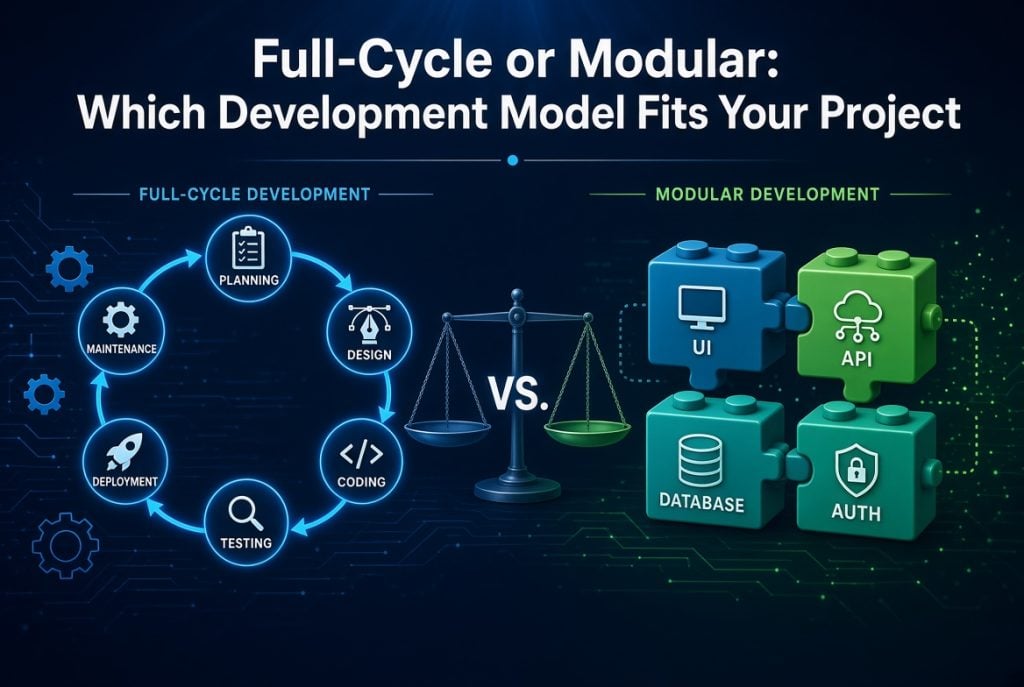
Full-cycle means one partner owns the production plan. You approve milestones; they resolve dependencies between disciplines internally. Modular means you own the plan and contract defined workstreams — an art package, a multiplayer backend, a porting job — each with its own acceptance criteria. The difference people focus on is cost. The difference that matters is where integration risk sits. Under full-cycle, integration is the vendor’s problem, which is most of why the rate is higher. Under modular, integration is yours, and it never appears on an invoice. It appears as your producer spending three days a week reconciling two vendors’ definitions of done.
There’s a second commitment that’s easy to miss. Full-cycle asks you to be decisive on a schedule you don’t control day to day. Modular asks you to be specific. Studios that struggle with modular usually aren’t short on production discipline — they’re short on written acceptance criteria, and they find that out when the first delivery arrives technically compliant and practically unusable.
Where full-cycle genuinely wins
Full-cycle earns its premium when the design is still moving. If the combat system will change after first playable, a modular art contract written against the old spec becomes a rework order the moment design lands. One partner absorbing that churn internally is cheaper than three vendors each raising a change request against it.
It also wins on small teams. A ten-person studio running four vendors has effectively hired a full-time production manager it never budgeted for, and that overhead compounds as the vendor count grows.
Vendors packaging game development services end to end will tell you the handoff problem disappears under one contract. Partly true. What actually disappears is your visibility into which discipline is behind, because a single consolidated status report smooths over the seam where trouble usually starts. That’s a reasonable trade if you have milestone-level acceptance testing. It’s a poor one if your only checkpoint is a monthly build.
Where modular genuinely wins
Modular wins when the work is bounded and the quality bar is objective. Character art against a locked style guide. A console port with defined performance targets. Localization. QA. Each of these has acceptance criteria you can write before work starts, which means you can hold a vendor to them without arbitration.
It also wins on specialist depth. The XDS 2026 Insights Report recorded engineering as an external service jumping from 10 percent to 34 percent of outsourced work in a single year, entering the top three disciplines for the first time. That shift isn’t studios giving up engineering. It’s studios buying a networking specialist for four months instead of opening a requisition that sits unfilled for two quarters.
The underrated benefit is comparability. Three vendors quoting similar packages give you real price and quality signal. Under full-cycle you get one data point and no benchmark, which makes the second contract negotiation harder than the first.
The decision checklist most teams skip
Four questions, worth answering before the model gets chosen for you.
Can you write “done” in a sentence? If yes for a given workstream, that workstream can be modular. If the answer needs a meeting, it can’t. How stable is the design? A design that will move after first playable makes modular art and modular gameplay expensive in different ways, and stability rather than scope is the real variable. Who arbitrates between vendors? Modular needs a named person with authority to settle integration disputes, and if that person is your creative director you have chosen full-cycle without saying so. What happens in month nine? Vendor turnover is normal, modular contracts are easier to replace mid-flight, and the exit cost belongs in the original comparison rather than the post-mortem.
Teams that land between the two options often hire video game developer talent on a dedicated-team basis instead — capacity they direct themselves, without the specification burden modular demands or the loss of day-to-day control full-cycle involves. It’s a common answer in practice and the least discussed one in vendor pitches.
The Question Behind the Model Question
The two studios from the opening didn’t succeed or fail because of contract structure. One had a design locked enough to specify. The other didn’t, and picked the model that punishes ambiguity.
Engagement model is downstream of specification maturity. If you can describe the deliverable precisely, modular gives you price signal, replaceability, and specialist access. If you can’t yet — and most titles aren’t there at contract time, which is nothing to apologize for — full-cycle buys you the right to keep deciding.
The question worth asking before the RFP goes out is simpler than the models make it sound: how much of this game do we actually know?
Frequently Asked Questions
How do you compare cost between full-cycle and modular quotes?
Add your own management overhead to the modular side before comparing. A modular program usually needs a dedicated producer running vendor coordination, and that salary belongs in the comparison. Full-cycle quotes look higher on paper because integration labor is priced into the rate rather than absorbed quietly by your own team.
Can a studio start modular and move to full-cycle later?
Yes, and it’s more common than the reverse. Studios often contract one vendor for art, then expand scope once delivery is proven. The transition works best at a milestone boundary with a documented handover of build systems and tooling ownership, since undocumented pipeline knowledge is what usually makes the switch expensive.
What’s a realistic vendor count for a mid-sized studio?
Two to three concurrent vendors is where most mid-sized teams stop being able to coordinate without a dedicated producer. Past that, integration meetings start consuming the capacity the outsourcing was meant to free up. The binding constraint is coordination bandwidth, not budget.
Does full-cycle mean giving up creative control?
No, but it changes how control gets exercised. You approve at milestones rather than directing daily, which requires clearer creative documentation up front. Studios expecting day-to-day influence under a full-cycle contract usually end up paying full-cycle rates for a modular level of involvement.

Caroline is doing her graduation in IT from the University of South California but keens to work as a freelance blogger. She loves to write on the latest information about IoT, technology, and business. She has innovative ideas and shares her experience with her readers.