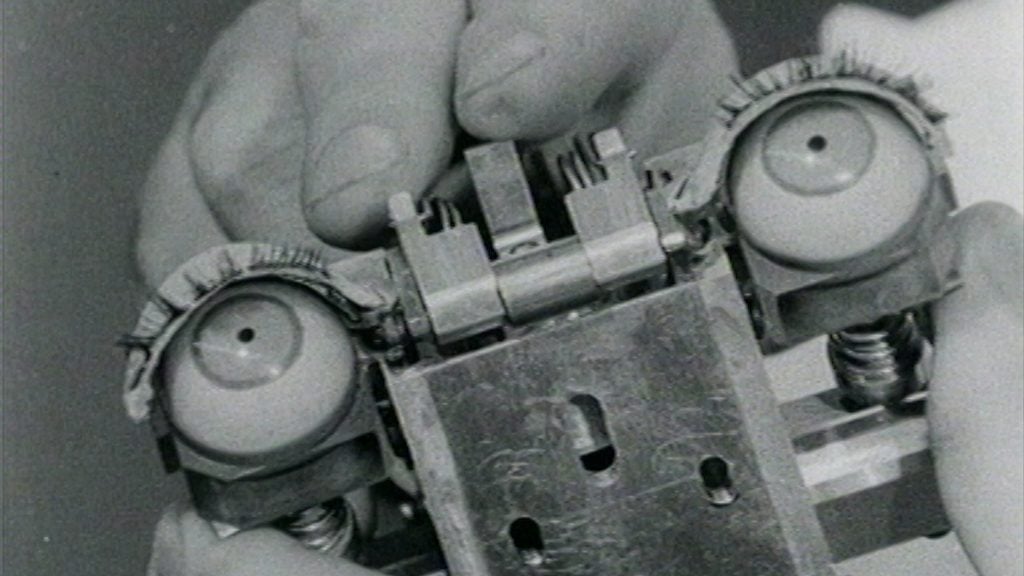
Artificial Intelligence (AI) is absolutely the most pressing issue of our technological times. This is not to say that there are not other worries, but certainly AI has become more than prevalent, and is worming its way into our lives, whether we like it or not. It has become so ubiquitous that even those of us who go out of our way not to use it are slapped in the face every time we use an internet search. There it is, right at the top of the screen, AI search results, and the quality of those results is, let’s say, inconsistent at best. But, like most technologies, the common person has no idea how it works or where it comes from.
Ghost in the Machine, a new documentary premiering at the Sundance Film Festival, serves to both educate and warn the general populace about this important topic. Unfortunately, a feature-length documentary may be the wrong way to present this vital information. For people generally in the know, there is not a lot of brand-new information here. And for people who are blissfully ignorant, there is no time to provide the depth necessary in a manner so that they won’t simply tune out. Now, this is not to say that there are no advantages to this extremely well-researched work. Director Valerie Veatch takes a challenging topic and manages to distill some deeply important points. She also smartly arranges this in a series of chapters, which makes it a bit easier to digest.
For me personally, the most interesting section is the direct line that Veatch draws from white supremacy to the use of AI, via a discussion of intelligence testing and eugenics. It has been well documented that intelligence measurement has a deep history in eugenics, racism, and deep misogyny, but Veatch makes this subtext text in a mostly understandable way. As AI leaders in modern times use shortcuts like “General Intelligence,” it can become easier to simply gloss over the roots of what that actually means. After all, most of us think that we know what intelligence means, just like we think we know what artificial intelligence means. After all, there are many kinds of intelligence, and many of these are not accurately measured by standard tests. Importantly, she shows that the definition of AI is purposefully vague, which leads to later chapters, poking more than a little fun at the supposed geniuses among us.

However, these early sections feel incredibly rushed due to the sheer amount of knowledge that the director has unearthed. This introduction alone could have filled the entire nearly two-hour runtime. If this had been given more time to breathe, it could have been even more impactful. A refreshing idea, though, is how clear Veatch’s vision for the documentary comes across. She does not hide that AI is an actual threat, and not simply a neutral technology that is a general good in the right hands. She shows us that the foundation on which it is built is rotten to the core. It is not as simple as adjusting to the new reality that AI is forming; all things AI must be reconsidered through this damaged lens.
Using experts from many fields, obviously including AI researchers, Veatch makes a deeply compelling case for the evils of AI. Importantly, she is not afraid to take apart the culture of privilege housed in Silicon Valley. As a former resident of that particular area, there is certainly a god-like worship of some of these figures, especially Elon Musk and Sam Altman, both featured prominently here. These two co-founded OpenAI, but have since split ways, though they both have aligned themselves with President Trump in different ways. Despite Musk leaving that company, he certainly has remained focused on his own AI, with Grok (which has recently come under fire for creating sexually explicit images without consent). Altman, on the other hand, as shown here, has avoided solid answers to what AI is, what it can do, and what, if any, limitations should be placed upon it. There is a particularly damning clip in which his vision for AI essentially amounts to building a great system and then asking that system to do the work for him. And here is where Veatch turns the bullseye on the myth of the great man, and very effectively.
Ghost in the Machine is mostly effective but feels incomplete. Not that many of us know what is next, but there does not seem to be a call to action to close the film. This is truly an impossible task, as AI (and its dangers) are constantly changing and evolving. This is a documentary that would be better as a ten-hour docuseries, but frankly, she would have to keep adding chapters, as there is no end in sight. The goal seems to be to warn us of the dangers (including the ecological and race-driven ones), and she certainly accomplishes that. There is a much more complete documentary hidden in her exemplary research work here; it is just a shame that we have the limits of a feature placed on it.
Ghost in the Machine had its World Premiere in the NEXT section of the 2026 Sundance Film Festival.
Director: Valerie Veatch
Rated: NR
Runtime: 110m
Ghost in the Machine is mostly effective but feels incomplete. Not that many of us know what is next, but there does not seem to be a call to action to close the film. This is truly an impossible task, as AI (and its dangers) are constantly changing and evolving.

Dave is a lifelong film fan who really got his start in the independent film heyday of the 90’s. Since then, he has tried to branch out into arthouse, international, and avant garde film. Despite that, he still enjoys a good romcom or action movie. His goal is to always expand his horizons, through writing and watching new movies.
![‘The Boys’ Season 5 Premiere Doesn’t Pull Any Punches [SPOILER WARNING]](https://cdn.geekvibesnation.com/wp-media-folder-geek-vibes-nation/wp-content/uploads/2026/04/THBY_S5_UR_501_00331_R2_3000-450x300.jpg "‘The Boys’ Season 5 Premiere Doesn’t Pull Any Punches [SPOILER WARNING]")