TL;DR
- The best plot twists do more than shock audiences — they change how we understand everything that came before them.
- Fight Club, The Prestige, Oldboy and The Usual Suspects all deliver unforgettable reveals.
- Some of cinema’s greatest twists are hidden in plain sight, making repeat viewings even more rewarding.
- Our No. 1 pick became so culturally famous that avoiding its biggest spoiler is almost impossible.
Major spoiler warning: This article reveals the endings and biggest twists from every movie discussed below. If there is a film on this list you have not seen, consider this your chance to turn back.
A truly great movie plot twist does something much harder than simply surprise us.
It makes us immediately reconsider the movie we just watched.
Suddenly, an innocent conversation means something different. A character’s strange behavior makes perfect sense. The clue we ignored 90 minutes earlier becomes painfully obvious, and sometimes the only reasonable response is to start the movie again to see how the filmmakers managed to hide the truth directly in front of us.
For this ranking, shock value alone is not enough. We’re looking at how well the twist is set up, what it adds to the story, how much it changes our understanding of the movie and whether the reveal still works even after everyone knows it is coming.
Here are our picks for the 15 greatest movie plot twists of all time.
15. Saw (2004)
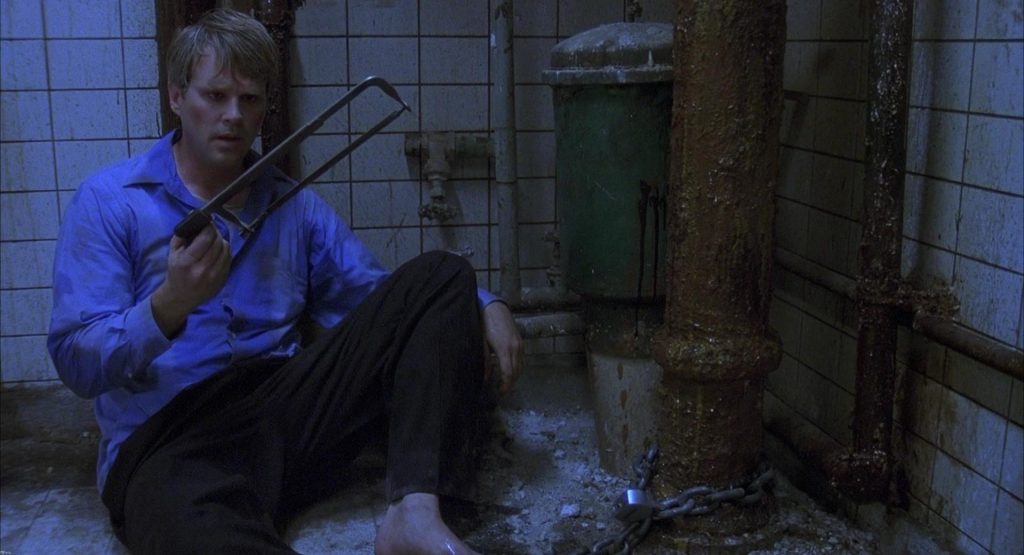
For most of James Wan’s Saw, two men are chained inside a disgusting bathroom with a corpse lying between them. The assumption is simple: whoever Jigsaw is, he is somewhere else watching the nightmare unfold.
Then the corpse moves.
John Kramer was inside the room the entire time.
The reveal works because audiences have been looking directly at him for practically the entire movie without ever considering that the supposedly dead body might matter. Tobin Bell slowly rising from the floor as Charlie Clouser’s “Hello Zepp” kicks in immediately transformed Jigsaw from an unseen mastermind into one of modern horror’s defining villains.
The franchise would eventually build an increasingly elaborate mythology around Kramer and his apprentices, but nothing ever matched the beautifully simple cruelty of realizing the killer had been only a few feet away all along.
14. Planet Of The Apes (1968)
George Taylor spends Planet of the Apes believing he has landed on a distant world where intelligent apes dominate primitive humans.
Then he reaches the beach.
The ruined Statue of Liberty reveals the truth: Taylor never traveled to another planet. He has returned to Earth thousands of years in the future after humanity destroyed its own civilization.
The image has become so famous that modern audiences frequently know it before watching the film, but that cultural familiarity should not diminish how devastating the original reveal was. The entire movie suddenly becomes less about discovering an alien civilization and more about humanity confronting the consequences of its own self-destructive tendencies.
13. Primal Fear (1996)
Edward Norton’s film debut comes with one hell of an introduction.
Richard Gere’s defense attorney Martin Vail believes he has uncovered the explanation for his seemingly innocent client’s violent behavior. Aaron Stampler suffers from dissociative identity disorder, with the brutal Roy emerging whenever the frightened young man becomes overwhelmed.
Vail gets him acquitted.
Then Aaron casually reveals that there never was an Aaron.
The meek stutter, terrified personality and mental disorder were all performances. Roy was always the real person.
Norton’s transformation in those final moments is what makes the twist land. Vail realizes he did not save a vulnerable young man from the justice system. He was manipulated by a murderer who correctly identified exactly what kind of story the arrogant attorney wanted to believe.
12. Gone Girl (2014)
Gone Girl does something unusual with its major twist: it reveals the truth halfway through the movie and then keeps going.
For the first half, David Fincher carefully builds the possibility that Nick Dunne murdered his missing wife Amy. Evidence accumulates, Nick behaves terribly in public and Amy’s diary paints a frightening picture of their marriage.
Then Amy drives down the highway, very much alive.
She has engineered her disappearance to frame Nick for murder.
The reveal completely changes the movie’s genre. What appeared to be a murder mystery becomes a vicious battle between two people trapped inside one of cinema’s most dysfunctional marriages. Rosamund Pike’s performance takes on an entirely different dimension once the audience finally meets the real Amy rather than the carefully constructed version everyone else knows.
11. Arrival (2016)
Denis Villeneuve makes audiences believe they are watching memories.
They are actually watching the future.
Throughout Arrival, Louise Banks appears to remember moments with her daughter, who becomes ill and dies at a young age. Those scenes seem to explain the grief Louise carries when she begins communicating with the mysterious alien visitors.
Learning the Heptapods’ language changes Louise’s perception of time.
She begins experiencing future events as though they are memories.
The daughter we have been watching has not been born yet.
That revelation transforms Arrival from an intellectual first-contact story into something deeply emotional. Louise knows that loving Ian will eventually bring unimaginable grief, but she chooses that life anyway because knowing something will end does not make the experience meaningless.
10. The Others (2001)
Grace spends the film convinced that ghosts have invaded her isolated home.
She is right about the haunting.
She is wrong about who the ghosts are.
Nicole Kidman’s character eventually discovers that she and her children are dead. Grace killed them before taking her own life, and the supposedly supernatural intruders are actually living people attempting to occupy the house.
The twist beautifully reverses the traditional haunted-house movie. Every strange event we witnessed still happened; we simply understood the perspective incorrectly. The family was never being invaded by the dead.
They were the dead refusing to leave.
9. Shutter Island (2010)
Leonardo DiCaprio’s Teddy Daniels arrives at Ashecliffe Hospital looking for a missing patient and investigating what he believes may be a larger conspiracy.
There is a conspiracy.
It just exists for his benefit.
Teddy is actually Andrew Laeddis, a patient at the hospital who murdered his wife after she drowned their children. The elaborate investigation is a role-playing exercise created by his doctors in one final attempt to help him accept reality.
Martin Scorsese provides plenty of clues, from the awkward behavior of the supposed officers around Teddy to the strangely theatrical responses of the hospital staff. Once the truth is revealed, nearly every interaction can be viewed differently.
The final line makes everything even more complicated: Andrew may actually understand the truth but choose lobotomy rather than continue living with what he has done.
8. Psycho (1960)
Alfred Hitchcock spends much of Psycho encouraging us to imagine Norman Bates as a frightened man controlled by his murderous mother.
There is no mother.
At least, not anymore.
Norman killed her years earlier and preserved her corpse while developing a separate “Mother” personality that commits the murders throughout the film.
The reveal is famous now, but Psycho already pulled another enormous trick before audiences reached it. Hitchcock kills apparent protagonist Marion Crane less than halfway through the film, forcing viewers to completely reconsider whose story they are watching.
Between the shower scene and the truth about Mother, Psycho essentially rewrote the rules governing what audiences could expect from a mainstream thriller.
7. Memento (2000)
Christopher Nolan’s breakthrough does not deliver one conventional twist so much as gradually reveal that the person we trusted most cannot trust himself.
Leonard Shelby cannot form new long-term memories and uses notes, photographs and tattoos to track the man he believes murdered his wife.
The movie’s backwards structure places viewers inside his condition. We rarely know more than Leonard does because every scene begins without the context that would normally explain what happened before it.
Eventually, the film reveals that Leonard may have already found and killed the man responsible long ago. Worse, Leonard deliberately chooses to manipulate his own future memory by planting evidence that will send him after Teddy.
He knows tomorrow’s Leonard will believe whatever today’s Leonard leaves behind.
The mystery is no longer simply who killed his wife. It becomes whether Leonard needs an endless mystery because solving it would leave him without a purpose.
6. The Prestige (2006)
Christopher Nolan manages to hide two major answers inside one movie about people whose entire profession involves deception.
Alfred Borden’s mysterious “Transported Man” trick works because Borden is not one man. He and his identical twin have spent their lives sharing a single identity, alternating between Borden and his assistant Fallon at enormous personal cost.
Robert Angier discovers a considerably darker solution.
Nikola Tesla’s machine genuinely duplicates him.
Every night Angier performs the trick, one version appears across the theater while another drops into a water tank beneath the stage and drowns. Even Angier cannot know whether he will be the man receiving applause or the man dying beneath the floor.
The film tells us repeatedly to watch carefully.
We still look in the wrong place.
5. Oldboy (2003)
Some plot twists make a movie more clever.
Oldboy makes everything more horrifying.
Oh Dae-su spends 15 years imprisoned without understanding why. After his release, he searches obsessively for the person responsible while beginning a relationship with a young woman named Mi-do.
Lee Woo-jin eventually reveals that the relationship was never accidental.
Mi-do is Dae-su’s daughter.
Woo-jin orchestrated their meeting and used hypnosis to guide them toward one another as revenge for Dae-su revealing an incestuous relationship from Woo-jin’s past.
The revelation does not simply solve the mystery surrounding Dae-su’s imprisonment. It destroys him. Park Chan-wook turns the audience’s desire for answers into something we immediately wish we could unknow.
4. The Usual Suspects (1995)
Who is Keyser Söze?
For most of The Usual Suspects, Roger “Verbal” Kint appears to be the least threatening person in the room. Kevin Spacey’s character gives investigators the story behind a disastrous criminal operation while describing the almost mythical crime lord responsible for everything.
Verbal finishes his story and walks away.
Then Agent Kujan looks around his office.
Names, locations and details from Verbal’s supposedly truthful account came from objects sitting around the room. He invented the story in real time using whatever his eyes happened to find.
Outside, Verbal’s limp gradually disappears.
Keyser Söze was sitting directly across from Kujan the entire time.
By the time the detective realizes it, he is gone.
3. Fight Club (1999)
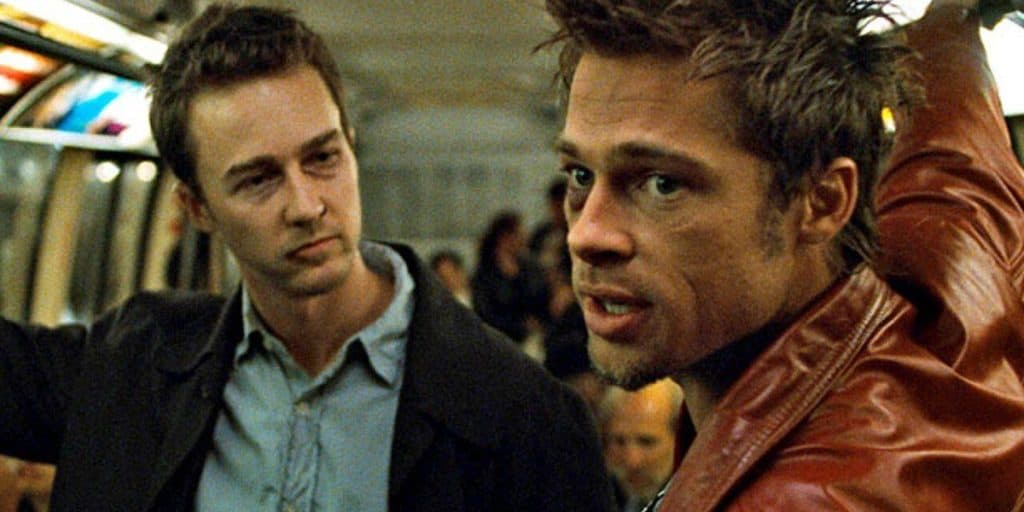
Tyler Durden is everything Edward Norton’s unnamed narrator wishes he could be.
That is because Tyler is him.
The narrator’s insomnia, dissatisfaction and fractured identity create Brad Pitt’s charismatic anarchist as an alternate personality. Every conversation between them has to be reconsidered once the truth becomes clear.
David Fincher deliberately plants Tyler throughout the movie before formally introducing him, including blink-and-you’ll-miss-it appearances that suggest the character is already emerging inside the narrator’s mind.
The twist also strengthens the movie’s central ideas. Tyler is not some mysterious outsider who corrupts an innocent man. He is the narrator’s anger, insecurity and desire for destruction given a body and permission to act.
He cannot defeat Tyler simply by punching him because he has been fighting himself the entire time.
2. Se7en (1995)
The twist in Se7en is not that John Doe has another victim.
It is realizing what the final two sins actually are.
Detectives Somerset and Mills believe Doe’s killing spree remains incomplete when he unexpectedly turns himself in. He leads them into the desert, where a delivery van brings a mysterious box.
Somerset opens it.
We never need to see what is inside.
Doe has murdered Mills’ pregnant wife Tracy because he envied Mills’ ordinary life. That makes Doe himself Envy.
He then reveals the final stage of his plan.
If Mills kills him in anger, Mills becomes Wrath.
Brad Pitt’s detective knows exactly what Doe wants.
He shoots him anyway.
John Doe finishes his masterpiece by turning the detective pursuing him into the final piece.
1. The Sixth Sense (1999)
“I see dead people.”
Cole tells Malcolm Crowe exactly what is happening.
We simply do not realize Malcolm is included.
Throughout M. Night Shyamalan’s The Sixth Sense, Bruce Willis’ child psychologist believes he survived being shot by a former patient and is now trying to help a frightened boy who claims he can communicate with ghosts.
The ending reveals that Malcolm died from that gunshot.
He has been one of Cole’s ghosts throughout the entire movie.
What makes the reveal extraordinary is how honestly the film plays its trick. Nobody other than Cole actually speaks directly to Malcolm after the opening sequence. His wife appears distant because she cannot see him. The cold that accompanies supernatural activity appears around him because he is supernatural activity.
Even Malcolm’s wardrobe quietly reinforces the truth. He repeatedly wears variations of clothing connected to the night he died, as though his existence has become trapped inside the memory of his final living moments.
The audience supplies the missing explanation because Bruce Willis is standing there. If we see him, surely everyone else does too.
They don’t.
Few twists have become more famous, and that familiarity makes the movie’s achievement even more impressive. Knowing the ending does not ruin The Sixth Sense.
It gives you an entirely different movie to watch the second time.
That is why it remains our pick for the greatest movie plot twist of all time.
Honorable Mentions
Limiting the history of movies to 15 twists means leaving out plenty of worthy contenders. Chinatown delivers one of cinema’s most disturbing family revelations, The Empire Strikes Back forever changed Luke Skywalker’s story, Incendies builds toward a devastating mathematical truth, and Predestination takes identity-based time travel to almost absurd extremes.
There is also Get Out, Identity, Jacob’s Ladder, The Game, Atonement, No Way Out, Frailty and Secret Window. Any one of them could reasonably find a place in a different version of this ranking.
What Makes A Great Plot Twist Actually Work?
The weakest twists exist only to surprise audiences. They arrive without sufficient setup, contradict what happened earlier or depend on hiding information the movie had no reasonable reason to conceal.
The greatest twists work in the opposite direction.
They reveal information rather than rewriting it.
Malcolm was always dead. Tyler Durden was always the narrator. The Statue of Liberty was always waiting on that beach. Angier’s hats were always telling us what Tesla’s machine actually did.
The filmmaker gave us the answer.
We just interpreted the evidence incorrectly.
That is also why great twists survive repeat viewings. The shock disappears, but craftsmanship takes its place. Instead of wondering what happens, we begin noticing how carefully the movie prevented us from understanding what was already happening.
Sometimes the best reaction to a movie ending is disbelief.
The better reaction comes five minutes later.
“How did I not see that?”

DC Fanboy! Superman is the greatest comic book character of all time. Favorite movies are Man of Steel, Goonies, Back To the Future