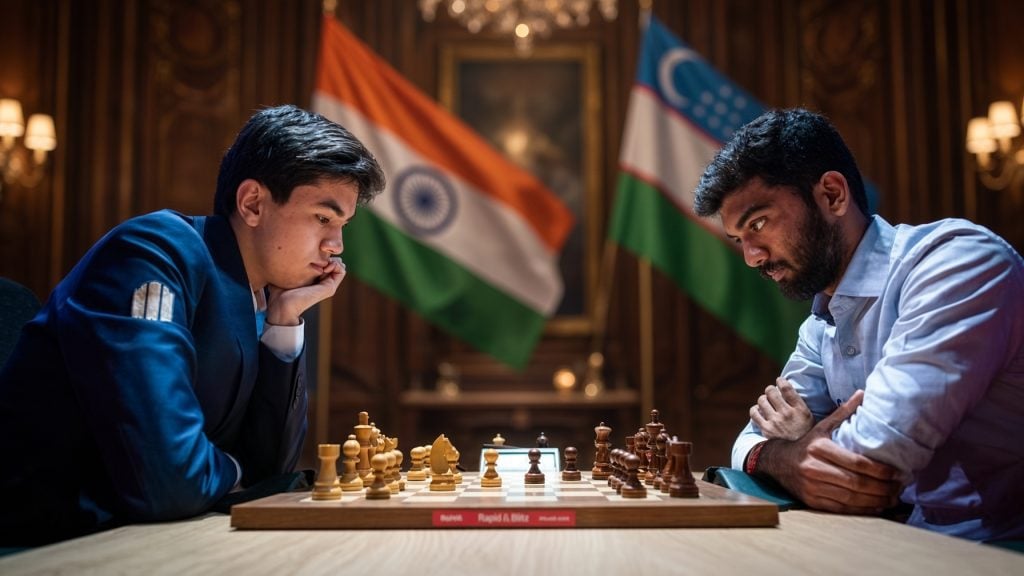
Two twenty-year-olds are about to sit down and decide who holds the most prestigious title in chess, and neither of them has ever known a world where the other wasn’t a serious rival. Gukesh Dommaraju defends the crown he won at eighteen; Javokhir Sindarov challenges as the player who’s spent the past year quietly building the strongest classical form of anyone in the world. No previous World Championship match has ever paired two players this young, and every one of those fourteen games will be played on the same world chess championship chess set design used at every major FIDE event.
The Match, By the Numbers
FIDE confirmed Geneva as the host city after considering bids from India, the United States, and Cyprus, ultimately choosing neutral ground so neither player would have a home-crowd advantage.
| Detail | Specifics |
| Dates | November 22 – December 13, 2026 (Game 1 on November 24) |
| Format | 14 classical games; tiebreaks if the score reaches 7-7 |
| Prize fund | $2.5 million, with $200,000 per classical win for each player and the remainder split evenly |
| Tiebreak split | $1.3 million to the winner, $1.2 million to the loser |
That prize structure is unusual on its own — most title matches split the fund purely on final result, not on a per-game basis that rewards decisive play throughout the match rather than just the final scoreline. Fans following along at home often want to replay each game as it happens, and browsing a chess online store for equipment built to the same match specification is a common first step for anyone serious about doing that properly.
Why Geneva, and What Neutral Ground Actually Means
Interim FIDE President Viswanathan Anand described Geneva as a city with a long tradition of bringing nations together, which is a diplomatic way of saying neither Gukesh nor Sindarov gets to play in front of a home crowd. That matters more in chess than it might seem — a champion defending a title on home soil carries a psychological edge that neutral venues are specifically designed to remove.
Sindarov reportedly wasn’t thrilled about a cold-weather venue, and Uzbekistan didn’t bid for the match at all, likely because the country is already hosting the 2026 Chess Olympiad the same year. Geneva’s alpine winter wasn’t exactly the ideal condition either player was hoping for, but neutrality mattered more to FIDE than climate preference. Viewers wanting to follow along on chess boards built to the same proportions used in Geneva can find that same design at any serious retailer, not just through official match merchandise.
The Equipment Standard Behind Every Move
Every World Championship match plays out on equipment built to exact, non-negotiable specifications — proportions and weighting so consistent that a player from Chennai and a player from Tashkent sit down at a board neither has any physical advantage adjusting to.
World Chess builds two main lines around that same world championship chess board design. There’s the full-size Championship set, matched to official match proportions, and then there’s Studio — same design logic, just scaled down for anyone who wants it for home study without eating up a whole room.
Here’s the thing that actually matters once you’re playing for real instead of just admiring the photos: the chess pieces follow the exact same weighting rules across both lines.
Both lines trace back to the same tournament chess set proportions used at matches like this one, just built for different situations — a permanent, full-size setup for serious study, or a more compact version for anyone without room for a dedicated table.
It’s not really about which one is “better” — it’s about being honest with yourself about how seriously you’re actually going to use it. And naturally, chess set price shifts quite a bit between the two depending on the materials and finish you go with.
For fans who want to replay the actual games at home on tournament-grade equipment, choosing one of the Best Chess Sets designed around those exact official specifications is a far better starting point than settling for a mismatched board and piece set assembled from whatever was lying around.
That distinction matters more than casual fans usually realize. A set that merely looks similar to tournament equipment doesn’t replicate the actual experience of reading a position the way commentators and analysts do during live coverage. Board contrast, piece silhouette, and weight all factor into how quickly a viewer can follow a complicated middlegame without constantly pausing to figure out which piece is which.
Why This Matchup Is Genuinely Unprecedented
Gukesh was just eighteen when he pulled it off — beat Ding Liren in Singapore back in 2024, in a final game that had everyone on the edge of their seat, and walked away the youngest undisputed world champion chess has ever had. Sindarov, meanwhile, has been building toward this for a while now. He won the 2026 Candidates in Cyprus with a round to spare, riding the momentum of a 2025 that already included a FIDE World Cup title.
Both players will be twenty when the match begins, which makes this the youngest World Championship pairing chess has ever seen — a genuine generational handoff happening in real time rather than a gradual one. Fans setting up a permanent chess table set at home to follow the whole match tend to treat it as a small investment in watching history rather than just another piece of furniture, especially with three and a half weeks of games to track from start to finish.
A few things worth watching as the match unfolds:
- Recent form heading in, since Sindarov has reportedly been the stronger classical player over the past several months
- How each player adapts to neutral-venue conditions neither has faced in a title match before
- Whether the per-game prize structure encourages more decisive, less draw-heavy chess than past matches
- The tiebreak scenario, since a 7-7 final score triggers a format neither player has experience with at this exact stage
Following a Piece of Chess History
The Wikipedia entry on the 2026 World Chess Championship lays out just how brutal the road here actually was — eight of the strongest players alive fought through the Candidates for the right to even challenge Gukesh, and Sindarov’s win in Cyprus was the end of that gauntlet, not some lucky break. And per FIDE’s own announcement, this match is landing right in the middle of a bigger shakeup for the federation too, just weeks before a new president gets elected.
If you’re the kind of fan who wants to look for the best place to buy chess sets built to genuine professional chess set standards, you’ll notice the search keeps circling back to the same small group of makers — the ones who supply real FIDE events, not the listings that just eyeball the proportions and hope nobody checks.
Any decent chess set store carries that distinction clearly if you know to ask about it.Whatever happens over those fourteen games, the match itself guarantees something chess hasn’t seen before: a world champion crowned or defended by someone who was still a teenager competing at the sport’s highest level barely two years ago.

Amanda Dudley is a lecturer and writer with a Ph.D. in History from Stanford University. After earning her doctorate in 2001, she decided to pursue a fulfilling career in the educational sector. So far, she has made giant strides by working as an essay writer for EssayUSA, where she delivers high-quality academic papers to students who need them.