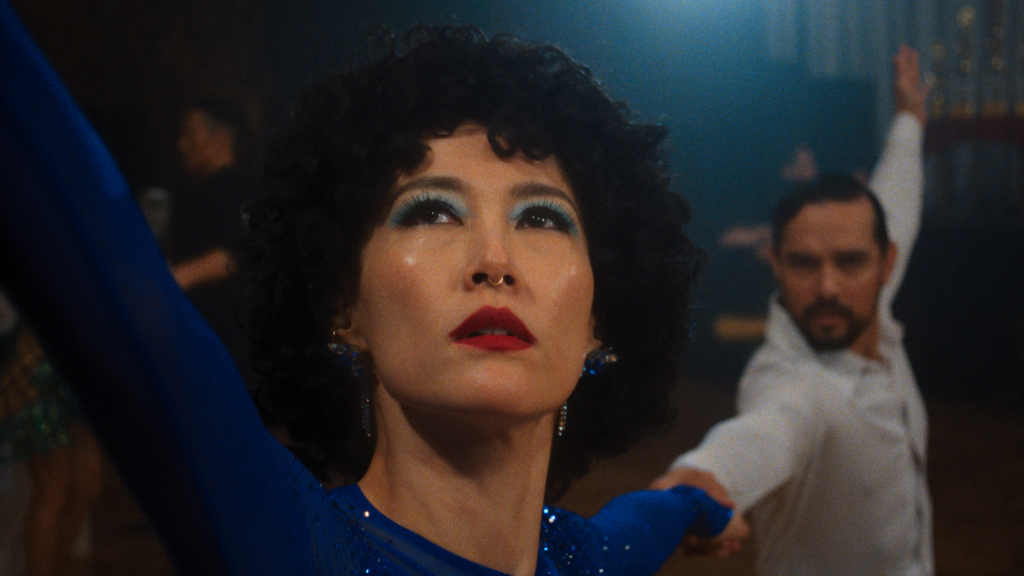
The opening moments of Ha-chan, Shake Your Booty! feel like a dream. Haru (Rinko Kikuchi) slowly moves through her house while eating and lovingly gazing upon her husband, Luis (Alejandro Edda), as he playfully waters the plants in the garden. The blending of their Japanese and Mexican cultures is a beautiful shorthand for the seamless life they have formed with one another, speaking each other’s languages and spicing up a traditional dish of oyako-don with jalapeños. It takes mere moments for us to know how in love with one another they are, culminating in the two amateurs competing in Tokyo’s ballroom dance scene. The movements are transcendent, even giving way to a surreal instance of the pair levitating above the competition for a moment of singular beauty. Unfortunately, beauty cannot always last.
Josef Kubota Wladyka returns to feature filmmaking following his acclaimed thriller Catch the Fair One, but this time, things are less overtly intense. Yes, we have a character who is immobilized with grief, but the Japanese tendency to suppress emotion trades in tremendous breakdowns for reserved despondency. Of course, if anything is going to shake her out of her doldrums, it is dancing. When words fail to capture the complexity of your feelings, dancing allows you to express yourself without reservation, especially in a society that has certain expectations of women in particular. Oh, and there is also her family—sister Yuki (Yoh Yoshida) and their cousin Hiromi (YOU)—who help scrape her off the floor and encourage her to reconnect with life. The underlying theme of women supporting one another is subtle yet very welcome.
The baby-steps back into the world begin at a local dance class, which is being led by new instructor Fedir (Alberto Guerra), who is internationally renowned for his dancing talents. While Haru is still actively grieving, having a gorgeous new man in her life to fixate on and distract her from her pain feels necessary to her. Haru uses dance to get closer to Fedir, most amusingly when she feigns incompetence in order to get a personal demonstration of a specific dance move. Fedir is married to an arguably more accomplished dancer who is still touring the world, but Haru hears rumors that they have an open marriage, which (after researching what exactly that entails) she uses as fuel for her burgeoning obsession.
The best moment during this stage of bubbling attraction, and, honestly, the scene of the movie, comes when a group of Japanese businessmen bump into Haru, to which Fedir demands an apology on her behalf. Magical realism takes over once again, and the ensuing skirmish turns into a thrilling musical number set to “Be My Baby” that dials the fantastical up to 11. It allows us into Haru’s mind for a beat as we understand on a deeper level how dancing shapes her emotions and worldview. A close second for best scene comes when Haru takes Fedir to a stage production of Dirty Dancing being performed in Japanese. Fedir does not speak the language, but the iconic story and the musical number transcend any linguistic barriers.
Both of these scenes stand out because they highlight the impact of dance, an activity that is so vital to the character of Haru. Yet, this is also where we see the movie’s most notable shortcomings. For as important as dance is to our main character, there are long stretches where it feels like an afterthought. The more Haru gets intoxicated by her dynamic with Fedir, and ultimately jealous upon his wife’s return, the more frustrating the movie becomes. Character decisions fly wildly out of the realm of believability and into a register that seems manufactured for drama rather than rooted in anything authentic. The movie aims to show the universal power of dance, but it gets distracted and rarely demonstrates how Haru is being healed, in whatever small way, by the art form.
Even when the movie is on the verge of going completely off the rails, things are kept on solid ground thanks to the infinitely charming performance of Rinko Kikuchi. The Oscar-nominated actress has not had a role this juicy and complex in over a decade, since Kumiko, The Treasure Hunter, and that feels like a loss for cinema. Decked out in flashy clothes and a curly perm hairstyle, you simply want to give this woman a hug and forgive her for any mistakes she might make on her journey of grief. Some of her most dramatic moments come from her reconnecting with her deceased husband in ways we dare not spoil here, and every shot of her face lingers in your mind. At over two hours long, the momentum begins to feel a bit sluggish near the end, yet you are never less than completely invested because of this character brought to life so effectively by Kikuchi.
The conclusion brings together all of the elements that represent the best parts of what this movie could be. The emotional high you are left on sands off some of the rough edges created by the screenplay, but not quite all of them. Dancing is life, and there are moments when the movie forgets to embrace that. But when it does click, it results in some of the most transcendent moments we have experienced in recent memory. It is a special, often hilarious movie that makes you want to tap your toe and give an extra shimmy through your everyday life.
Ha-chan, Shake Your Booty! had its World Premiere in the U.S. Dramatic Competition section of the 2026 Sundance Film Festival.
Director: Josef Kubota Wladyka
Writers: Josef Kubota Wladyka, Nicholas Huynh
Rated: NR
Runtime: 122m
It is a special, often hilarious movie that makes you want to tap your toe and give an extra shimmy through your everyday life.
-
7.5
-
User Ratings (0 Votes)
0

Dillon is most comfortable sitting around in a theatre all day watching both big budget and independent movies.