

Call it Henry and Ebb’s excellent adventure, until it isn’t. Imagination is a refuge for creativity and safety, but what if it became a place for danger? For Henry (Kingston Rumi Southwick; fans will recognize him from Widow’s Bay), childhood is a nightmare. Growing up is daunting, and the world around him seems to have left him behind. Enter Ebb (Banks Repeta), Henry’s security blanket, confident support system, and best friend. Oh, and he’s imaginary. Henry’s Ebb is a traditional coming-of-age story, but one that soaks up the merriment of nostalgia to the point it becomes self-destructive to one’s growth and well-being. Well acted, with a haunting message that strikes a chord.
For Henry, his best friend Ebb has been a constant. Reeling from the turmoil of an abusive mother and having a runaway father, Ebb is the only part of his life that does not ebb. And yet, the more of a friend Ebb proves to be as Henry gets older, the more he may become the biggest obstacle to Henry’s growing up. His relationship with his mother hits rock bottom, and Henry decides to leave with Ebb to find the father he barely remembers. Two friends hit the road, traveling through the American South. However, the journey grows tenuous as Ebb’s control and manipulation of Henry come into focus. Reality blurs as Ebb’s hold refuses to wane, forcing Henry to reconcile his trauma with his friendship.
At the core of Henry’s relationship with Ebb is the nostalgia of childhood innocence and how coping mechanisms, while beneficial, can have a detrimental long-term impact. What begins as security blankets suffocates his growth. Imaginary friends provide comfort and safety, giving children a sense of complete control. They build their own worlds. Imaginary friends provide stability. They are also temporary. Children outgrow them once the real world and real people enter the scene. In this film, that dynamic never occurs for Henry.
Examine the backstory for Henry for a moment: His home life is in shambles. His father exits the picture, his grandmother dies, and his mother is at loose ends. Enter Ebb, a source of stability and protection. However, for Henry, the control and safety he creates from his imaginary friend becomes a double-edged sword. The story examines the tragedy through the lens of Ebb’s control. Their journey to find his father is one of self-discovery, where Henry can see the light at the end of the tunnel. That light is the life he always wanted, and Ebb will never have it.
In an inferior script, an internal battle of self-control would play out in an almost campy way. Director and writer Thomas Mendolia is less interested in crafting cheap shocks and funhouse-type scares. Instead, he offers an examination of a child arrested in development—the psychological underpinnings of an imaginary friend that has overstayed its welcome.
We find ourselves in a time when nostalgia becomes a poetic affair. People grow fond of memories, as if everything were once sunshine and happy talk. But we all know that is not the case. Reality is far from black-and-white. There are many more shades of gray than a straightforward either/or dichotomy.
Ebb’s reaction in the story is to lose control. He is stagnant. It was a moment meant to help Henry cope with the dark traumas and pain of the past. He was never meant to be a bridge to the future, but a roundabout of safety. Henry’s problem, as in life, is that walking in circles is fine if you don’t realize the path is circular; once it becomes clear, there is no choice but to take a beeline for the exit ramp.
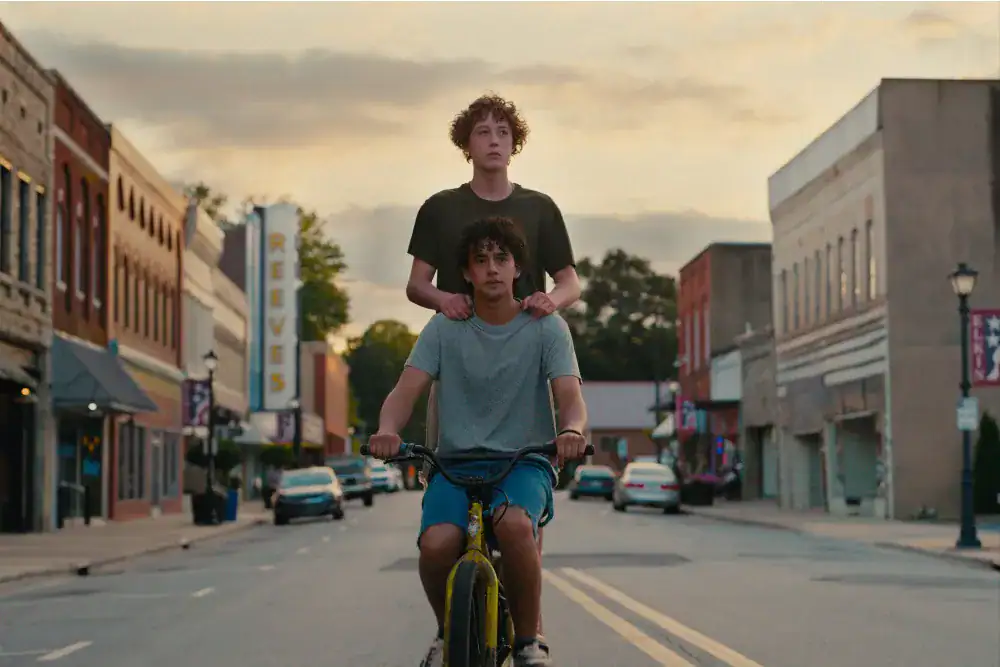
The film has moments of unsettling imagery. Henry rides a bike through quaint, charming towns, with Ebb in tow. When the image cuts to reality and shows only Henry, without Ebb, it’s haunting and sad. Henry’s Ebb manages a delicate balance between drama and something darker. This isn’t quite a horror movie, but it unsettlingly examines how both Henry and we, the audience, can spend our lives running from and ignoring difficult truths. Turning our backs on them does not make the truths disappear.
Ebb, for his part, is the emotional wall that keeps Henry from recognizing hard truths or the need to grow. Ignorance can be bliss, but it can ultimately be a bitter pill, and the film takes a hard look at the latter; the outcome is a story with echoes of Stand by Me, but with a more sinister packaging.
Henry’s Ebb is honest, and I applaud its tenacity in chipping away at the comfort we often surround ourselves with. The adults here operate as fully realized figures. They function, but they struggle to hold it all together. The kids are kids, but they’re real kids, living in hardship, innocence, and wonder. In a beautiful yet terrifying deconstruction of an imaginary friend, the story delivers a psychological verdict on youth’s innocence and growing pains.
Henry’s Ebb will premiere at the Tallinn Black Nights Film Festival.
Before we let you go, we have officially launched our merch store! Check out all of our amazing apparel when you click here and type in GVN15 at checkout for a 15% discount!
For major deals and money off on Amazon, make sure to use our affiliate link! If you are purchasing any of the latest and best in physical media at MovieZyng, you can support us using our affiliate link.
In a beautiful yet terrifying deconstruction of an imaginary friend, the story delivers a psychological verdict on youth’s innocence and growing pains.
-
GVN Rating 8
-
User Ratings (0 Votes)
0

Writing & podcasting, for the love of movies.
His Letterboxd Favorites: The Dark Knight, Halloween, Jaws & The Odyssey.