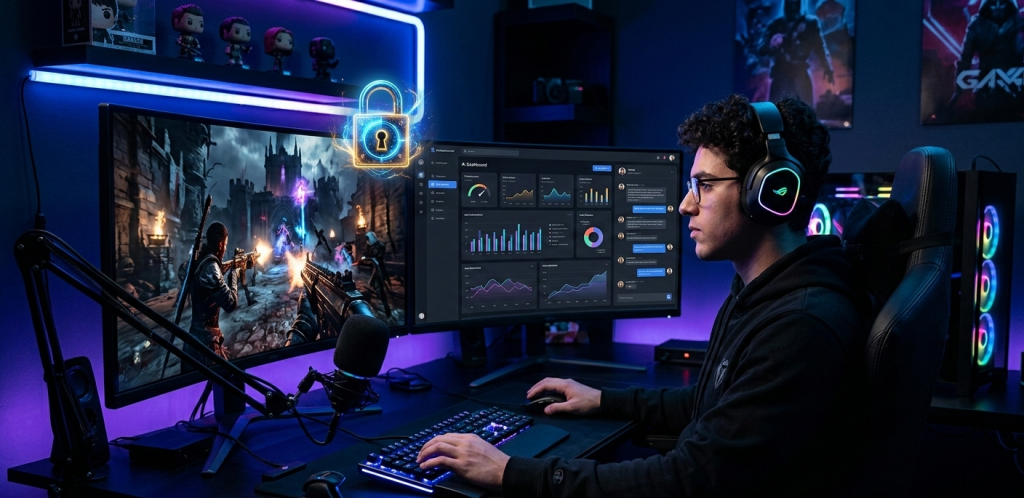
AI agents have been quietly building a presence in gaming for the past year. Not as NPCs. Not as matchmaking algorithms. As actual assistants, you connect to your accounts to track stats, manage rosters, run clan logistics, or simply play alongside you in co-op scenarios.
Most gamers accepted the trade-off without blinking. You grant access, the AI makes your life easier, done. But a string of security reports published in late 2025 and early 2026 has changed the picture. Researchers at Zenity Labs, Cisco, and NIST have all documented the same basic problem: AI agents that get compromised don’t just leak data. They act on your behalf, and they do it fast.
If that agent is tied to your Steam account, your PlayStation Network profile, or your Discord server, the blast radius of a breach is a lot wider than a leaked password. This article breaks down what’s actually happening, which risks are real, and what you can do right now to protect yourself without giving up the tools you actually want to use.
The Real Reason Gamers Should Care About AI Agent Security
Let’s be direct about the threat. It’s not that AI game assistants are badly made. Most of them are well-intentioned tools built by small dev teams or indie studios. The problem is structural.
A report from Zenity Labs, presented at Black Hat USA in 2025, showed that some of the most widely used AI agents across platforms like Microsoft 365 and Google Workspace could be hijacked with minimal effort. Researchers demonstrated data exfiltration, workflow manipulation, and user impersonation. One of the scariest findings: once attackers gained access, they could establish memory persistence, meaning the agent kept working for them in the background long after the initial compromise.
That same attack surface exists anywhere an AI agent holds credentials. Your gaming accounts qualify. A hijacked agent with write access to your Discord server can send phishing links to your entire community. One with access to your gaming platform can make purchases, change your email, or lock you out entirely.
88% of organizations reported confirmed or suspected AI agent security incidents in the last year. (Source: Gravitee State of AI Agent Security 2026 Report)
That stat comes from enterprise environments, but the underlying vulnerability applies to any AI tool that holds persistent credentials. Gaming agents are no different.
How Attackers Get In: The Three Most Common Entry Points

Understanding how these attacks actually work makes the risk feel a lot more concrete. Security researchers have identified three entry points that show up again and again.
Prompt injection. This is the most widely documented attack type for AI agents right now, and NIST has been publishing guidance on it since early 2025. The basic idea: an attacker embeds malicious instructions into content the agent will read, like a message, a file, or a webpage. The agent can’t reliably tell the difference between trusted instructions and manipulated data, so it follows the malicious ones. In gaming terms, imagine an AI that reads your Discord messages being tricked by a message that contains hidden commands to export your account data.
Over-permissioned credentials. Most AI gaming tools request broad access during setup because it’s easier to build that way. You approve everything, and the agent works smoothly. But broad permissions mean a broad attack surface. Researchers at Cisco’s threat team found this pattern everywhere: agents granted permissions they never actually needed, creating unnecessary exposure. If an agent only needs to read your game stats, it shouldn’t have write access to your account settings.
Phone number exposure. This one gets overlooked the most. Many AI gaming tools, especially those that integrate with Discord or Telegram bots, require account registration via phone number to verify identity or enable 2FA. When that number is your personal number, it becomes a target. Successful SIM-swap attacks and social engineering campaigns have used gaming account phone numbers as entry points to reach financial accounts linked to the same identity.
What Gaming Accounts Are Actually at Risk
Not every gaming tool carries the same risk level. Here’s a practical breakdown based on what kind of access the agent actually holds.
High risk: AI agents connected to your main platform accounts (Steam, PlayStation Network, Xbox Live, Epic Games). Any breach here means potential access to your payment methods, purchase history, and linked email. Agents that have write permissions on these accounts are especially dangerous.
Medium risk: Discord server managers and clan bots with admin privileges. These don’t usually touch payment data, but a compromised server bot can damage communities you’ve built over the years. Phishing campaigns launched from trusted server accounts are extremely effective because your members already trust the source.
Lower risk, but not zero: Stat trackers and read-only analytics tools. If all the agent does is read public or semi-public data, your exposure is limited. Watch out for scope creep, though: many stat trackers quietly request broader permissions than they need during OAuth flows, and most users don’t read the fine print.
The Phone Number Problem Nobody Talks About in Gaming Communities

Discord, Telegram, and WhatsApp are where most gaming communities actually live. And all three platforms require a phone number at some point, whether for account creation, 2FA setup, or bot verification.
AI gaming agents that integrate with these platforms inherit that requirement. When you set up an agent on your community Discord, you’re often creating bot accounts or secondary accounts that need verification. Most people just use their personal number. It’s the obvious choice, it’s free, and it works.
The problem is that your personal number links everything. Your gaming identity, your messaging identity, and potentially your financial identity if any of those platforms have payment data attached. A SIM-swap attack on your number can cascade across all of it.
The fix that developers and more privacy-conscious gamers have started using is dedicated virtual phone numbers for bot accounts and AI agent setups. A virtual number completes SMS verification the same way a real number does. The agent works identically. But your personal number stays completely out of the loop.
Services like Quackr offer non-VOIP temporary phone numbers across 30+ countries that work reliably with Discord, Telegram, and WhatsApp verification. For a community manager running multiple AI tools across multiple servers, this is quickly becoming standard practice.
Practical Steps to Lock Down Your Gaming AI Setup
You don’t need to stop using AI tools. You need to use them more deliberately. These steps take under an hour total and significantly reduce your exposure.
Audit your connected apps right now. Go to your account security settings on Steam, Epic, Discord, and any platform you use. Look at every connected application. Remove anything you no longer use actively. This is the fastest single action you can take.
Apply least privilege when setting up new agents. When an AI tool’s OAuth screen asks for permissions, read each one. If a stat tracker is requesting write access to your profile, that’s a red flag. Look for tools that offer read-only modes or scoped permission requests.
Use a dedicated virtual number for bot and agent accounts. If your AI tools need to verify through SMS or register an account, use a separate number. You can receive SMS online through a virtual number service for a few dollars a month. The agent gets what it needs, and your personal number stays private.
Enable 2FA on your main gaming accounts using an authenticator app, not SMS. SMS-based 2FA is the weakest form because of SIM-swap risk. If you’re using it on Steam or Epic right now, switch to an authenticator app like Google Authenticator or Authy.
Monitor agent activity logs if the tool provides them. Good AI tools expose logs of what actions they’ve taken. Check these occasionally. Unexpected actions are often the earliest signal of something wrong.
Where This Is Heading in 2026
The security picture around AI agents is getting sharper fast. NIST published technical guidance on agent hijacking evaluations in 2025 and has continued refining it. OWASP ranked prompt injection as the number one vulnerability in their LLM Top 10 list. Cisco’s State of AI Security 2026 report specifically called out MCP-connected agents as an expanding attack surface.
Gaming companies haven’t caught up yet. Most major platforms don’t have specific policies covering third-party AI agent integrations beyond standard API terms of service. That gap will close eventually, probably after a high-profile incident forces the issue.
Until then, the responsibility is on you. Not in a scary way. In the same way that gamers learned to use strong passwords, enable 2FA, and not click sketchy trade links. The threat model has expanded. The habits need to be kept up.
AI gaming tools are genuinely useful, and they’re only getting better. A little setup time spent on permissions and account separation is a small price to pay for using them without handing attackers a roadmap to your digital life.
The best gaming setups are the ones you don’t have to think about after they’re built. Get your security layer right once, and then go back to actually playing.

Sandra Larson is a writer with the personal blog at ElizabethanAuthor and an academic coach for students. Her main sphere of professional interest is the connection between AI and modern study techniques. Sandra believes that digital tools are a way to a better future in the education system.

![‘The Boys’ Season 5 Premiere Doesn’t Pull Any Punches [SPOILER WARNING]](https://cdn.geekvibesnation.com/wp-media-folder-geek-vibes-nation/wp-content/uploads/2026/04/THBY_S5_UR_501_00331_R2_3000-300x200.jpg "‘The Boys’ Season 5 Premiere Doesn’t Pull Any Punches [SPOILER WARNING]")