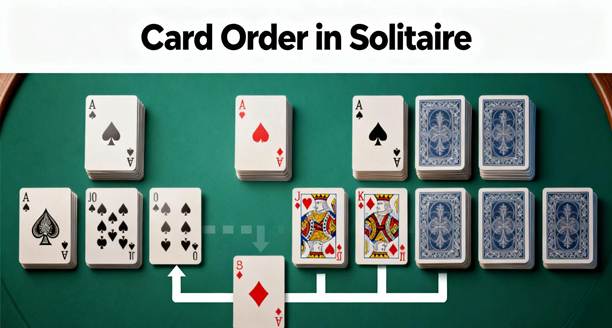
Solitaire looks like a simple time-killer, but if you’ve ever wondered why some games feel “impossible” while others fall into place, you’re already thinking about the two biggest hidden factors: card order and your memory. This becomes even more noticeable when you Play Solitaire Online for Free, where every shuffle feels different and outcomes change fast.
What “Card Order” Really Means in Solitaire
Every solitaire game starts with one big coin flip, the shuffle. The way the cards are ordered decides:
- Which cards are buried deep in the tableau?
- How quickly can you reach your aces and low cards?
- Whether useful cards stack nicely or block one another.
- You can’t change the initial order, but you can control how that order unfolds.
How your decisions reshape the deck
Each move you make changes which cards become available next:
- Moving one card may reveal a key card that opens up a whole column.
- Dropping a king into an empty space might feel good now, but it can trap useful cards underneath if you’re careless.
- Drawing from the stock without any plan can cause you to “cycle past” the one card you really needed.
Play Solitaire like this instead: Prefer moves that reveal a face-down card over moves that just shuffle visible cards around. When you have two similar moves, choose the one that opens the column with more hidden cards.
Don’t rush to move everything to the foundations. Keeping some cards in the tableau can give you more flexibility later. In other words, the deal decides what’s possible, but your choices decide what actually happens.
How Memory Changes the Outcome of a “Luck-Based” Game
Good solitaire players don’t just react to what’s visible; they quietly track what’s already appeared and what’s still missing. That’s where memory comes in.
What does a strong memory do for your game
Good memory helps you:
- Remember which cards are sitting in the stock or waste pile.
- Keep track of which ranks you’ve already seen (e.g., “I’ve seen all the 7s except hearts”).
- Plan a few moves ahead instead of playing one move at a time.
This matters most in:
- One- or three-card draw games where you cycle through the stock.
- Tight games where one wrong move can permanently bury a critical card.
- In long sessions, your brain gets sharper at recognizing patterns and remembering positions over time.
- If you’ve ever thought, “I know that 5 of hearts is coming up soon, don’t waste this move,” that’s memory quietly boosting your win rate.
Simple Ways to Use Memory to Win More
You don’t need genius level memory to win at Solitaire. You just need a few light habits, because almost every game gives you a real chance. Many players ask Is Every Solitaire Game Winnable, and in most cases, smart moves matter more than luck.
1. Pay attention to the stock order
When you flip through the stock:
- Notice a few key cards: missing aces, low cards you need to unlock columns, or specific colors you lack.
- On the next cycle, try to remember roughly where they will appear: “That red 6 shows up just after the king of clubs.”
Even a fuzzy sense of order helps you time when to:
- Hold off on a move because a better card is coming.
- Sacrifice one small play to unlock a bigger one in the next pass.
2. Prioritize columns with deep face-down stacks
Whenever you have two legal moves:
- Choose the one that uncovers more hidden cards, even if the other move looks cleaner.
- Over time, you’ll start remembering which columns are “heavy” and which are mostly cleared.
- This habit naturally trains your working memory, and it wins games.
3. Mentally group areas of the tableau
Instead of tracking every single card:
- Think in chunks: “Left side has lots of hidden cards, middle is mostly clear, right side has two long stacks.”
- Within each chunk, remember one or two key cards (like a blocking king or queen).
- Chunking is how memory experts remember long sequences. You’re applying that same principle to cards.
Is Solitaire Luck or Skill?
The fairest answer is: the deal is luck, but what you do with it is skill. Here’s a simple way to think about it:
Luck controls:
- The starting layout.
- How “clean” or “messy” the tableau is.
- Whether crucial cards are buried or conveniently placed.
Skill and memory control:
- Whether you reveal cards in the smartest order.
- How often do you trap yourself rather than open new paths?
- How do you manage the stock and waste pile?
- How do you decide between a “safe” move now and a more powerful move later?
- Two people can play the same deal and get totally different outcomes. The one who tracks card order, uses memory, and plans ahead will win far more often.
Practical Strategy Checklist To Win Solitaire Game (Without Overcomplicating It)

The odds of winning the Solitaire game are almost 99%, which clearly tells you that if you follow this Solitaire strategy checklist, you can win every game.
Reveal first, tidy later
If a move reveals a face-down card, it usually beats a move that just reorders visible ones.
Empty columns carefully
Only park a king in a space if that column helps you uncover more cards, not just because the spot is open.
Watch your foundations
Don’t rush every card up. Sometimes keeping a card in the tableau gives you extra flexibility in building sequences.
Pay attention when cycling the stock
Notice one or two important cards each time. On the next pass, time your moves to catch them when they appear.
Play slowly for a few games
Take your time and think one or two moves ahead. Speed will come naturally after your brain learns the patterns.
Final Thoughts: Your Brain Is the Real Advantage
You can’t control the shuffle, but you control how you reveal cards, how closely you watch the stock, and how you actively use your memory instead of just reacting. Always remember that there are different variations of solitaire, and there has been debate over which one is better: Soltiaire vs Spider Solitaire.
If you start treating solitaire as a light memory and strategy puzzle rather than just a time-filler, you will win more games, feel fewer unfair losses, and give your brain a gentle daily workout.
FAQs
Can memory skills help me win more solitaire games?
Yes, remembering stock cards and tableau positions lets you plan ahead and avoid bad moves, boosting your win rate over time.
Does card order matter more than skill in solitaire?
Card order sets the starting challenge, but smart moves to reveal hidden cards turn tough deals winnable. Skill beats pure luck.
How do I start using memory strategies right away?
Watch 1-2 key cards per stock cycle, prioritize revealing face-down cards, and chunk the tableau into left/middle/right zones.

Amanda Dudley is a lecturer and writer with a Ph.D. in History from Stanford University. After earning her doctorate in 2001, she decided to pursue a fulfilling career in the educational sector. So far, she has made giant strides by working as an essay writer for EssayUSA, where she delivers high-quality academic papers to students who need them.