

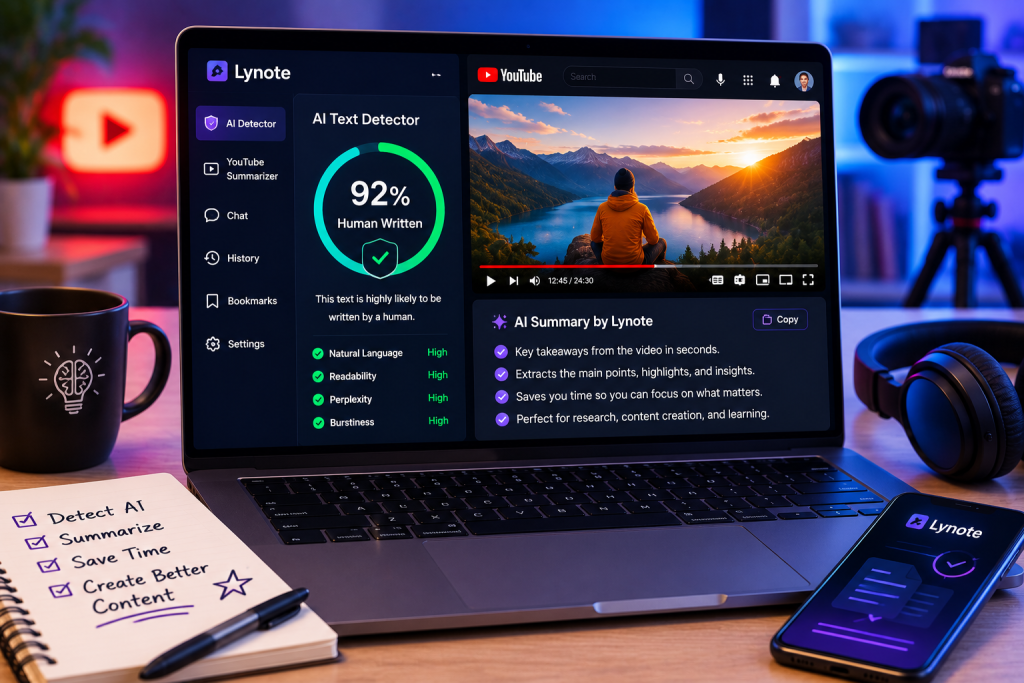
Content creators, streamers, and the broader geek and fandom communities online produce and consume an enormous amount of written and video content — reviews, lore breakdowns, fan theories, script drafts, and hours upon hours of long-form video essays. Two very modern problems keep showing up across that world: figuring out whether a piece of writing was actually written by a person, and finding a fast way to get through hours of video content without watching every minute of it.
Lynote, an AI productivity platform, has built tools for both problems, and they’ve quietly become useful additions to the workflow of creators who spend as much time researching and writing as they do filming.
Spotting AI-Written Text
AI-generated writing has a distinct fingerprint — smooth, grammatically flawless, but often flat in rhythm and predictable in structure. It’s the kind of writing that reads fine on the surface but starts to feel oddly generic the longer you look at it. That fingerprint is exactly what Lynote’s AI detector is built to catch.

Rather than returning a single confidence score, the tool analyses text sentence by sentence and highlights the specific passages most likely to be AI-generated, AI-edited, or a mix of both, along with an explanation of why — repeated patterns, unusually uniform sentence rhythm, or similarity to known outputs from models like ChatGPT, Claude, or Gemini. That level of detail matters for creators reviewing user-submitted content, fan fiction, community posts, or scripts from freelance writers, where a simple percentage doesn’t give enough to act on.
The detector supports more than 50 languages and claims a 99% accuracy rate across major AI models, and — unlike some detectors — it’s also built to catch text that’s been run through a paraphrasing or humanizing tool, which is where a lot of AI content tries to hide these days.
Making Sense of Long-Form Video
On the video side, the problem is almost the opposite: too much content, not enough time. Long-form video essays, multi-hour streams, developer commentary, and deep-dive lore videos are staples of geek culture, but they’re also genuinely time-consuming to get through if you just need the key points.
Lynote’s YouTube summarizer addresses this by combining AI-generated text summaries with key video snapshots, giving a faster, more visual way to understand what a video covers without watching it start to finish. The tool automatically generates chapters and timestamps, so instead of reading a flat summary top to bottom, users can click straight to the section they care about and jump to that exact moment in the video.
For tutorial or how-to style content, the summarizer goes a step further, extracting the key actionable points and turning them into step-by-step checklists rather than just a narrative recap. Summaries export in Markdown, which slots neatly into Notion or Obsidian for anyone building out a personal wiki or research archive, and the tool supports multiple languages for both the source video and the summary output. It’s free to use with no account required.
Why This Combination Fits the Community
Communities built around gaming, anime, comics, and tech culture generate huge volumes of both text and video content, often from a mix of professional creators and passionate fans. Being able to quickly check whether a piece of writing was AI-generated — useful for moderating community submissions or verifying freelance work — and being able to quickly digest long video content without losing hours to it are both genuinely practical needs, not just novelty features.
Worth Trying
Neither AI detection nor video summarisation is a brand-new idea, but Lynote’s combination of sentence-level detail on the detection side and visual, chapter-based summaries on the video side makes both tools more immediately useful than a lot of the free alternatives currently out there — and the fact that both are accessible without creating an account removes the usual friction of trying something new.

Caroline is doing her graduation in IT from the University of South California but keens to work as a freelance blogger. She loves to write on the latest information about IoT, technology, and business. She has innovative ideas and shares her experience with her readers.