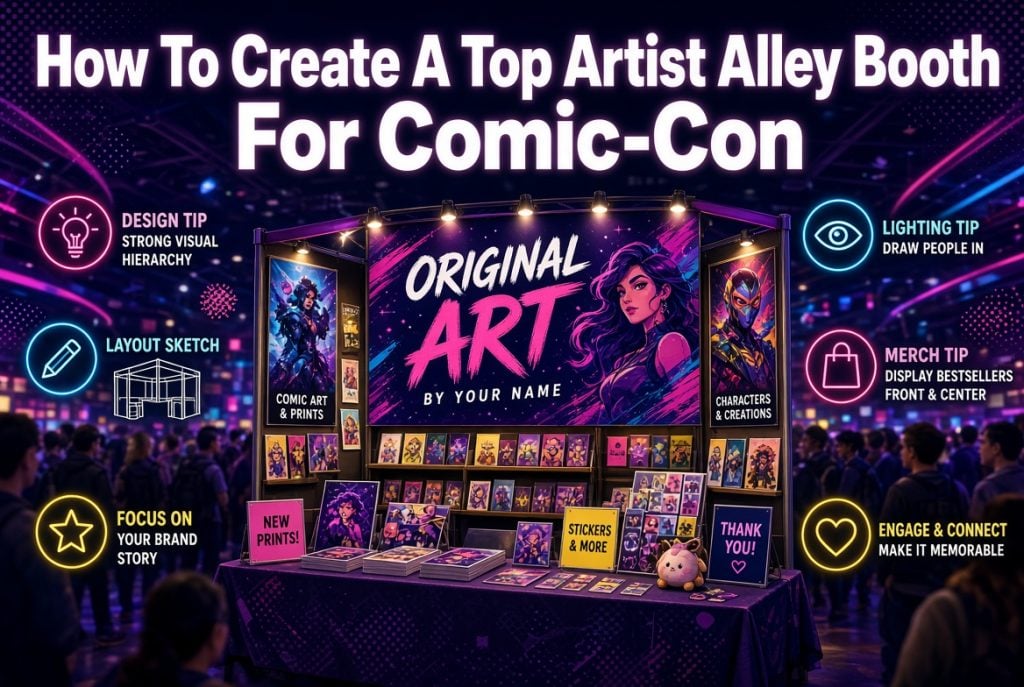
Walking into Artist Alley for the first time feels a little like showing up to a boss fight without checking a build guide first. Rows and rows of insanely talented illustrators, all fighting for the same few feet of foot traffic, and somewhere in that chaos, you’ve got maybe three seconds to convince a stranger to stop walking and actually look at your table. That’s not meant to scare you off. It’s meant to explain why the artists who do well at conventions aren’t necessarily the most talented ones in the room. They’re the ones who figured out how to present what they’ve got.
Whether this is your first con or your twentieth, here’s how to actually build a booth that pulls people in, keeps your prints intact through a packed weekend, and makes you look like you belong next to the pros, because you do.
Visual Merchandising: Give the Aisle a Reason to Look Twice
Your table is fighting for attention against dozens of others doing the exact same thing, so the goal isn’t cramming in everything you’ve ever drawn. It’s giving people one obvious thing to look at first.
Put your strongest, most eye-catching piece at eye level, dead center, where someone glancing down the row actually stops mid-stride. Everything else, prints, stickers, pins, should support that centerpiece instead of competing with it. Group work by series or fandom rather than scattering everything randomly, since a con-goer hunting for their favorite character wants to scan a section, not dig through a pile. And go vertical wherever you can, grid walls, easels, tiered risers, since horizontal table space runs out fast and height is basically free real estate.
Print Storage: Protect the Work That Pays Your Table Fee
Nothing kills the mood at a booth faster than watching a bent corner happen right in front of you. Store your bulk stock in rigid, clear-front bins organized by size, so you’re not flipping through a chaotic stack while three people wait to buy prints. Keep your display copies separate from your sellable stock entirely, that way your showpiece never gets sun-faded or handled into rough shape by curious browsers.
If you’re doing an outdoor artist market or a con with an open-air component, weather protection stops being optional. Humidity alone can wave paper stock within a single afternoon, so keeping your inventory shielded from wind and sudden rain isn’t just about looking put together, it’s about not losing product.
Handling High-Traffic Lines Without Losing Your Mind
A packed line in front of your table is the dream and the nightmare at the same time. Have a simple system before the con starts: pre-bagged prints for your top sellers so you’re not fumbling with sleeves mid-rush, a visible price sheet so people aren’t asking one by one, and a clear separation between “grab and go” merch and anything requiring a real conversation, like commissions or sketch requests.
If you can bring a friend or partner to help run the table during peak hours, do it. One person handling money while another keeps the browsing line moving is the difference between a smooth afternoon and a stressed one where half the crowd wanders off before they ever get helped.
Looking Professional Enough to Get Noticed by Publishers and Scouts
Here’s the part most first-time artists underestimate. Editors, small press scouts, and fellow creators walk Artist Alley too, and a booth that looks put-together signals something about your work before they’ve even seen your portfolio. A wrinkled, sagging tablecloth or a backdrop covered in creases reads as unfinished, even if your art is genuinely great.
A wrinkle-free fabric setup solves this instantly. Tension fabric displays stretch drum-tight over their frame, so there’s no ironing or steaming required between con days, and the backdrop looks just as crisp on day three as it did when you unpacked it. It’s a small upgrade that quietly tells everyone walking by that you take this seriously.
If you’re regularly setting up at outdoor artist markets or convention overflow spaces between big shows, having your own portable structure is worth the investment too. Independent creators building a full con circuit setup often turn to custom tents canada artists rely on for weather cover and branded shade, giving your table the same weatherproofed, professional presence whether you’re indoors under fluorescent lights or outside at a summer pop-up market.
The Real Secret: Presentation Buys You a Second Look
Great art gets you remembered. A booth that actually shows it off gets you noticed in the first place. Nail the display, protect your prints, keep your line moving, and show up looking like the professional you already are, and Artist Alley stops feeling like a chaotic gauntlet and starts feeling like exactly the kind of stage your work deserves.

Andrea Bell is a blogger by choice. She loves to discover the world around her. She likes to share her discoveries, experiences and express herself through her blogs. You can find her on Twitter:@IM_AndreaBell