This year’s crop of films at the Sundance Film Festival seems to be connecting to a moment in world (and especially United States) politics, and that feels deeply uncomfortable. Now, it is possible that this reviewer is seeing these themes because of what is all around, but after Everybody to Kenmure Street, it becomes more and more difficult not to see the parallels. There is constantly a need to reach out to community in a world that is somehow growing more divided each and every day. And given simply the title of How to Divorce During the War, how does one not see the geopolitical dangers making our petty problems seem insignificant?
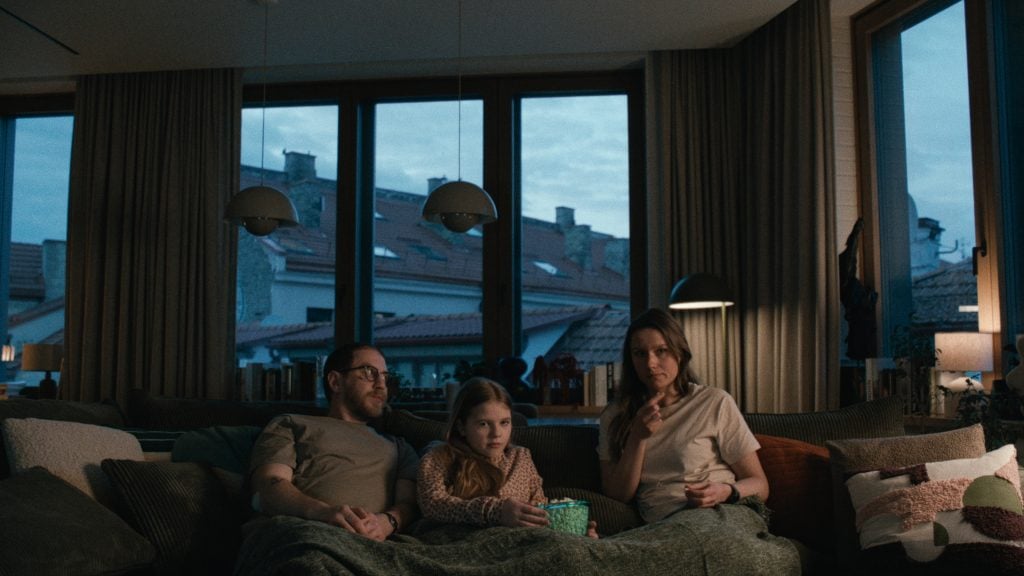
Writer/director Andrius Blaževičius sets himself up with an intensely difficult challenge. As the title suggests, even before said title shows up on screen, he must set up a marriage in trouble, as well as set the appropriate context, as Russia invades Ukraine. In the opening of the film, this is expertly created by showing both halves of the marriage, Marija (Žygimantė Elena Jakštaitė) and Vytas (Marius Repšys), as completely separate entities who only intersect when focusing on their daughter, Dovile (Amelija Adomaitytė). Vytas is a struggling documentary filmmaker, while Marija works for a company that aims to make viral videos. The dichotomy of these two, both technically in the arts, hammers home immediately. As with any divorce movie worth its salt, it is easy to put yourself in the shoes of either the starving artist or the breadwinner forced to caretake for the family.
How to Divorce During the War also works extremely hard to balance the serious tone of the plot with some well-placed dark humor. Not all of this balance works completely, but it is enough to keep the audience on board throughout the runtime. One can certainly imagine two other films that focus on one tone, but what we have in front of us is a little bit of both. The scene that really encapsulates this tonal mismatch also happens to be the best scene in the film.
As Marija and Vytas sit awkwardly in their car, waiting for Dovile to return from music practice, Marija finally gets up the courage to admit that she wants a divorce. Instead of employing camera movement to drive home the impact, Blaževičius and the cinematographer, Narvydas Naujalis, keep the frame completely static, mostly never even moving inside the vehicle. The performances by the two leads are fantastic in this painfully extended scene. The gamut of emotions is run through, and we are given a real keen insight into the way things have crumbled, despite never seeing their history. This is an impressive accomplishment, combining direction, writing, and acting all in a perfect combination. There is also a shocking moment of violence that is both disturbing and chuckle-worthy because of the reaction of the other party. This is the tonal conflict that the film will battle with for the next 90 minutes, with some degree of success.
The remainder of the film has the bad luck of living up to this incredible moment, focusing on the individual journeys of Marija and Vytas. Vytas, being basically unemployed, is forced to move back in with his parents. He must endure their consistent watching of Russian state news, inundating him with government propaganda (feel familiar yet?). In the midst of working a service job, he tries to regain his passion by becoming engaged in artful protest. Meanwhile, Marija is grappling with a new relationship (which started while she was married), mostly single parenthood, and the pressure to help Ukrainian refugees. Both of them want to do the “right thing,” but who among us has not struggled to stay the course when it gets more difficult? Sure, I want to house refugees, but look at this mess in the kitchen. Watching Jakštaitė finally lose her temper feels both upsetting and a release of a breath that we did not know we had been holding.
As the film moves towards its conclusion, the audience can feel that it won’t end in a way that is completely satisfying. But then again, how like life is this? If two people share the burden of raising a child together, will we expect them to both soar once they are apart? They still must come together, in one way or another, regardless of where they end up personally. How to Divorce During the War may not be perfectly gratifying, but sometimes even having one great scene (and several good moments) is enough to keep the film afloat and make for an easy recommendation for those who can deal with a stylistic challenge.
How to Divorce During the War had its World Premiere in the World Cinema Dramatic Competition section of the 2026 Sundance Film Festival.
Director: Andrius Blaževičius
Writer: Andrius Blaževičius
Rated: NR
Runtime: 108m
How to Divorce During the War may not be perfectly gratifying, but sometimes even having one great scene (and several good moments) is enough to keep the film afloat and make for an easy recommendation for those who can deal with a stylistic challenge.
-
7
-
User Ratings (0 Votes)
0

Dave is a lifelong film fan who really got his start in the independent film heyday of the 90’s. Since then, he has tried to branch out into arthouse, international, and avant garde film. Despite that, he still enjoys a good romcom or action movie. His goal is to always expand his horizons, through writing and watching new movies.