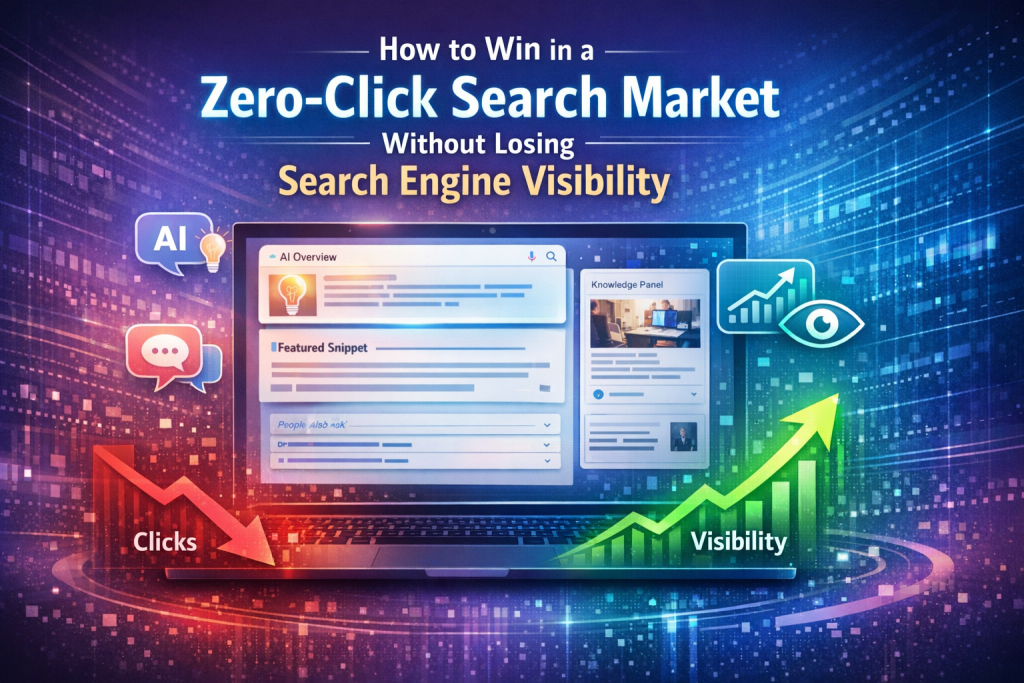
Zero-click searches are reshaping digital visibility.
They may reduce direct traffic in some cases. But they also create new opportunities for authority, brand exposure, and long-term growth.
When your brand appears in AI summaries, featured snippets, and knowledge panels, you are visible at the exact moment users are searching for answers.
This article explains how zero-click search works, why it is accelerating, and how to protect and grow your ai search visibility in an AI-first environment.
What Is a Zero-Click Search?
A zero-click search occurs when a user finds the information they need directly on the search engine results page without clicking through to a website.
Instead of visiting a page, users interact with SERP features such as:
AI-generated overviews
Featured snippets
Knowledge panels
People Also Ask boxes
Local packs
Image and video carousels
In these scenarios, the search engine delivers the answer immediately.
That does not mean your content is ignored. It often means your content is being displayed directly in the results.
How Has AI Changed User Search Behavior?
Search journeys have become shorter and more efficient.
Previously, users would:
Search → Click → Scan → Extract answer
Now, the process often looks like:
Search → Read AI summary → Leave
AI Overviews combine insights from multiple sources into structured responses. Many informational searches are satisfied without additional clicks.
This shift has created a measurable pattern across industries:
Impressions increasing
Click-through rates declining
Brand exposure expanding
The takeaway is clear. AI has reduced friction in search, but increased the importance of visibility.
For brands, this means technical precision and AI-aligned optimization are no longer optional. Companies that actively maintain top positions in search engines with AI SEO are adapting their content structure, semantic depth, and technical SEO to ensure they remain citation-worthy in AI-generated results.
Why Is Visibility More Important Than Clicks?
Clicks represent action. Visibility represents influence.
Appearing consistently in AI answers, snippets, and knowledge panels builds familiarity with your brand.
Repeated exposure leads to:
Stronger brand recall
Increased branded searches
Higher trust
Improved conversion rates
In many cases, zero-click visibility acts as the first touchpoint in the buyer journey.
Over time, users return directly to brands they recognize.
How Does Answer Engine Optimization Differ from Traditional SEO?
The rise of AI search has introduced Answer Engine Optimization, or AEO.
Below is a clear comparison:
Factor | Traditional SEO | Answer Engine Optimization |
Primary Goal | Increase website traffic | Earn citations in AI answers |
Core Metrics | Rankings, CTR, sessions | Mentions, snippet captures, AI visibility |
Content Structure | Keyword-focused long-form pages | Direct, structured answers |
Success Indicator | Organic clicks | Brand presence in SERP features |
Modern content must perform in two contexts:
As a full resource when users visit your site
As extractable source material for AI engines
This dual function requires stronger formatting and clarity.
How to Build a Zero-Click Strategy
Step 1: Identify Your Zero-Click Keywords
Not all queries behave the same.
Focus on keywords that trigger enhanced SERP features such as:
AI Overviews
Featured snippets
Knowledge panels
People Also Ask boxes
These represent queries where search engines aim to resolve intent instantly.
When evaluating keywords, assess:
Signal | Strategic Meaning |
High impressions, low CTR | Likely zero-click influence |
Competitor snippet ownership | Citation gap |
AI Overview presence | Structured answer opportunity |
These signals reveal where visibility can be gained.
Step 2: Optimize Existing Content with Structured Formatting
AI engines prioritize clarity.
To increase citation probability:
Answer the core question within 40 to 60 words
Use clear H2 and H3 headings
Structure explanations with bullet points
Eliminate unnecessary introductory fluff
Use short, logically segmented paragraphs
Think of your content as modular knowledge blocks.
If AI cannot easily extract it, it will not prioritize it.
Step 3: Use Schema Markup to Improve Interpretability
Structured data reinforces machine readability.
Three schema types are particularly effective:
FAQPage Schema
Improves eligibility for question-based SERP features.
HowTo Schema
Supports step-by-step visibility in AI summaries.
LocalBusiness Schema
Enhances local pack and knowledge panel appearance.
Here is a strategic comparison:
Schema Type | Purpose | Visibility Benefit |
FAQPage | Q and A content | Supports PAA and AI answers |
HowTo | Procedural guidance | Enables structured step lists |
LocalBusiness | Local presence | Improves knowledge panel data |
Schema does not guarantee ranking.
But it improves interpretability and extraction probability.
Step 4: Expand Topical Authority
AI systems favor depth over isolated articles.
To strengthen authority:
Build interconnected content clusters
Cover foundational and advanced queries
Update statistics and examples regularly
Internally link contextually
From a theoretical standpoint, this aligns with topical graph reinforcement. The more comprehensive your coverage, the stronger your semantic footprint.
Authority increases citation likelihood.
When Should You Target Zero-Click Keywords?
Not every zero-click keyword deserves investment.
Target them when they align with business value.
Ideal Opportunities | Why They Matter |
High-intent queries | Influence purchasing decisions |
Industry definitions | Build thought leadership |
Comparison queries | Support evaluation stage buyers |
Weak SERP features | Easier to capture |
Examples include:
Best CRM software for startups
Email marketing tools comparison
How to choose an SEO platform
These queries create both awareness and authority.
When Should You Avoid Zero-Click Queries?
Avoid keywords that offer minimal strategic return.
Avoid If | Reason |
Purely factual query | No commercial relevance |
Dominated by major publishers | Low probability of replacement |
No differentiation possible | Limited brand value |
Outside your expertise | Weak authority signals |
Zero-click visibility must align with meaningful outcomes.
Which Metrics Matter Most in a Zero-Click Search World?
Traditional SEO metrics tell only part of the story.
Expand your tracking to include:
Metric | Why It Matters |
AI citation frequency | Measures presence in AI responses |
SERP feature share | Tracks snippet and PAA ownership |
Branded search growth | Indicates rising brand recognition |
Impression share | Reflects overall visibility |
Cross-platform mentions | Ensures presence beyond Google |
Visibility across multiple platforms strengthens resilience against algorithm changes.
Which Metrics Should You Track for Zero-Click Searches?
Traditional SEO metrics like traffic and CTR only tell part of the story. In a zero-click environment, visibility, sentiment, and citation frequency provide a more accurate picture of performance.
When answers are delivered directly on the SERP or inside AI systems, success is no longer measured only by visits. It is measured by presence.
Here are the key metrics that matter in a zero-click search landscape.
1. AI Visibility Score
This measures how frequently your brand appears in AI-generated responses.
It includes visibility across:
Google AI Overviews
Perplexity
Claude
Other AI-driven answer engines
The more consistently your brand is referenced, the stronger your perceived authority becomes.
This metric reflects citation strength, not just ranking position.
2. SERP Feature Share
SERP Feature Share tracks the percentage of enhanced results you control for your target keywords.
This includes:
Featured snippets
People Also Ask placements
Knowledge panels
AI Overview inclusions
Owning these features increases exposure even if users do not click.
Think of this as your real estate share on the results page.
3. Brand Mention Sentiment
Frequency alone is not enough.
You must also evaluate the tone and context of your mentions.
Key questions to ask:
Is your brand cited positively?
Is it referenced as an authority?
Is it compared favorably to competitors?
Positive sentiment in authoritative contexts carries more weight than high-volume neutral mentions.
This metric reflects trust positioning.
4. Question Coverage Rate
Question Coverage Rate measures how many audience questions your content addresses within SERP features and AI responses.
Higher coverage indicates:
Broader topical authority
Stronger semantic depth
Greater likelihood of AI citation
If competitors answer more related questions than you, they will likely dominate visibility.
This metric reflects topical completeness.
5. Multi-Platform Visibility
Search no longer happens only on Google.
Users increasingly rely on:
Traditional search engines
AI-powered answer platforms
Conversational assistants
Tracking visibility across platforms ensures you are not optimizing for a single ecosystem.
This metric reflects cross-environment authority.
FAQs – Winning in a Zero-Click Search Market
Why is my website traffic dropping even though my rankings are still high?
Because rankings no longer guarantee clicks. AI Overviews, featured snippets, and other SERP features often answer the query directly on the results page. Users may see your content, but they do not need to visit your site to get the information.
How do I measure visibility if I cannot rely on clicks?
Shift your focus to visibility-based metrics such as AI citation frequency, SERP feature ownership, brand mention sentiment, impression share, and branded search growth. These indicators reveal how often your brand appears and influences users, even without direct visits.
What is an AI Visibility Index?
An AI Visibility Index measures how frequently your brand appears in AI-generated answers across platforms like Google AI Overviews, ChatGPT, and Perplexity. It reflects citation strength and authority rather than traditional ranking position.
How can micro-brands compete in a zero-click world?
Micro-brands can compete by focusing on niche expertise, creating highly structured answer-focused content, and targeting long-tail queries where larger publishers lack depth. Precision and clarity often outperform scale in AI-driven search environments.
Conclusion
Zero-click search is reshaping SEO.
Success now requires shifting from a traffic-focused mindset to a visibility-first strategy. The brands that win will be those that deliver clear, structured answers that AI systems can extract, cite, and surface consistently.
Your content must work in two ways:
As a resource for users who click
As a trusted source for AI-generated summaries
Both drive business impact.
The key is optimizing and measuring for both visibility and traffic.
Audit your SERP features, track your AI citations, and identify where competitors are gaining exposure.
In the future of search, being cited is just as powerful as being clicked.