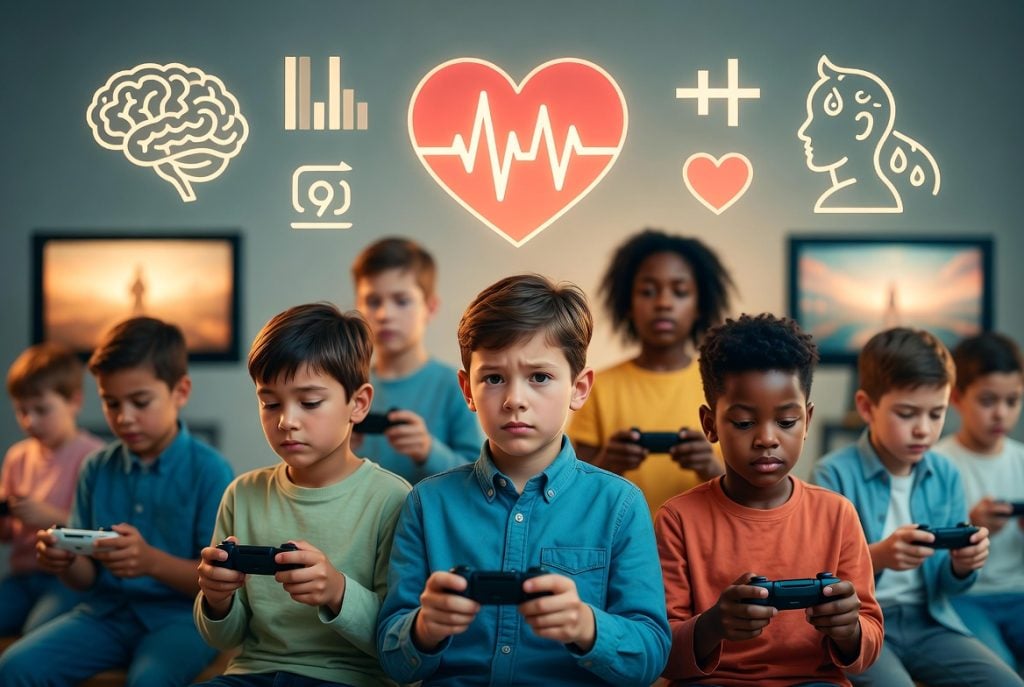
Video games both increase and reduce a child’s anxiety and emotional control. If we look closely at how this happens, the most important factor is not whether children are playing or not but how they are playing. With regular and controlled exposure, children will find ways to overcome problems, learn to relax, and interact with like-minded people through games. When playing too much or when the games are inappropriate to the children’s age, it may lead the child to feel more anxious, sleepless, and even less able to be frustrated or deal with negative emotions in general. Video games, like any other activities, are not per se positive or negative, which is why parents have to take a really important role in understanding and guiding the children’s play at their level with their games.
This makes the role of video gaming as a potential trigger of anxiety or emotional problems somewhat ambiguous to parents because the research results truly support either side, according to what aspects are analyzed. There are several factors that determine whether video games are beneficial or not to a child. The type and the quantity of the games children play, as well as their availability to have a chat about what they play may help prevent the child’s isolation. To sum up, children need to find their right balance, which parents should assist in monitoring to avoid gaming-related problems.
When Gaming Actually Helps Kids Cope
Games can be a legitimate means of relaxation for many children. When they have a difficult day at school, getting into a game that they are familiar with can really reduce their stress, just as an adult would decompress by watching a TV show, talking to his friend, or going for a walk. The element of control is crucial because the child, who often feels that there is nothing they can do about what is happening to them, will be able to make decisions, have problems solved, and see themselves succeeding in a setting that reacts in a predictable way to their efforts. That kind of predictability is mostly soothing for a child with anxiety. Besides that, there’s also an aspect of developing real-life skills and that is something that is not very well known to many. By playing with puzzles and strategizing, one not only plans but also develops patience gets sharpened and frustration gets managed. This is so because most of the time, success is achieved through making mistakes again and again as well as the will to keep trying. Playing together in groups gives a kid a great opportunity for communication, setting up common goals, and learning how to resolve minor problems that come with working together. Some specific forms of playing have been found as a means for getting help with problem-solving and processing speed, for instance. Because of this, the stereotype that games are only a way for passively relaxing or getting addicted, in reality, hides much of what actually is happening.
When Gaming Makes Anxiety and Dysregulation Worse
The problems mostly stem from quantity and when they are played not what is in the game itself. When playing time dominates sleep exercise homework, and face-to-face time, the reduction of those areas will make you anxious regardless of what is being played. Late-night gaming, in particular, is problematic because not only the stimulation but also the blue light that comes with gaming disrupt sleep and poor sleep is one of the primary drivers of child anxiety and irritability. If the child is tired and has not slept enough, they will probably overreact to the slightest things.
Game content and style as well as the level of intensity and the design have a role. Fast-paced, high-stakes, or violent games keep the nervous system in a state of constant stimulation, A part of the game can cause the child to become overexcited, and some of them may feel excited for a long time when they put the controller down. Online competitive games are a challenge as, when you lose, your teammates criticize you or face toxic behavior from strangers, it can be a great source of stress and shame. A lot of parents see the explosion after the game and the way the player expresses their feelings if they think they have been treated unfairly in the game by their opponents.
What the Warning Signs Actually Look Like
Obviously red flags don’t only show up while playing games but also during or after playing. When a kid is told to stop for example, extreme overreactions meltdowns aggression, or really severe emotional pain indicate that they’ve gotten so used to gaming to handle their emotions that they almost rely on it anymore. If the child stops caring much about activities that gave him or her pleasure before, his or her academic performance slides, they start to avoid socializing in the real world or with offline friends, and they keep deceiving others by lying about their playing habits, the mental health of the youngster would be seen by professionals as a matter of worry. One sudden withdrawal from a game doesn’t mean you have a problem; but a repeated series of such things is evidence.
Besides looking out for game addiction signs, you also should keep checking whether game use is just a manifestation (i.e. a way of escape) without necessarily being the issue itself. When a child starts to use games much more than their previous level, he or she may be avoiding some negative life circumstances which could be things like being bullied, stress from school, tensions in the family or anxiety growing slowly at a background which the child himself cannot yet express. That means, in this category, the use of the screen is the visible thing but underneath lies the true problem. Without addressing the underlying aspect, if you just cut gaming, you should see your actions have a negative effect. Because of this, if anxiety, irritability, or withdrawal do not diminish even though the youngster is still doing okay with a limited amount of gaming, it should be a warning that you are going into a deeper issue.
When the pattern is entrenched and home adjustments aren’t shifting it, professional support helps sort cause from symptom. A therapist who specializes in child therapy can assess whether the gaming is driving a child’s anxiety or masking it, and give both the child and the parents concrete tools for emotional regulation that don’t depend on a screen. The distinction between a kid who games a lot and a kid whose gaming signals real distress isn’t always obvious from the outside, and getting that read right early saves a lot of conflict later.
Practical Steps Parents Can Take
It is far more important to create flexibility and freedom when a child needs it the most than to restrict their time through strict limitation and control. When both agree in advance on when and for how long to play games and when that time will not interfere with going to bed, as well as not affect sleeping time, mealtimes and physical activities as being the things which are absolutely not negotiable and should not be compromised, most of the day-to-day conflicts get erased. Most pediatricians would generally advise that, besides the time limits, the main thing is to ensure that the child is able to disconnect from a screen before bed, which is the core of the AAP’s family media guidance. They explain that the amount of time a screen should be on for is really child- and age-dependent, which makes the exact number of hours to screen time really not so important. Watch not only how much, but also what kind of games a child is getting their kicks out of. If a child who loses control easily is given the right to decide and make choices, they tend to stick with the ones at their level, so the parents’ role is a choice between providing cooperative or creative games which do not force a child to keep running to the next achievement, and the more competitive games. The parents’ knowledge of the kind of content that their kids are exposed to through gaming also affects them emotionally.