In the modern tattoo landscape, there is a profound resurgence of interest in “cultural weight.” Today’s enthusiasts are no longer satisfied with generic designs; they are looking backward to move forward. From the intricate swirls of Celtic Uncial to the sharp, authoritative lines of Medieval Blackletter, ancient manuscripts offer a treasure trove of inspiration for those seeking ink with deep historical roots. However, a significant challenge remains: ancient calligraphy was designed for parchment and quills, not for human skin and oscillating needles. Many historical scripts are too complex or poorly proportioned for the practicalities of modern tattooing.
As a senior SEO and digital analyst, I approach design through the lens of “usability and longevity.” Just as we optimize website architecture for the future, a tattoo must be optimized for the skin. To bridge the gap between archaeology and modern aesthetics, the use of an AI-driven tattoo font generator has become the essential bridge. This technology allows us to extract the soul of ancient scribal arts while refining them for the clarity and precision required by contemporary standards.
The Aesthetic Conflict: Why Ancient Scripts Need Modernization
Ancient manuscripts are masterpieces of human dedication. Monks and scribes spent lifetimes perfecting the “Insular” scripts of the British Isles or the “Carolingian” minuscule of the Frankish Empire. However, these scripts often feature overlapping lines, inconsistent spacing, and excessive decorative “serifs” that pose a massive risk in tattooing. When ink is placed in the dermis, it naturally migrates over time. If a tattoo remains too faithful to a dense, 10th-century manuscript, it will likely merge into an unreadable dark patch within a decade.
This is why a specialized tattoo font generator is so valuable for history lovers. It performs a digital “cleanup” of these ancient letterforms. By utilizing AI, these generators can maintain the “flavor” of the history—the specific slant, the Gothic weight, the Celtic curves—while ensuring the lines are clean and the negative space is preserved. Modernization doesn’t mean stripping away the character; it means ensuring the character survives the biological reality of the human body.
From Parchment to Skin: Strategic Design with a Tattoo Font Generator
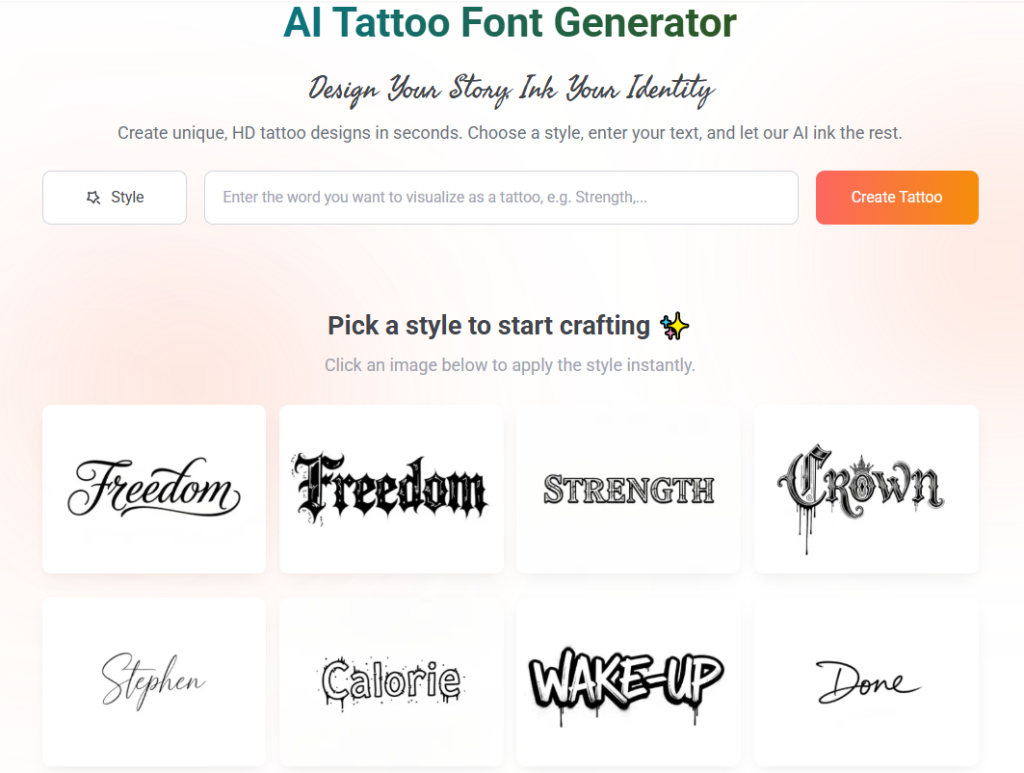
When we look at the tattoo font generator on Refont, we aren’t just looking at a list of fonts; we are looking at a digital laboratory for “Ink Archaeology.” To successfully modernize an ancient manuscript style, one must follow a specific structural logic.
1. Decoding the Gothic Spirit
The Blackletter or “Gothic” script is perhaps the most requested historical style. However, original manuscripts like the Gutenberg Bible feature letters that are very close together to save expensive parchment. In a tattoo context, this is a disaster. Using a professional generator allows you to take that Gothic authoritative weight and “air it out.” By increasing the tracking and kerning, you keep the intimidating power of the medieval script but ensure it is legible from more than a few inches away.
2. Simplifying the Uncial and Celtic Curves
Celtic scripts are famous for their rounded, almost liquid-looking forms. While beautiful, the original manuscripts often feature “knotted” letters that are too intricate for small-scale tattoos. A high-quality tattoo font generator can extract the essential “Uncial” curve—that feeling of ancient mystery—and render it with single-needle precision. This allows for a tattoo that feels like an artifact but looks like a piece of high-end modern art.
3. Maintaining Structural Integrity
Ancient scribes often varied their stroke weight based on the angle of their quill. In tattooing, inconsistent stroke weight can lead to uneven healing. Digital generators help “standardize” these historical scripts. They ensure that the “skeleton” of the letter is balanced, which provides a more trustworthy blueprint for your tattoo artist to follow.
Applying EEAT Principles to Historical Tattooing
- Expertise: A specialized generator reflects the expertise of typographers who understand both historical calligraphy and the physics of tattooing. It prevents you from choosing a “technically impossible” font.
- Experience: The digital preview gives you the experience of the tattoo before it’s permanent. You can see how a 12th-century script interacts with 21st-century fashion.
- Authoritativeness: Using a tool like Refont ensures your design is typographically authoritative. It isn’t just a “fake” version of history; it is a professionally rendered modernization.
- Trustworthiness: Trust comes from transparency. By seeing exactly how the letters intersect and breathe, you can trust that the final result on your skin will match your vision.
The “Archaeology” Workflow: How to Use Refont for History
To get the best result when modernizing ancient text, I recommend a “Layered Approach.”
First, identify the era that resonates with your narrative. Is it the sharp, vertical discipline of the 14th century? Or the flowing, interconnected romance of the Renaissance? Once you have the era, use the tattoo font generator to input your chosen text.
The next step is “Technical Refinement.” Look at the “ascenders” and “descenders” (the parts of letters that go up and down). In ancient manuscripts, these were often very long and flourished. For a tattoo, you might want to use the generator to find a version that is slightly more “contained.” This prevents the text from taking up too much vertical space on your limb and ensures the design follows the natural “flow” of your muscles.
Finally, consider the “Ink Saturation.” Ancient ink on parchment was often brownish or faded. For a modern tattoo, you want high-contrast black. The generator allows you to see the design in high-definition black, providing a clear “stencil” for your artist. This clarity is essential because even the most skilled artist can struggle with a blurry or poorly defined historical reference image.
Conclusion: Honoring the Past, Designing for the Future
Modernizing ancient manuscripts is not about changing history; it is about honoring it in a way that respects the medium of the human body. By using a tattoo font generator, you are acting as an “Ink Archaeologist.” You are digging through the beauty of the past and using the technology of the present to ensure those ancient stories continue to be told.
Whether you are inspired by the religious intensity of Old English or the flowing elegance of Italian Humanist scripts, the goal is the same: a tattoo that carries the weight of centuries but possesses the clarity of modern design. Your skin is the latest page in an ancient book. Make sure the typography is worthy of the story you are telling.
Take your time with the digital canvas. Play with the historical weights, adjust the ancient spacing, and build a design that is both a tribute to our ancestors and a masterpiece for your own future.

Caroline is doing her graduation in IT from the University of South California but keens to work as a freelance blogger. She loves to write on the latest information about IoT, technology, and business. She has innovative ideas and shares her experience with her readers.