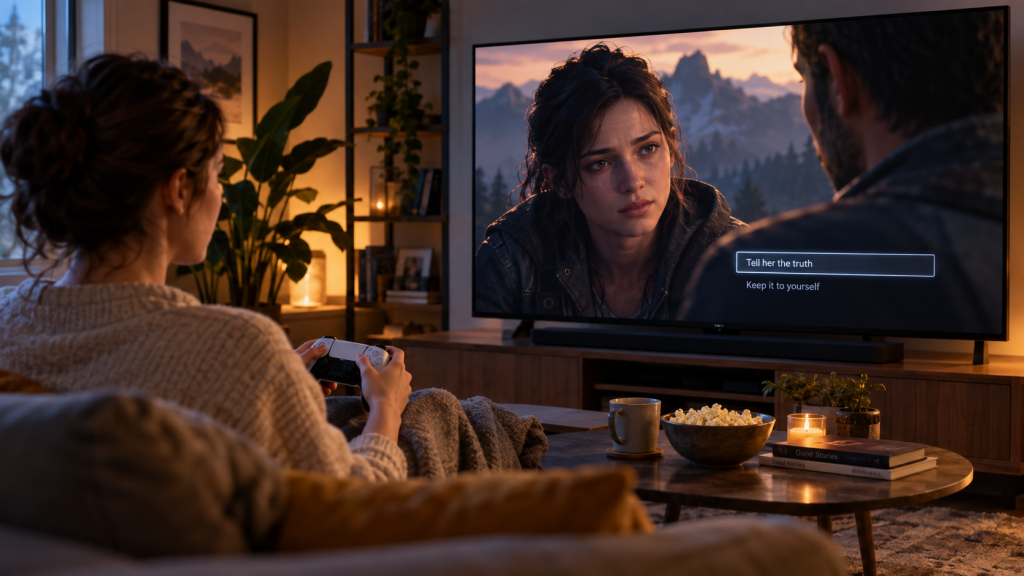
Some people hear “game” and picture a controller with twelve buttons, a teenager shouting through a headset. Fair enough. That image has been loud for years. Interactive stories work differently. They look closer to a film night, a podcast drama, or a paperback thriller on the sofa, except the viewer gets asked what happens next. The pace is slower. A person can sip tea, read a subtitle, and still keep up. There is room for hesitation, which is where many non-players start to relax. No score flashes. Nobody yells through the speakers. Someone researching online casino cz might find https://4vize.cz/ while checking operators with an international license, yet the same person could enjoy a quiet story app because choices feel like opinions, not tests. No fast thumbs required.
The remote-control version of choice
Interactive stories borrow habits people already know. A viewer pauses Netflix to ask, “Would she really open that door?” In this format, the screen answers, “Fine. Decide.” Another reader may play in mezinárodní online casino with top payouts, but story choices use softer stakes: trust the stranger, hide the letter, tell the truth at dinner. One sentence later, a whole scene tilts.
That small tilt matters.
There is no need to memorize combo moves. The player reads a line, watches a face change, and clicks. In “Black Mirror: Bandersnatch,” a choice as silly as breakfast cereal becomes a signal that control is unstable. In “Detroit: Become Human,” silence during a police interview says as much as a speech. The play sits inside attention.
Why non-players stay with the plot
People who say they dislike games dislike the chores around games. Menus. Gear. Long tutorials before anything human happens. Interactive fiction trims that fat. It puts a person in a scene quickly, then trusts curiosity to do the rest.
A good branch feels personal, even when it was written in Twine, Ink, or a studio script tool. The player wonders if Maya should forgive her brother, not whether a stat sheet is high enough. That emotional math is familiar. Families do it at kitchen tables. Friends do it after missed calls.
The best titles leave fingerprints. “Life Is Strange” made rewinding time feel less like a superpower and more like panic. “80 Days” turned a map into gossip, weather, debt, and bad luck. It is choosing under pressure.
The screen becomes a conversation
Watching is usually one-way traffic. A film moves, and the ending arrives on schedule. Interactive stories break that rhythm. They add friction in tiny doses.
Click.
That click changes how a scene is remembered. If a detective lies to a witness and the witness cries, the player owns a piece of that damage. If a teenager leaves a party early and misses the accident, relief mixes with doubt. The story stops being received and starts being carried.
This is why short formats work so well. A phone story with five-minute chapters fits a bus ride. “Florence” uses puzzles so simple they feel like breathing, then changes those puzzles when the relationship cools. No leaderboard appears. No boss fight arrives. The drama is in the hands.
Choices do not need to be clever
A common fear sits under the phrase “I’m not a gamer.” It means, “I will be bad at this.” Interactive stories answer with low shame. Most have no fail state. A messy choice still produces a scene.
Bad calls are content.
Writers design for regret, curiosity, and second guesses. In “The Walking Dead,” picking who gets food is uncomfortable because supplies are scarce and every face is watching. The interface is plain. The pressure is social. That difference matters for people who freeze around skill checks but understand an awkward room.
The genre also respects spectators. Couples play aloud and argue over replies. A parent can let a child choose the brave option, then talk about what bravery costs. Some players replay every branch. Others refuse, because their first version feels true. Both habits fit.
Where to start without buying a console
An easy first step is a short mobile title, not a sixty-hour epic. “Florence” takes about forty minutes. For text-first readers, “The Uncle Who Works for Nintendo” runs in a browser and starts like a sleepover story gone sour.
Simple tools help too. A laptop trackpad is enough. Subtitles should stay on, because choice timers punish missed lines.
The right question is not, “Does this count as a game?” A better one is, “Does this story want a witness or an accomplice?” For people who prefer watching, that small shift is the hook. Pick one story under an hour tonight, choose without googling, and see which scene lingers tomorrow. No walkthrough is needed.