

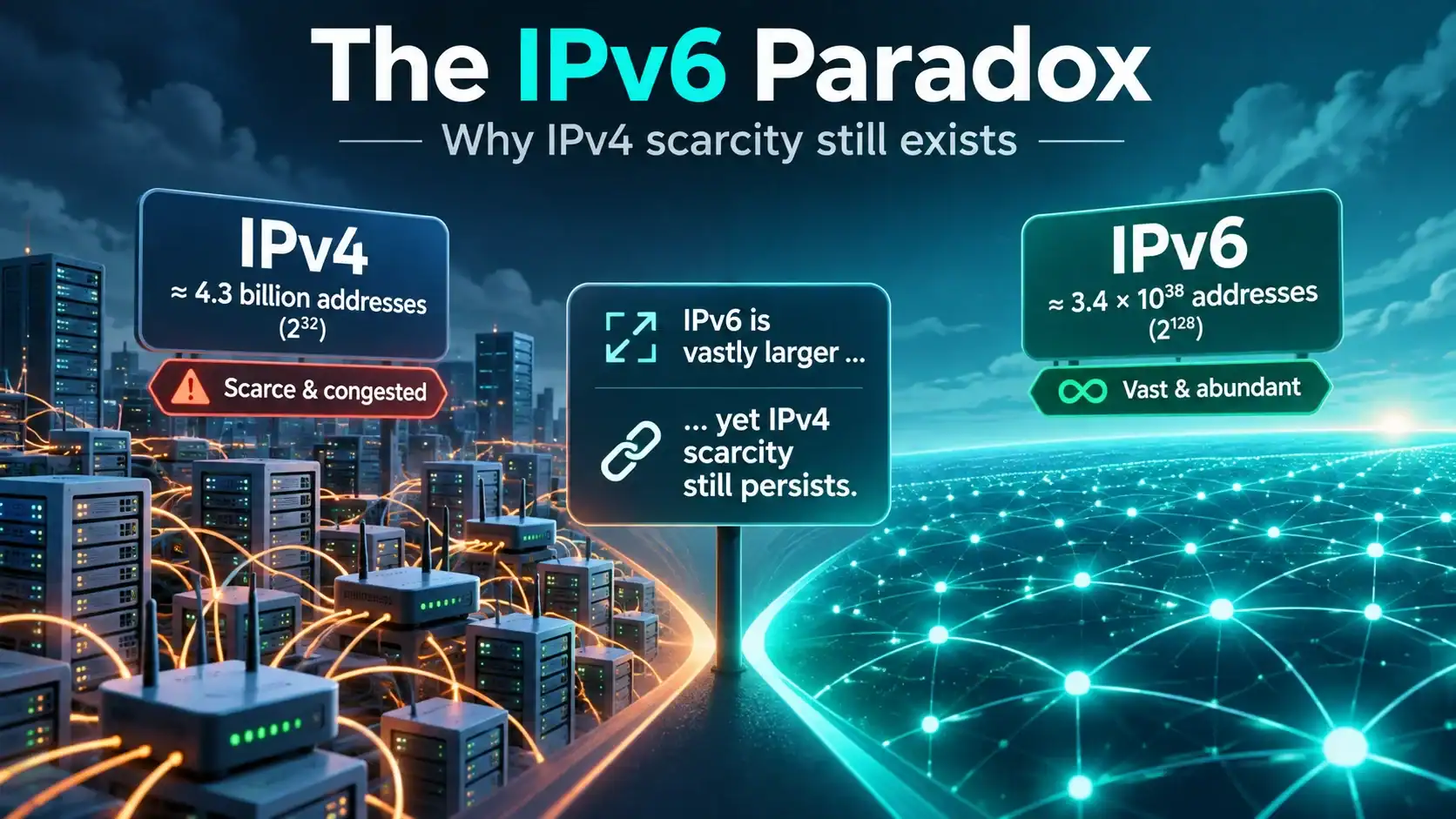
The internet has a numbers problem that seems, at first glance, to have already been solved.
IPv4, the addressing protocol that helped build the modern internet, provides approximately 4.3 billion possible addresses. IPv6, its successor, offers an almost unimaginably larger number: approximately 3.4 × 10³⁸ possible addresses.
With that much additional capacity, it might seem reasonable to assume that internet address scarcity should be a thing of the past.
Yet businesses still buy, sell and lease IPv4 addresses. Internet service providers continue to manage limited IPv4 capacity, while cloud platforms and hosting companies maintain systems designed for both protocols.
So why does scarcity remain relevant when a much larger addressing system already exists?
The answer reveals how technology, compatibility, infrastructure investment and economic incentives interact.
IPv4 Was Designed for a Different Internet
IPv4 uses a 32-bit addressing system.
When it was developed, the internet was vastly smaller than today’s global network of personal devices, enterprise systems, data centres, applications and connected services.
Although the theoretical address space contains more than four billion combinations, some ranges are reserved for private networking, documentation and other special purposes.
The rapid expansion of internet connectivity eventually placed enormous pressure on the available supply of public IPv4 addresses.
Regional Internet Registries progressively reached exhaustion stages within their ordinary free-pool allocation systems.
As new networks continued to require IPv4 connectivity, a secondary market developed around the transfer and leasing of existing resources.
IPv4 scarcity, therefore, is not simply a mathematical observation. It has become an operational and economic consideration for organisations maintaining internet infrastructure.
IPv6 Offers a Much Larger Address Space
IPv6 was developed to address limitations in the original IPv4 architecture, particularly its restricted address space.
Using 128-bit addresses, IPv6 provides enough combinations to support an extraordinary number of network identifiers.
The protocol also introduces differences in addressing and network configuration.
However, a larger address space does not automatically make the existing IPv4 internet disappear.
An IPv6-only endpoint cannot communicate directly with an IPv4-only endpoint without an appropriate translation or intermediary mechanism.
This compatibility issue is one of the reasons why internet operators continue to maintain both protocols.
Dual-stack environments, in which IPv4 and IPv6 operate alongside one another, remain a practical approach for many organisations.
Why IPv4 Demand Continues
Internet infrastructure is built through layers of hardware, software, configuration and commercial relationships.
A business may depend on applications designed for IPv4 connectivity.
A customer may use an internet connection or device that does not have fully functional IPv6 access.
An enterprise may operate security systems that rely on established IPv4 allowlists.
A hosting company may need IPv4 compatibility to serve customers across different networks.
These dependencies cannot always be eliminated through a simple software update.
They may require operational changes, customer coordination, network redesign or additional investment.
Consequently, the decision to deploy IPv6 does not automatically remove every reason to maintain IPv4 resources.
IPv4 and IPv6 adoption are interconnected, but they are not identical questions.
The Economic Reality Behind Address Scarcity
As IPv4 resources became harder to obtain through ordinary allocation channels, existing address holdings acquired greater commercial significance.
Organisations with available capacity could transfer or lease resources under applicable policies and contractual arrangements.
At the same time, businesses needing additional public connectivity faced decisions about purchasing, leasing, address sharing or accelerating IPv6 adoption.
This created a market shaped by technical compatibility and constrained supply.
Understanding these developments requires attention to both infrastructure and economics.
Publications such as BTW Media examine the relationship between internet governance, network operations, market structures and the institutions supporting global connectivity.
This broader perspective helps explain why a technically available replacement protocol does not automatically eliminate the commercial importance of an established one.
The relevant question is not whether IPv6 has more addresses.
It is why operators continue to need IPv4 compatibility, how those requirements change over time and what costs arise during the transition.
Does IPv6 Really Solve Scarcity?
The debate becomes more complicated when scarcity is considered beyond the total number of available addresses.
Lu Heng explores this issue in his essay examining the debate over IPv4 scarcity.
Heng challenges the assumption that expanding the address space necessarily resolves the economic and institutional issues associated with internet number resources.
His argument distinguishes numerical abundance from the wider systems that determine how resources are coordinated, accessed and used.
This is a governance perspective rather than a rejection of IPv6’s technical advantages.
IPv6 substantially reduces the risk of exhausting its global address space under foreseeable deployment models.
However, deploying a larger addressing architecture does not remove questions involving administrative authority, network continuity, institutional accountability or the cost of changing infrastructure.
These questions can remain important regardless of protocol version.
Why Compatibility Matters More Than Headlines
Technology transitions are rarely instantaneous.
The introduction of a new standard does not automatically make existing systems obsolete.
Businesses must consider the practical cost of migration, including hardware compatibility, software requirements, security controls and customer access.
For example, an organisation moving a public-facing application to IPv6 must still consider whether all intended users and partners can reach it.
If some customers depend on IPv4-only connectivity, additional arrangements may be necessary.
This is why the success of IPv6 cannot be measured solely through the availability of addresses.
It must also be assessed through adoption, reachability, performance and operational compatibility.
What the Future Looks Like
IPv6 will continue to play an essential role in supporting internet growth.
Its expansive address space provides a long-term foundation for new networks, services and connected technologies.
Meanwhile, IPv4 management remains relevant for organisations whose infrastructure must support existing compatibility requirements.
Over time, adoption patterns and technical improvements may reduce some forms of IPv4 dependence.
Nevertheless, the transition demonstrates an important lesson about technological change.
Infrastructure is not replaced simply because a technically superior alternative exists.
It changes when the surrounding systems, users, networks and economic incentives can support that alternative.
IPv6 addresses the numerical limitations of IPv4. The broader challenge is ensuring that the internet’s technical evolution also supports interoperability, operational continuity and responsible resource coordination.

Caroline is doing her graduation in IT from the University of South California but keens to work as a freelance blogger. She loves to write on the latest information about IoT, technology, and business. She has innovative ideas and shares her experience with her readers.