

Before Iron Lung even becomes a film worth discussing on its own terms, it exists as a genuine curiosity. Markiplier is not just another internet personality dabbling in filmmaking; he’s one of YouTube’s true OGs, with a career stretching back over a decade and an audience of roughly 38 million subscribers. For years, his brand has been built on humor and fun. That context matters because Iron Lung represents a sharp, almost confrontational pivot away from that image. This is not a crowd-pleasing extension of his online persona, nor does it feel engineered to satisfy the masses. Instead, Markiplier wrote, directed, self-funded, starred in, and even distributed the film himself, placing full creative and financial responsibility squarely on his shoulders. While this is technically his feature directorial debut, it’s not coming from inexperience; his past work on ambitious interactive projects like A Heist with Markiplier, In Space with Markiplier, and A Date with Markiplier already hinted at a creator interested in structure and pushing form beyond passive viewing.
What makes Iron Lung especially fascinating, though, is not just its existence but its reception. Released with virtually no traditional marketing and initially slated for a limited theatrical run of fewer than 60 theaters, the film has quickly become something of a unicorn. Strong word of mouth propelled it into over 4,000 theaters, where it grossed an astonishing $28.4 million on a $3 million budget in under a week. That kind of success is rare for any independent release, let alone one this bleak, this patient, and this aggressively uninterested in comfort. It’s even rarer coming from a creator whose public-facing work is typically light, welcoming, and playful. That contrast is crucial going in, because Iron Lung is anything but familiar or reassuring. It’s a film that actively resists accessibility, and the fact that it has found such a wide audience anyway says as much about Markiplier’s reach as it does about the strange, unsettling pull of the film itself.
Iron Lung is a film that tests patience. It’s slow and frequently opaque, unfolding less like a traditional horror movie and more like a sustained act of psychological endurance. Markiplier’s (Mark Fischbach’s) feature debut is uninterested in comfort or clarity, favoring instead a suffocating sense of isolation and decay that never fully lets up. This will inevitably frustrate some viewers, especially those expecting a more conventional genre ride. But that friction feels deliberate. Iron Lung isn’t trying to entertain in the familiar sense, but it’s trying to trap you inside a headspace and refuse to let you out. The result is a bleak, carefully controlled experience that feels singular in both intent and execution, one that promises a filmmaker with a clear voice and little interest in compromise.
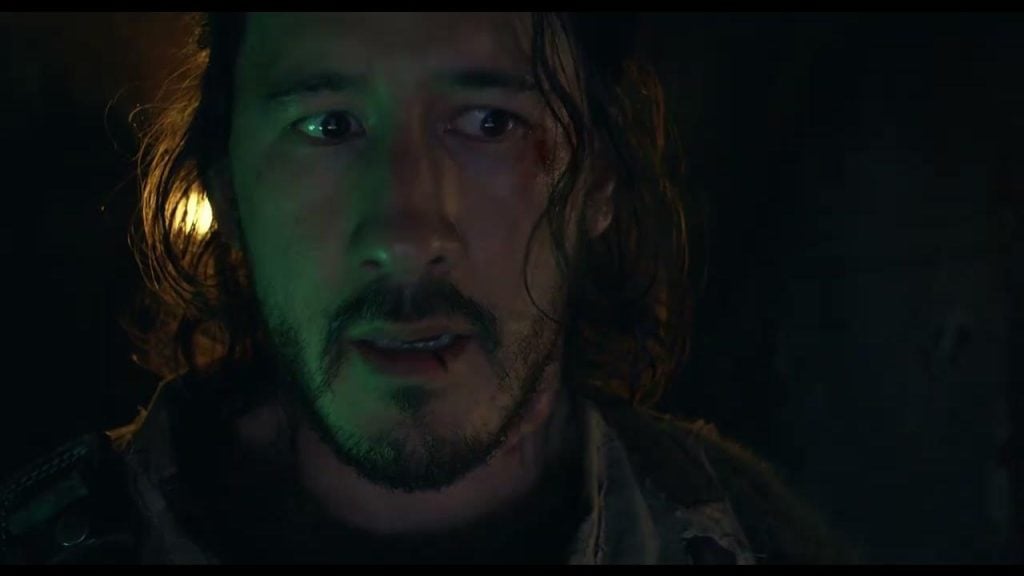
Based on the video game of the same name by David Szymanski, Iron Lung is set in a distant future after a catastrophic event known as the Quiet Rapture. The film imagines a universe where stars and planets have inexplicably vanished, leaving only scattered remnants of humanity clinging to survival aboard decaying space stations. In the midst of this collapse, a lone convict named Simon (Mark Fischbach) is offered a grim bargain: pilot a crude, welded-shut submarine into an uncharted ocean of blood discovered on a dead moon, and earn his freedom…assuming he survives the descent. With limited visibility, unreliable communication, and no real understanding of what awaits beneath the surface, Simon’s mission becomes a test of endurance. As the journey continues, uncertainty mounts, reality begins to blur, and the film settles into a state of mounting dread, putting the viewer straight in a psychological toll of existing in a universe that has already begun to rot.
One of the most common reactions Iron Lung is likely to provoke is frustration with its pacing, and that response is understandable. The film moves slowly, often lingering in moments where very little seems to be happening. Tasks repeat. Silence stretches. Information is withheld. But that all feels very purposeful. Markiplier leans into the tedium of isolation, treating it as a core component of the horror rather than a flaw to be smoothed over. Sitting alone inside a sealed metal coffin at the bottom of an alien ocean is not meant to be exciting or thrilling, and the film refuses to manufacture excitement where it wouldn’t belong. Instead, it lets time drag, letting unease accumulate through routine and uncertainty. The effect is mentally draining, sometimes even exhausting, but that exhaustion mirrors Simon’s own experience. By keeping the audience at arm’s length and denying easy clarity, Iron Lung makes confusion and discomfort part of the narrative language, reinforcing the sense that humanity, like its lone pilot, is stumbling forward without answers.
Where Iron Lung truly asserts itself is on a technical and sensory level. The film’s craftsmanship is impressively controlled, especially given how limited its physical space is. Nearly the entire movie unfolds inside a cramped, welded-shut submarine, and yet it never feels visually careless or repetitive. The cinematography emphasizes tight framing, and it constantly reminds you of how little room Simon has to exist, let alone breathe. There’s no visual relief here as every angle reinforces the feeling of being boxed in, buried, and cut off from anything resembling safety.
What’s most striking, though, and what becomes the film’s masterstroke, is how confident Markiplier’s direction feels throughout. This doesn’t play like a tentative first feature or a filmmaker feeling things out as he goes. His vision is clear from the start, and the film never wavers from it. Every shot feels intentional, and every limitation feels chosen. He understands exactly how much to withhold, how long to linger, and when to let stillness do the work. Even in moments when very little is happening on a narrative level, the film maintains a constant sense of unease simply through control of space, rhythm, and framing.
The production design, particularly the submarine itself, is central to that effect. The Iron Lung feels convincingly functional and deeply unpleasant to occupy as it’s tight, grimy, and just incredibly relentlessly restrictive. It’s not just a setting but a psychological pressure chamber, one that gradually wears Simon down as much as the mission does. Combined with a soundscape that emphasizes mechanical strain and oppressive silence, the film creates an environment that feels actively hostile. Watching Iron Lung often feels like being sealed inside the machine with Simon, and one that’s slowly closing in on itself.
As Simon, Markiplier carries nearly the entire film on his own, and for the most part, he succeeds. His performance works best in the smaller, more internal moments—when Simon is confused, frightened, or quietly unraveling under the weight of isolation. There’s an honesty to those scenes that feels natural, especially given how little the character has to work with in terms of external interaction. Watching Simon perform routine tasks or react to fragmented information becomes compelling not because of big dramatic beats, but because of how steadily his composure erodes.
That said, there are moments where Markiplier’s inexperience as less of an actor and more of an entertainer becomes visible, particularly during scenes that require him to cry or show a lot of big emotions during a heightened scene. Some of those scenes feel a bit strained, as if the intensity slightly outpaces his range. Still, they never derail the film. If anything, that roughness occasionally adds to the sense that Simon is in over his head, grasping for control in a situation that’s far beyond him. It’s a performance that doesn’t always polish its edges, but it remains committed and effective enough to anchor the film’s oppressive atmosphere.
What’s most fascinating about this game adaptation is how it ends. There isn’t a clear understanding of its mythology, but rather a feeling, one of exhaustion and dread. The film is deeply psychological, operating in a space where reality, hallucination, and fear begin to blur together. There’s a strong sense that the audience is not meant to fully “solve” Iron Lung. Ambiguity is not a puzzle to crack here; it’s the point. The film understands that uncertainty can be more disturbing than revelation, and it leans into that idea with confidence. By denying closure and easy interpretation, it mirrors a world where humanity no longer has the luxury of understanding what’s happening to it. What remains is a suffocating blood-filled meditation on isolation, decay, and the terror of continuing on when meaning itself has begun to dissolve.
Iron Lung is a strange, punishing, and deeply insane experience, and that’s exactly what makes it compelling. The final 15 minutes itself is truly insane and feature the most blood you’ll probably ever see in a movie. It’s not designed to win everyone over, nor does Mark seem interested in trying. Instead, he commits fully to its bleak tone, slow pacing, and oppressive atmosphere, trusting the audience to meet the film where it is rather than dragging them along for comfort. For a first feature, Markiplier demonstrates a surprising level of control and intentionality, crafting a film that feels focused, unmistakably personal, and filled with love.
This isn’t a traditional crowd-pleaser, and it’s not something you casually throw on for fun. But for those willing to sit with its discomfort, Iron Lung offers a uniquely suffocating descent into psychological and cosmic horror. It’s slow, weird, and draining in a way that feels oddly beautiful. Markiplier didn’t play it safe, and whether or not the film works for everyone, that commitment to vision is impossible to ignore.
Iron Lung is now playing exclusively in theaters.
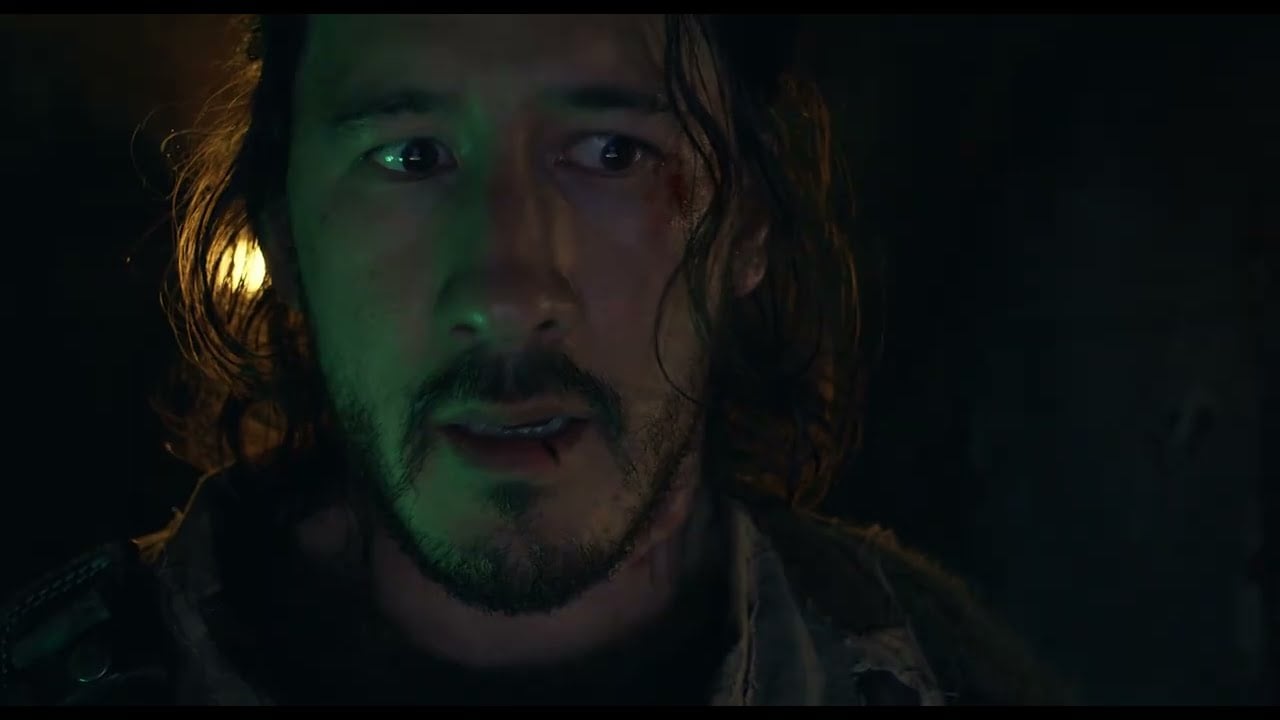
Iron Lung offers a uniquely suffocating descent into psychological and cosmic horror. It’s slow, weird, and draining in a way that feels oddly beautiful. Markiplier didn’t play it safe, and whether or not the film works for everyone, that commitment to vision is impossible to ignore.

Roberto Tyler Ortiz is a movie and TV enthusiast with a love for literally any film. He is a writer for LoudAndClearReviews, and when he isn’t writing for them, he’s sharing his personal reviews and thoughts on Twitter, Instagram, and Letterboxd. As a member of the Austin Film Critics Association, Roberto is always ready to chat about the latest releases, dive deep into film discussions, or discover something new.
![‘The Boys’ Season 5 Premiere Doesn’t Pull Any Punches [SPOILER WARNING]](https://cdn.geekvibesnation.com/wp-media-folder-geek-vibes-nation/wp-content/uploads/2026/04/THBY_S5_UR_501_00331_R2_3000-450x300.jpg "‘The Boys’ Season 5 Premiere Doesn’t Pull Any Punches [SPOILER WARNING]")




2 Comments
I loved the movie. Very creative VERY BLOODY!!!!! it is insane how bloody that movie is I LOVE IT!!!!!! very good movie
Hey! Someone who get’s what I’ve been saying. The “boring” parts were a feature, not a bug. After the credits started rolling, I felt something in me shift, and I turned to my wife and said, “I feel like I just came up for air.”