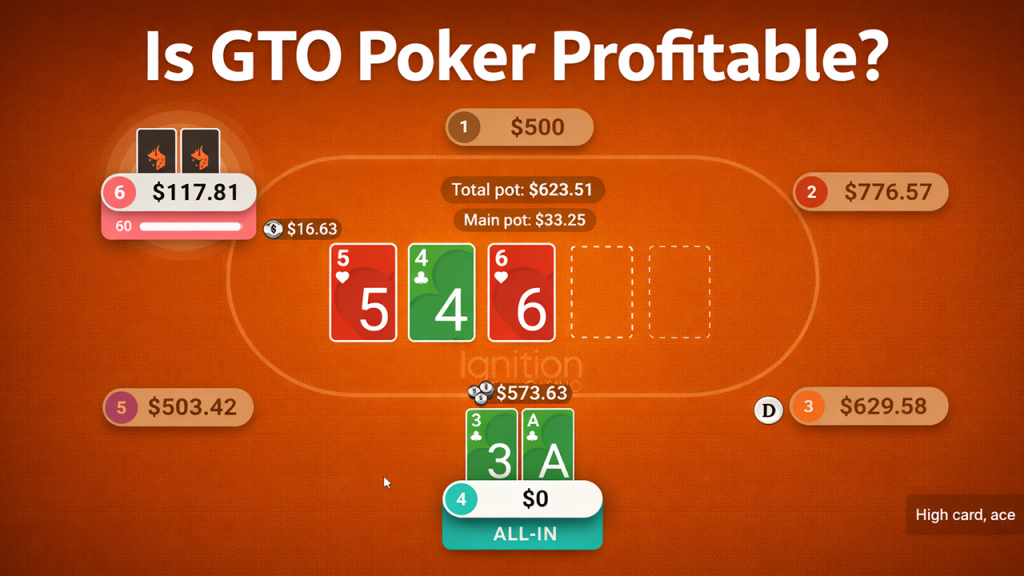
I hear it all the time, “If you want to win at poker, you have to learn GTO.” Open YouTube, scroll Twitter, or visit any poker forum and GTO is treated like the holy grail. It’s kind of crazy. Solvers, charts, and perfectly balanced ranges are supposed to be the difference between a losing player and a crusher. But after spending time studying it myself, I started asking a different question: is GTO poker actually profitable?
The thing most people don’t realize is that GTO isn’t designed to make the most money, it’s designed to make you unexploitable. And in games full of players who overcall, under-bluff, and make obvious mistakes, that distinction matters a lot. I’ve seen players use GTO for tens of thousands of hands just to scratch out a profit or break even.
So, I want to break down what GTO really does, when it actually helps, and when it quietly leaves money on the table.
What Is GTO Poker?
GTO stands for Game Theory Optimal, and at its core, it’s a strategy designed to make your play unexploitable. Basically, it means you’re choosing bet sizes, bluffs, and value hands in a balanced way that makes it hard for your opponents to get an edge on you.
But this next part is key. GTO doesn’t focus on who you’re playing against. Instead, it assumes your opponent is playing perfectly and asks, “What’s the safest strategy in the long run?” That’s why solvers are so popular, they calculate the optimal way to play every spot. However, no one plays perfectly so there is some nuance to this.
The key thing I had to learn is that GTO is a baseline, not a goal. It gives you a strong default strategy, but you eventually need to branch out past it to beat players who are above average.
Why GTO Can Be Profitable
GTO can be profitable, but not for the reasons most people think. For me, the biggest benefit of GTO is that it plugs leaks. Before I understood GTO concepts, I was over-bluffing in bad spots, calling too wide in others, and guessing far too often. Learning GTO gave me a solid framework for what to do in certain spots. It’s never perfect but the fact that it gives you a baseline helps.
Playing closer to GTO also protects me from getting run over by stronger players. When I’m balanced with my value bets and bluffs, good regs can’t just exploit one weakness over and over. That matters a lot in online games, where lineups change constantly and players are paying close attention. Even if I’m not maximizing EV every hand, I’m avoiding big mistakes that destroy win rates. That’s where this helps a lot.
Another reason GTO can be profitable is consistency. I’m not relying on reads that might be wrong or emotions that fluctuate session to session. GTO gives you frequencies and bet sizes you can fall back on when you’re tired or unsure. It can become profitable because it forces you to make less mistakes in different situations, especially playing against low and mid stake opponents.
Why GTO Is Not Always Profitable
In my experience, GTO isn’t profitable for most players because most games simply don’t reward it. The majority of poker tables are filled with players who make the same mistakes over and over, meaning they call too much, bluff too little, and don’t adjust. When I play perfectly balanced poker against those players, I’m often leaving money on the table instead of taking it.
Another issue is execution. GTO looks clean in a solver, but real games are messy. Stack sizes change, emotions creep in, and decisions have to be made in seconds. I’ve seen plenty of players, myself included at times, try to force solver-approved lines they don’t fully understand. That usually leads to costly mistakes, especially under pressure.
Rake is another killer, with this strategy at low and mid stakes. The issue is GTO assumes rake isn’t involved, but in real games, especially online, small edges disappear quickly. Playing thin, balanced lines just doesn’t overcome the house cut the way aggressive exploitation does.
Most importantly, GTO ignores who you’re actually playing against. Poker is a game of people, not equations. Meaning you need to be bluffing at a decent rate to win long term. You must stay unpredictable and make plays.
Best Stakes for GTO
I’ve found that GTO becomes more valuable as the stakes go up. At micro stakes, playing strictly GTO usually isn’t worth it. The games are too loose, the rake is brutal, and most opponents aren’t paying attention. You also get the occasional all-in shove with Jack Ten off suit that cracks your pocket queens. In those games, I make far more money by over-valuing strong hands and punishing obvious mistakes instead of worrying about balance. Just a little tip.
At low to mid stakes, GTO starts to matter more slightly more. This is where I use it as a default when I don’t have strong reads. Players are better, but still very exploitable, so blending GTO with some bluffing makes sense. You can also see how to play with it on Pokerstacked.
High stakes is where GTO really shines. When I’m playing against strong regulars who understand ranges and frequencies, being balanced becomes a smarter approach. At the end of the day, you want to combine GTO with bluffing and exploiting opponents at your table. This will keep them on their toes.
Common Mistakes
One of the biggest mistakes I see with GTO is treating it like a rulebook instead of a framework. Memorizing charts without understanding why they exist leads to bad decisions.
Another common mistake is assuming GTO means never adjusting. In harder games, sticking to only GTO while opponents make massive mistakes just costs money. I also see players copying high-stakes solver lines in low-stakes, high-rake games where they don’t apply. Overcomplicating decisions is another silent killer that will ruin the roi for the time you’re playing.
Final Thoughts
After spending a lot of time studying and playing with GTO, my view is pretty simple. GTO isn’t good or bad it’s just a baseline. It can absolutely make you a better player, but only if I use it the right way. When you start treating it as a baseline instead of a strict system, it helps you avoid big mistakes and stay sharp in tougher games. If you treat it like the end all, be all, that’s when it will backfire.
Poker isn’t played in a solver environment. It’s played against real people who have leaks, emotions, and habits they repeat endlessly. That’s where the real profit comes from. For me, the most success has come from understanding GTO well enough to know when I can safely deviate from it and then exploiting aggressively.
If I had to sum it up, GTO is a powerful tool, not a strategy on its own. Learn it, respect it, but don’t let it stop you from doing what poker has always rewarded, out playing the man.
Frequently Asked Questions
Is GTO poker necessary to win?
I don’t think it’s required to win at most stakes. I’ve beaten plenty of games by playing fundamentally sound, exploitative poker without memorizing solver charts.
Does GTO work in live poker?
In my experience, live poker rewards exploitation far more than balance. I use GTO ideas as a safety net, not a default.
Should I stop exploiting if I learn GTO?
No. If anything, learning GTO helps me recognize when I can exploit harder without exposing myself.
Do solvers guarantee profit?
Definitely not. They show optimal play, not optimal earnings.
Morgan Vance is an iGaming analyst with nearly a decade of experience covering online casinos and industry regulation. Known for breaking down complex betting systems into easy-to-understand insights, Morgan has reviewed over 500 casino platforms worldwide. His work often explores the intersection of blockchain technology and gambling, particularly the rise of crypto casinos and provably fair gaming.