

I think the most interesting way into Jimmy is the contrast between the two very different approaches to the biopic we’ve seen with Michael and Tony. Every year brings biopics that range from honest and complicated to sanitized celebrations of their subjects, and those two films make for a particularly clear comparison. Michael is largely a celebration of Michael Jackson’s life and music, offering an extremely polished version of his story that rarely seems interested in examining the more uncomfortable parts of his legacy. Tony, on the other hand, takes a messier, more honest approach to Anthony Bourdain, finding ways to celebrate him without pretending he was an uncomplicated person. Jimmy falls firmly into the Michael category, although it doesn’t have the benefit of an insanely good lead performance like Jaafar Jackson’s to make its romanticized approach more compelling. A biopic about James Stewart always felt inevitable, given his legacy as one of Hollywood’s most beloved actors and his remarkable military service. What feels unexpected is that a film about such an interesting period of his life could turn out this misguided.
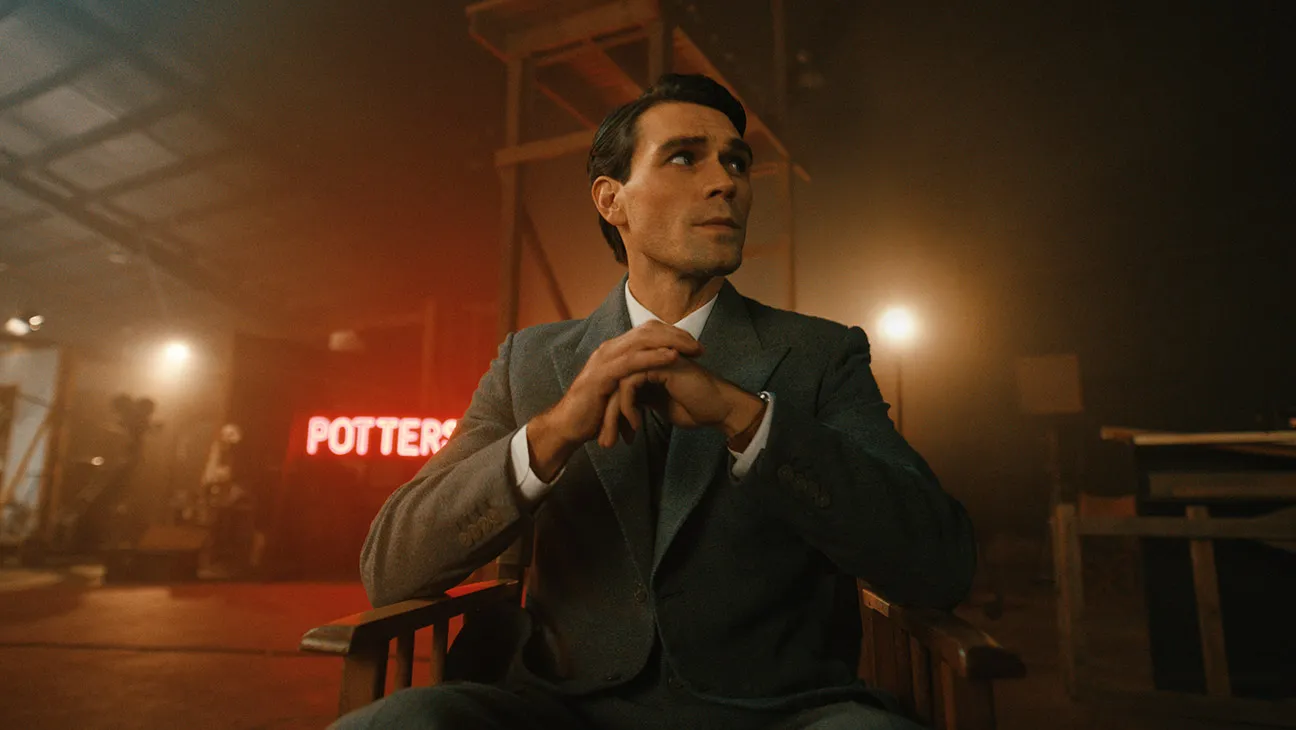
Directed by Aaron Burns and written by Justin Strawhand, Jimmy follows James Stewart during the years between his Academy Award win for The Philadelphia Story and his return from World War II, eventually leading into his casting as George Bailey in It’s a Wonderful Life. KJ Apa plays Stewart, with Jason Alexander as MGM studio head Louis B. Mayer, Max Casella as director Frank Capra, and Sarah Drew as gossip columnist Hedda Hopper. The film begins with Capra pitching Stewart the idea for It’s a Wonderful Life and from there, the story moves backward into Stewart’s decision to enlist in the U.S. Army Air Forces and his eventual service flying missions over Europe. He rises through the ranks to become a colonel, putting his Hollywood career on hold while serving during the war. There is a genuinely compelling story here about a major movie star stepping away from his career to serve his country, but the film seems far more interested in presenting Stewart as an uncomplicated American hero than in understanding the person behind that reputation.
The biggest problem is that Jimmy barely functions as a biopic about an actor. Stewart’s career in Hollywood is mostly treated as background information, with the film devoting the majority of its attention to his military service and the importance of honoring those who serve. His decision to enlist could absolutely support an interesting film, particularly given his fame and the unusual position he occupied as an established Hollywood star entering military service. Yet the screenplay does very little with the tension between those different parts of his identity. Instead, his military experience becomes the central point of the movie, and everything else seems to exist to reinforce the image of a patriotic man doing the right thing. By the time the story returns to his acting career, there is little sense of what he has lost, what has changed, or how his experiences have affected the person who will eventually play George Bailey.
The treatment of Stewart’s enlistment is especially annoying because the film appears willing to reshape basic facts to make its hero look even more noble. It presents him as having been drafted, when he actually enlisted voluntarily.Volunteering for military service is already a significant decision, particularly for someone with Stewart’s career and public profile. There is no reason to manufacture a different version of events unless the filmmakers believe the truth isn’t quite dramatic enough. That kind of embellishment becomes difficult to separate from the film’s larger approach, which repeatedly seems more concerned with creating an idealized version of Stewart than telling an honest story about him.
The movie also has a strange habit of explaining things to its audience as though nobody watching could possibly understand the significance of what is happening. To be quite frank and brutally honest it’s as if the filmmakers think it’s audience is stupid. The opening conversation about It’s a Wonderful Life is a particularly glaring example. Capra practically announces that the film will become a masterpiece and remain beloved for generations, even suggesting that people will still be watching it a century later. It is an absurdly convenient way to frame the importance of the movie, and it makes the filmmakers’ intentions painfully obvious. There is no need to have a character deliver a speech about the future legacy of a film when the audience already knows exactly what It’s a Wonderful Life became. The scene doesn’t reveal anything meaningful about Capra or Stewart. It simply congratulates the movie on its own historical importance before it has even begun telling its story.
The performances don’t do much to make the material more convincing. Apa is clearly trying, and there are occasional moments when he manages to get past the impression of an actor imitating someone audiences already know. His physical appearance helps, particularly the dark hair and bright blue contacts, and his vocal imitation is sometimes surprisingly close. There were a few moments when I could see Stewart coming through, rather than simply watching Apa perform an impression of the actor. Unfortunately, that voice also becomes a distraction, and the performance never quite develops into a convincing portrayal of the man himself. Apa deserves some credit for the effort as he is giving 110% here but he is ultimately working with a screenplay that gives him very little room to find anything beyond the familiar public image.
The supporting cast fares considerably worse. Alexander and Casella, in particular, seem to be playing exaggerated versions of recognizable Hollywood personalities rather than actual people. Their performances are so broad that it often feels like they’re waiting for the camera to acknowledge how much they’re performing. The same problem extends throughout the cast. Nobody seems particularly comfortable inhabiting the period or the characters they’re supposed to portray, and conversations don’t even come close to feeling like exchanges between real people. Instead, the dialogue is delivered with this artificial quality that makes even ordinary interactions feel incredibly staged. The film wants us to believe we’re watching important moments in the lives of historical figures but the performances make it difficult to forget that we’re watching actors in costumes.
That lack of authenticity extends to the production itself. The sets frequently look unconvincing and the period details never come together in a way that makes the world feel lived in. There is a noticeable limitation to the budget, particularly during the military sequences, but the issue isn’t simply that the film cannot afford the scale of a major war production. It’s that Burns struggles to create tension within the limitations he has. The flying sequences are dull, with little visual excitement or sense of danger. For a movie that spends so much of its runtime emphasizing Stewart’s service as a combat pilot, there should be moments that communicate what those missions actually demanded of him. Instead, the action feels strangely weightless. Even when the film is depicting a dangerous situation, there is rarely any genuine feeling that something could go wrong.
More broadly, Jimmy has no real sense of narrative momentum. Events happen very quickly with the film jumping from one major moment to another without allowing any of them to develop. Stewart makes an important decision, enters the military, trains, goes overseas, and rises through the ranks, but the screenplay rarely spends enough time with him to make those developments feel meaningful. There are stories within this period that could have carried an entire film, whether it is his transition from Hollywood to military life, the pressure of commanding other men, or the experience of returning home after years of war. Instead, the movie treats these moments like items on a checklist. It tells us what happened without giving us much of a reason to care about how it happened and the experience becomes an exhausting slog.
What makes all of this especially disappointing is that Stewart’s story genuinely deserves a thoughtful film as he is a very fascinating person. His military service is an extraordinary part of his life and his return to Hollywood raises interesting questions about fame, identity, responsibility, and the relationship between the man and the screen persona audiences loved. There is also something worth examining in the decision to make It’s a Wonderful Life after experiencing the realities of war. The film could have explored how Stewart’s experiences changed his understanding of sacrifice and the value of an ordinary life. Instead, it leans so heavily into patriotic sentiment and religious messaging that those possibilities are almost entirely lost. At times, Jimmy feels less like a biopic and more like a military tribute film with a famous actor’s name attached to it.
I rarely come away from a movie feeling that almost nothing worked, but Jimmy is a particularly frustrating exception. Its subject is fascinating, its central period offers plenty of dramatic possibilities, and Stewart’s life provides a natural bridge between Hollywood history and the realities of World War II. Yet the film never finds a compelling way to tell that story. We legit could have gotten a good movie, one that could have approached Stewart’s military service with nuance while giving equal attention to the actor and the person. Unfortunately, Jimmy never comes close to finding it.
The film never finds a compelling way to tell that story. We legit could have gotten a good movie, one that could have approached Stewart's military service with nuance while giving equal attention to the actor and the person. Unfortunately, Jimmy never comes close to finding it.
-
GVN Rating 0
-
User Ratings (0 Votes)
0

Roberto Tyler Ortiz is a movie and TV enthusiast with a love for literally any film. He is a writer for LoudAndClearReviews, and when he isn’t writing for them, he’s sharing his personal reviews and thoughts on Twitter, Instagram, and Letterboxd. As a member of the Austin Film Critics Association, Roberto is always ready to chat about the latest releases, dive deep into film discussions, or discover something new.