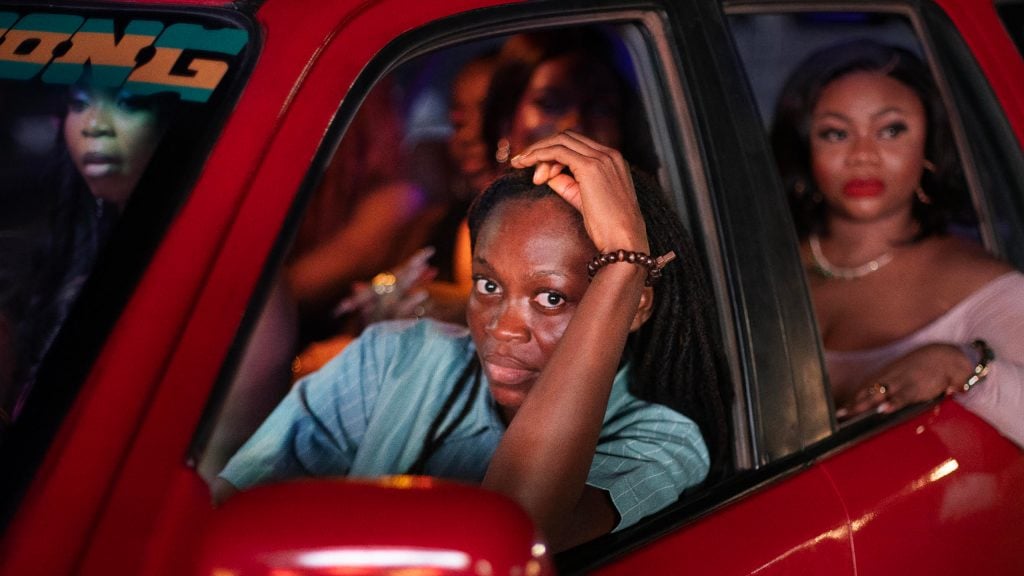
Women around the world experience life in widely different ways, but many of the obstacles that have to be overcome are rooted in the same cause. Whole systems have been created based in misogyny to keep women from success and from having agency over themselves and their lives. Olive Nwosu’s debut film LADY transports audiences into the lively streets of Lagos, centered around a young, hardworking woman who chooses the male-dominated field of taxi driving for her career. When oil becomes increasingly more expensive, a face from Lady’s past emerges and forces them both to overcome their trauma to set them free.
LADY is an instant feminist classic that examines the complexities of female friendship and how women endure. Nwosu opens her film with a gaze into the life of a young Black woman, who charmingly goes by Lady (Jessica Gabriel’s Ujah), who cherishes her independence. Working as a cab driver in the lively city that she calls home, Lagos, she has all the right skills to be successful, hardworking, motivated, and above all, ambitious. Not letting the male-dominated field she works in scare her away, she saves her earnings for a way out of Lagos to Freetown in Sierra Leone. Almost everyone Lady encounters is a man, who all do their best to remind her of the overwhelming patriarchy that surrounds her. Powerfully, she doesn’t let this discourage her, using their underestimations of her to fuel her further.
It’s not until Lady crosses paths with an old friend, Pinky (Amanda Oruh), who now makes her money as a sex worker, that she has to come face to face with her childhood scars. Their past is murky at first; there’s a connection that can be felt, but the depth of it is not explored until later in the film. When Pinky tells Lady that her pimp, Sugar (Tinuade Jemiseye), is looking for a new driver to escort his working women to jobs, Lady is apprehensive at first. But when the salary is revealed, Lady thinks of Freetown again. While she disagrees with the lifestyle and occupation of her childhood friend, she reluctantly takes the job after making her thoughts known.
Undoubtedly, the film is the most entertaining while audiences are taken on the job with Lady, as if we were passengers along for the ride. Nwosu uses this time to get to know Lady through those who surround her, Pinky being the one who knows her best, but all are ready to get to know their new chauffeur. Everything from Lady’s sex life to her Freetown dreams is picked apart through late-night gossip and heartfelt beachside chats. Lady and her new coworkers exude a sisterhood that, even if some of them haven’t known each other long, shows the lengths they are willing to go for one another and the power of female communities. While Pinky and Lady are the focus of these situations, their stories feel universal for two kinds of women living in Lagos: one who is looking to leave it all behind, and another who is maintaining what she can control.
Nwosu shows sex work in a realistic view, not exploiting the work for shock value or shame, but as something that fits the film’s themes. The most lavish sets in LADY are when these women are at work, either in nightclubs, beach parties, or private homes. Compared to the conditions that Lady has to work in, there’s a large economic disparity in Lagos. Understandably, women find themselves needing to sell their bodies or their time to provide. But she doesn’t make their work their entire personality; one of the best moments in LADY is when all the women are getting ready for bed, out of their glamorous clothes and makeup, and talking about where they would go in the world if given the chance. Many have dreams of being wives, mothers, or living independently away from Lagos.
Vividly shot by cinematographer Alana Mejia Gonzalez, LADY is one of the best-shot films of the entire festival. Gonzalez has a complete grasp of what the film is aiming to do through her disorienting nightclub scenes, capturing how overstimulating those atmospheres are, with hazy smoke littering the room, strobes flashing, and music blasting. When Lady is having flashbacks to her life as a child, the film cuts from the deep colors of a nighttime dip in a mansion’s pool to the small shared home in a crowded low-income neighborhood. The city is incredibly lively, with packed streets of people just trying to make a living.
For her debut feature, Nwosu gives one of the more memorable films from the World Cinema Dramatic Competition, with her inspiring story of female friendship and its importance to healing old wounds. Writing a well-layered character like Lady, someone who uses confidence as a shield as a woman in a man’s world, she makes Lady a woman who is abrasive, so she doesn’t get hurt, but protective of the women in her life, even to the extreme. It also helps amplify such a powerfully written woman, with Ujah being the one who brings her to life. Her performance is natural, making it easy to see life through her perspective. We feel her ambition and can sense her frustrations.
LADY is made by women, starring women, and shows how women advocating for one another demonstrates the strength they have in numbers. Nwosu’s debut is truly a joy, showing that women have different desires, different ambitions, but a similar goal of living life as freely as they wish.
LADY had its World Premiere in the World Cinema Dramatic Competition section of the 2026 Sundance Film Festival.
Director: Olive Nwosu
Writer: Olive Nwosu
Rated: NR
Runtime: 93m
LADY is an instant feminist classic that examines the complexities of female friendship and how women endure
-
9
-
User Ratings (1 Votes)
8.6

![‘The Boys’ Season 5 Premiere Doesn’t Pull Any Punches [SPOILER WARNING]](https://cdn.geekvibesnation.com/wp-media-folder-geek-vibes-nation/wp-content/uploads/2026/04/THBY_S5_UR_501_00331_R2_3000-450x300.jpg "‘The Boys’ Season 5 Premiere Doesn’t Pull Any Punches [SPOILER WARNING]")