

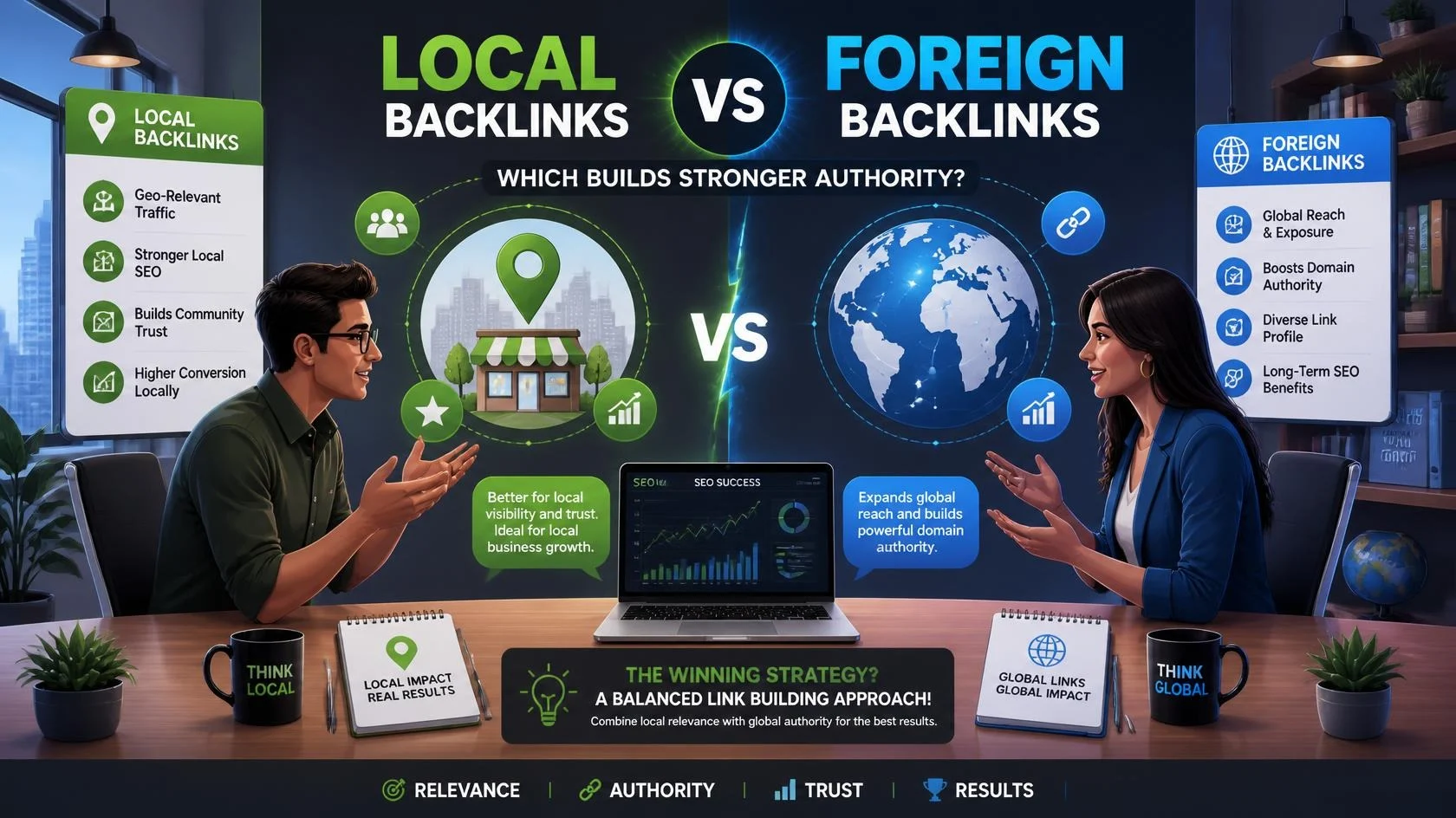
Picture two Malaysian clothing stores launching in the same month. One earns links from Malaysian lifestyle blogs and local news sites. The other buys a bundle of links from blogs overseas.
Which one is more likely to show up for shoppers searching in Kuala Lumpur? That’s the heart of the local backlinks vs foreign backlinks debate. For a .my website, where a link comes from shapes relevance, referral traffic and trust. Below, you’ll see how each type works, when overseas links still earn their place, and how to balance both.
Local Backlinks vs Foreign Backlinks: The Short Answer
For a .my site that targets Malaysian customers, local backlinks usually matter more. They reinforce your country relevance, send visitors who can actually buy from you, and come from sites your audience already trusts. Foreign backlinks still pass authority, so they help when they’re relevant and editorial. A healthy profile is mostly Malaysian, with selective international links.
What Counts as a Local Backlink, and What Counts as Foreign?
A local backlink comes from a website that serves Malaysia: a .my or .com.my domain, or a .com site clearly built for Malaysian readers, such as a local news outlet, trade association or community blog. A foreign backlink comes from a site written for another country’s audience.
The domain ending isn’t the whole test. A .com blog run by a Kuala Lumpur food writer is local in practice. A .my site that publishes content for overseas readers might not be. Judge a link by who the site is for, not just where it’s registered.
Why Local Backlinks Tend to Matter More for .my Sites
Your .my domain already tells search engines you belong to Malaysia. Country-code domains are a recognised geotargeting signal. Links from Malaysian websites back that up from the outside, because other sites in your market are vouching for you.
There’s also the practical side. A link is a road as well as a ranking signal. When a Malaysian news site or industry body links to you, the people who click are far more likely to be customers than readers from a blog in another time zone.
Three reasons local links earn their keep:
-
Relevance: they confirm the market you serve, which matters most for searches with local intent.
-
Traffic quality: referral visitors can buy, book or call, and they understand your prices, delivery areas and language.
-
Trust: a mention from a publication or association your customers already know does more for credibility than a link they’ll never see.
One more thing people forget: Malaysia is multilingual. A relevant link from a Bahasa Malaysia or Chinese-language site reaches audiences that English-only outreach misses, and it’s often easier to earn because fewer people are asking.
Do Foreign Backlinks Still Help a .my Website?
Yes. As far as Google has publicly documented, a link doesn’t need to come from the same country to pass value. A link from a respected international publication or a leading site in your industry can carry real authority, and some Malaysian businesses depend on that.
Foreign links make the most sense when your customers aren’t only in Malaysia:
-
Exporters and manufacturers who want visibility with overseas buyers.
-
SaaS and online services that sell to several countries.
-
Tourism and hospitality brands that need to reach travellers before they land.
-
E-commerce stores that ship to Singapore, Brunei or beyond.
If none of that describes you, foreign links are a supporting act. They help when the linking site is about your topic and the link sits inside genuine editorial content. They don’t help much when the only connection is that someone sold you a package.
Here’s how the two compare in practice. Treat it as general guidance, since every niche behaves a little differently.
| Factor | Local backlinks | Foreign backlinks |
| Country relevance signal | Strong | Weak to neutral |
| Referral traffic | Mostly Malaysian prospects | Often outside your market |
| Pool of possible sites | Smaller, more selective | Much wider |
| Authority potential | Varies by site | Can be very high from major publications |
| Best for | Local services, retail, B2C | Exporters, SaaS, international brands |
How to Check the Balance in Your Own Backlink Profile
There’s no official ideal ratio. Anyone quoting an exact 70/30 split is guessing. What you can do is see where you stand and compare it with sites that already rank for your keywords.
-
Export your referring domains from Google Search Console or a tool such as Ahrefs or Semrush.
-
Mark each domain as Malaysian, regional or international, based on who the site serves.
-
Check relevance. Does the site cover your industry, or is it a general blog that links to anything?
-
Look at which pages receive the links. If everything points at the homepage, your service pages are going without support.
-
Run the same check on two or three Malaysian competitors that outrank you, and look for gaps.
A real link inventory also shows why domain endings are a poor shortcut for classifying an audience.
Rankpage Case Study: How Rankpage Made Listing.my’s Pages Work Together
Rankpage organised Listing.my around directory categories and supporting guides, mapped topics to suitable pages, and connected guides to relevant categories with internal links. Navigation was planned to help visitors browse providers.
These changes make relevance practical: someone entering through an article has a route to related businesses, and a category has a clear topic of its own. That is a stronger foundation for incoming links than an unclear destination page, whatever the linking domain’s suffix.
The October 2026 referring-domain export contained 950 rows, with 125 recording at least one dofollow link. Only nine domain names ended in .my; the other domains cannot be classified as foreign from their suffix alone. Rankpage’s confirmed contribution here is the page planning and internal connections.

Figure: Referring-domain rows grouped by whether the export records at least one dofollow link.
Source: Rankpage client evidence: Listing.my Ahrefs referring-domain CSV, collected 21 October 2026.
Common Mistakes with Local and Foreign Backlinks
-
Buying foreign link bundles. Dozens of cheap links from unrelated overseas blogs rarely help a Malaysian service business and can look unnatural.
-
Treating any .my link as good. A spammy directory or link network in Malaysia is still spam.
-
Ignoring language. Chinese and Bahasa Malaysia publications are often overlooked.
-
Sending every link to the homepage. The pages that earn revenue need links too.
-
Skipping unlinked mentions. If a Malaysian site already names your brand without linking, a polite request is often the easiest win.
Where to Find Quality Local Backlinks in Malaysia
The best local links tend to come from real relationships and useful content, not from lists of sites that accept payment. Good starting points:
-
Industry associations and chambers of commerce that list members or publish resources.
-
Local news and business publications, reached through press releases, expert comments or original data.
-
Universities and colleges, through talks, internships or research collaborations.
-
Suppliers, partners and clients who can mention you on their own sites.
-
Event sponsorships and community projects that publish sponsor pages.
-
Vetted Malaysian business directories, mainly for citation consistency.
These tactics work better when they’re planned together rather than done as one-off favours, so it helps to map them out as a local link building strategy that starts with an audit of your current profile and a look at what competitors have earned. Guest posts, niche edits and local citations then fill the gaps the audit finds.
FAQs
Do foreign backlinks hurt a .my website?
Not by themselves. Harm comes from spammy, irrelevant or manipulative links, whatever country they’re from. A relevant link from an overseas site is fine. A pile of paid links from unrelated blogs is the risk.
How many local vs foreign backlinks should I have?
There’s no official number. If you serve Malaysian customers, lean towards local links and add international ones where they’re relevant. Comparing your profile with the top-ranking Malaysian competitors gives a more realistic target than any fixed ratio.
Is a link from a .com.my site worth more than one from a .com?
Not automatically. Relevance, editorial quality and real traffic matter more than the domain ending. A .com site written for Malaysians can be a better link than a thin .com.my page nobody reads.
Are links from Singapore or Indonesia foreign backlinks?
Technically yes, but they can still be highly relevant if you sell in those markets. Regional links often sit between local and international in value for Malaysian businesses.
Do local citations count as backlinks?
Often they do, because many directory listings include a link back to your site. Some are nofollow, so their main value is consistent business details and discoverability rather than raw authority.
The Bottom Line
On the local backlinks vs foreign backlinks question, the practical answer for most .my sites is to build a Malaysian base first, then add relevant international links where your business really operates. Quality and relevance beat country labels every time.
If you’d like a second pair of eyes on your backlink mix, Rankpage Malaysia lets you request an SEO audit and walks through the key findings in a consultation. Start by exporting your referring domains and tagging them. You’ll probably see the gaps faster than you expect.

Madeline Miller love to writes articles about gaming, coding, and pop culture.