

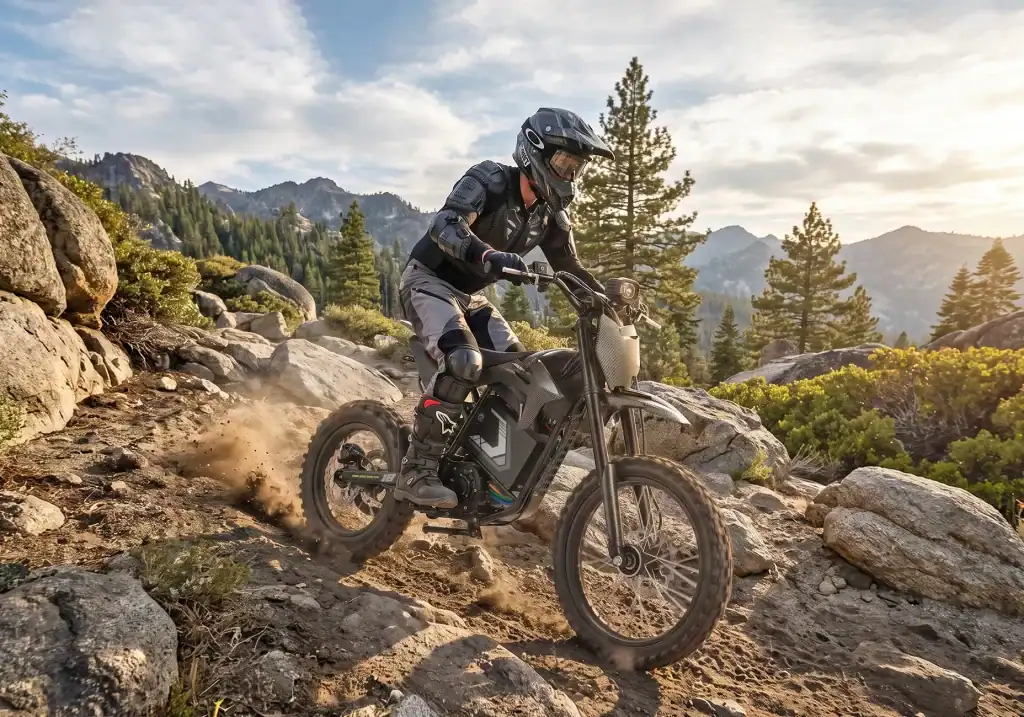
Picture a gap between two trees just wide enough to fit through, followed immediately by a switchback with a rut on the outside line. Nothing about that section rewards a bigger motor. What it rewards is a bike that does exactly what’s asked of it at walking pace, with enough margin left over to correct if the front wheel drifts a few inches off line. That margin — not top speed, not peak wattage — is what actually separates a bike that feels controllable on tight trail from one that doesn’t.
The Cone Test: What Tight Trails Actually Demand
A useful way to feel this directly: set up a tight, winding line — a few cones, or just natural obstacles like trees or rocks spaced a bike-length apart — and thread it at a slow, deliberate pace. Not a timed run, just a slow weave with real course corrections along the way. What shows up almost immediately isn’t whether the bike has enough power; it’s whether small throttle and steering inputs translate into small, predictable movements, or whether the bike surges, hesitates, or resists tight direction changes. A spec sheet full of impressive numbers says nothing about how that test goes. Riding it does.
Throttle Response: Smoothness Beats Speed
The first thing the cone test exposes is throttle response. A bike with an abrupt, twitchy low-end throttle map turns a gentle input into more speed than intended, which is exactly the wrong behavior threading a tight gap. A bike with a smoother, more progressive response at low throttle gives a rider finer control over exactly how much power reaches the wheel — which matters far more here than how much power is available at full throttle, since full throttle is never the point in a space this tight.
Power Modes: Choosing the Setting That Buys the Widest Margin
This is where mode selection earns its keep. Dropping into the lowest available setting before a technical section — rather than whatever mode a ride happened to start in — buys the widest margin for error, since a lower cap means a small throttle mistake tops out at a lower speed regardless of how it happened. Different bikes set that lowest ceiling differently: some cap out in the low teens, others a bit higher. The exact number matters less than the habit of actually using the lowest setting when the trail calls for it, rather than defaulting to whatever’s already selected.
Weight Distribution: Why a Planted, Centered Bike Threads Tighter Lines
Where a bike carries its weight changes how it behaves at walking pace. A bike with weight concentrated out at the wheel has more momentum to manage through each small correction; a bike with weight centered closer to the rider’s own body tends to feel more willing to change direction on a tight line without a fight. This is the same logic that makes a loaded backpack worn high between the shoulders feel different from the same weight carried low and centered — mass placement changes how manageable a slow, deliberate movement feels, independent of how much total weight is involved.
Turning Radius: The Spec Sheet Almost Never Tells You This
Wheelbase length, fork rake, and handlebar width all shape how tight a bike can actually turn, but turning radius itself is a spec that’s rarely published for dirt bikes the way it routinely is for cars. That’s worth naming plainly rather than working around: there’s often no number to compare on paper, which means the tight-turn feel of a specific bike is something to test in person — the cone test again — rather than something a spec sheet is going to answer directly.
Seat Height: Footing Is Part of Control, Not Just Comfort
A rider who can’t plant a confident foot at the pause between two switchback turns loses control margin before the throttle even comes back into play. Seat height and footing confidence matter just as much in a slow technical section as anywhere else — arguably more, since tight trail is exactly where a rider is most likely to need a foot down mid-maneuver rather than just at a full stop.
Testing Control Margin Before You Buy
All five of these — throttle response, mode selection, weight distribution, turning behavior, and footing — add up to one thing: how much room there is to make a small mistake without it becoming a bigger one. None of it shows up cleanly on a spec sheet, which is exactly why the cone test is worth running on an actual electric dirt bike rather than assumed from torque and top-speed numbers alone.
Control Margin, Not Top Speed, Wins on Tight Trails
Peak power matters on an open stretch. It matters much less between two trees at walking pace, where the bike that wins is the one that responds predictably to small inputs and leaves room to correct when a line doesn’t go exactly as planned. Testing that directly on electric dirt bikes — not just on paper — is what actually predicts how a specific model will feel where control matters most.

Hi! I’m Bryan, and I’m a passionate & expert writer with more than five years of experience. I have written about various topics such as product descriptions, travel, cryptocurrencies, and online gaming in my writing journey.