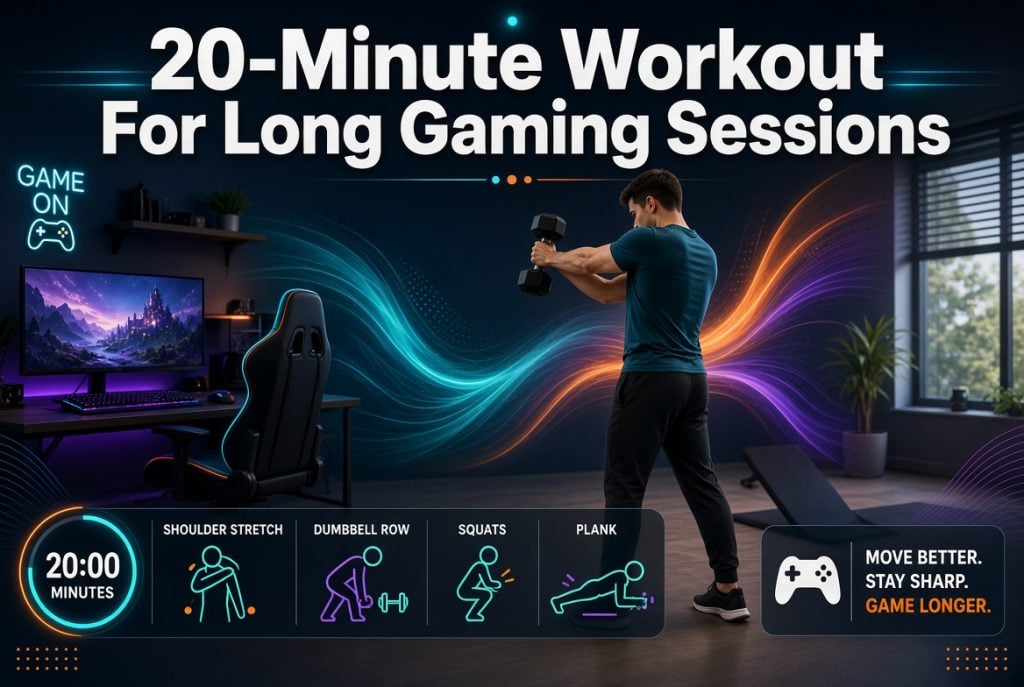
Sitting still for six or eight hours a night in a raid, a scrim block, or a ranked grind puts real strain on your hips, shoulders, and focus. Competitive gaming rewards precision and composure, and both start slipping when your body locks up from hours in the same position. Esports athletes have started training like other performance athletes for exactly this reason: extended gaming sessions ask a lot of your joints, your posture, and your nervous system.
My 20-Minute Workout for Long Gaming Sessions is built around one idea: a short, repeatable session can support the stamina, posture tolerance, and mental clarity you need for marathon gaming sessions, without eating into your practice or scrim time. This is not a promise that lifting weights will sharpen your reflexes overnight. Fitness will not rewrite your mechanics. What consistent training can do is help you stay comfortable, composed, and alert deep into a long session, which is often the difference between your best play and your worst.
Gaming performance depends on more than aim training and VOD review. Strength, mobility, and cardiovascular conditioning give you a physical base that supports focus late into a session, when fatigue and stiffness start working against your decision-making. That base is a genuine competitive advantage, and it takes about 20 minutes a day to start building it.
The 20-Minute Routine That Supports Match Stamina
This routine pairs strength training with short bursts of conditioning, following the same minimalist training logic used in effective 20-minute workouts: warm up fast, work hard with minimal rest, and cool down with intent. It uses compound exercises like squats and deadlifts alongside targeted upper-body work, structured so you can complete it before or after a gaming block without wrecking your energy for the session ahead.
Why This Mix of Strength and Conditioning Works
Strength training and conditioning solve different problems that gamers face. Resistance training builds the muscular endurance that keeps your shoulders and lower back stable during long sitting stretches, while short conditioning bursts raise your cardiovascular baseline so fatigue sets in later.
Research on short, high-intensity sessions has found that 20 minutes of focused work can produce cardiovascular improvements comparable to much longer moderate-intensity sessions over several weeks. You don’t need an hour at the gym to move the needle. You need a structure that hits both systems, which is what this circuit-training approach does. If you want a deeper breakdown of the format, this 20-minute circuit training workout covers the same principles in more depth.
The 3-Minute Warm-Up for Stiff Hips, Shoulders, and Wrists
Start with movement that targets the joints gaming stiffens most: hips, shoulders, and wrists. This is not optional stretching you can skip when short on time; it’s what protects your form once you load weight.
- Hip circles and cossack squats (30 seconds each side): loosens hips locked from sitting
- Arm circles and shoulder rolls (30 seconds): wakes up the shoulder joint before pressing or rowing
- Wrist flexor and extensor stretches (30 seconds each): counters hours of mouse and controller grip
- Cat-cow stretch (30 seconds): mobilizes the spine and lower back before loading it
This warm-up takes three minutes and should leave you slightly warm, not winded. For more warm-up options you can rotate in, a quick cardio warm-up is worth building into your routine.
The 14-Minute Full-Body Circuit
Perform each superset back-to-back with minimal rest, resting 60 to 90 seconds between rounds. Complete three rounds if your schedule allows it, or two rounds on days you’re pressed for time.
Superset 1 (bodyweight or dumbbell):
- Squats x 12
- Bicep curls x 12
Superset 2 (compound strength):
- Deadlifts x 10 (dumbbell or barbell, full range of motion)
- Bench press or push-ups x 10
Superset 3 (shoulder and core stability):
- Lateral raise x 12
- Plank x 30 seconds
Move with control through the full range of motion on every rep, particularly on squats and deadlifts, where cutting the movement short reduces the training effect and increases strain on the lower back. Push each set close to muscular failure on the last round without breaking form. If you want more exercise variations to rotate into this structure, these quick strength training workouts offer solid substitutions.
The 3-Minute Cooldown for Mobility and Recovery
Close every session with mobility work, not a hard stop. A brief cooldown lowers your heart rate gradually and keeps the flexibility gains from the session.
- Child’s pose (30 seconds): releases the lower back after deadlifts and squats
- Doorway chest stretch (30 seconds each side): counters the forward shoulder posture of gaming
- Standing forward fold (30 seconds): stretches hamstrings and lower back
- Deep breathing (60 seconds): brings your heart rate down before you sit back at your desk
Skipping this step is the most common reason people feel stiff again within an hour of finishing a workout.
How to Scale the Session for Your Current Fitness Level
Scale the routine by adjusting load, reps, and rest rather than changing the structure. Beginners should use bodyweight or light dumbbells, complete two rounds instead of three, and rest a full 90 seconds between supersets.
Intermediate lifters can add weight to squats, deadlifts, and bench press, and shorten rest to 45 to 60 seconds to raise the conditioning demand. Advanced trainees can add a fourth round, superset in more resistance training work, or reduce rest further to push closer to a HIIT-style pace. If you’re training at home without much equipment, this 15-minute home workout routine is a useful reference for no-equipment substitutions on travel days or tournament weekends.
How to Build Physical and Mental Durability Between Matches
Physical training supports the systems behind sharp late-session play: cognitive function, stress regulation, and physical comfort at your setup. None of that guarantees faster reaction times or better in-game decisions, but it removes physical friction that works against both.
How Exercise Can Support Reaction Time and Decision-Making
Exercise supports the physiological conditions that make good decision-making and hand-eye coordination possible over a long session, without functioning as a direct reaction-time trainer. Cardiovascular conditioning improves blood flow throughout the body, including to the brain regions involved in focus and decision-making, and better circulation supports sustained attention as a session wears on.
The gains are indirect. Regular training will not shave milliseconds off your reaction time the way aim training or reflex drills might. What it can do is delay the mental fatigue that degrades decision-making in hour four of a session, which matters as much in ranked play as raw mechanics.
Progressive Overload Without Adding More Training Time
You can get stronger on the same 20-minute schedule by applying progressive overload within the session instead of extending it. Progressive overload means gradually increasing the demand on your muscles over time, through more weight, more reps, or less rest, so your body keeps adapting.
Add small increments week to week: 5 pounds on your deadlift, one extra rep per set, or 10 seconds less rest between supersets. Track these numbers in a notebook or app so you know exactly what to bump next session. For more structured templates that build in progression, these 20-minute workout templates are worth keeping on hand.
Fueling Long Sessions With Protein, Healthy Fats, and Hydration
Nutrition determines how much of your training and gaming performance actually shows up when it counts. Protein supports muscle repair after resistance training and helps you avoid the energy crashes that come with skipping meals during a long session.
Aim for a protein source at each meal (chicken, fish, eggs, or a plant-based equivalent), and include healthy fats like nuts, olive oil, or avocado to support sustained energy rather than the spike-and-crash pattern of sugary snacks. Hydration matters just as much: even mild dehydration reduces alertness and can slow cognitive processing during a long session. Keep water at your setup and refill it on every break, not just when you notice you’re thirsty.
Body composition changes (muscle gain, fat loss, general weight loss) will follow from consistent training and eating habits over months, not from any single workout or meal.
Rest Days, Sleep, and Stress Management for Consistent Play
Recovery is where your training and your gaming performance actually consolidate, which makes rest days non-negotiable rather than optional. Training the same muscle groups every day without recovery leads to soreness, poor form, and eventually burnout, both physically and competitively.
Build in two to three rest days a week, and treat sleep as part of your training plan, not separate from it. Poor sleep undermines reaction time, mood, and stress management more directly than almost any other factor in a gamer’s routine. Stress management practices like short meditation sessions or breathing exercises can help you reset between matches and avoid tilt carrying into your next game.
For a deeper look at recovery habits that pair well with this routine, these workout recovery practices and this guide on managing stress are both worth bookmarking.
Where EMS Training Fits, and Where It Does Not
EMS (electrical muscle stimulation) suits use electrical impulses to trigger muscle contractions, and some gamers use them for light activation during recovery days or long sessions. Treat EMS as a supplementary tool, not a replacement for the resistance training described above.
Conventional strength training builds the coordinated, full-body movement patterns and progressive overload that EMS alone cannot replicate. EMS may have a role in muscle activation or recovery support when used under proper guidance, but it should never substitute for squats, deadlifts, and compound lifts as your primary training method.
Conclusion
Twenty minutes a day of structured strength and conditioning work gives you a realistic way to support stamina, posture tolerance, and focus during long gaming sessions. The routine above pairs a fast warm-up, a full-body circuit built on compound exercises and supersets, and a mobility-focused cooldown, scaled to your current fitness level and progressed gradually over time.
Pair the training with consistent hydration, protein-forward meals, and enough rest days to actually recover, and track how you feel in hour four or five of a session rather than chasing a specific performance number. If you’re staying more comfortable at your setup, recovering faster between matches, and holding focus later into your sessions, the training is doing its job.

Sandra Larson is a writer with the personal blog at ElizabethanAuthor and an academic coach for students. Her main sphere of professional interest is the connection between AI and modern study techniques. Sandra believes that digital tools are a way to a better future in the education system.