“The arc of the moral universe is long, but it bends toward justice.”
This quotation, of course, from Dr. Martin Luther King, Jr., is important to remember at both the best and worst of times. Despite the fact that Dr. King was American, this is true throughout history, all over the world. It can be hard to remember when things are particularly difficult, especially when people are dying because of the length of that arc. One such time and place where this was true was Paraguay in the late 1950s, as detailed not only in history but in Marcelo Martinessi’s film, Narciso.
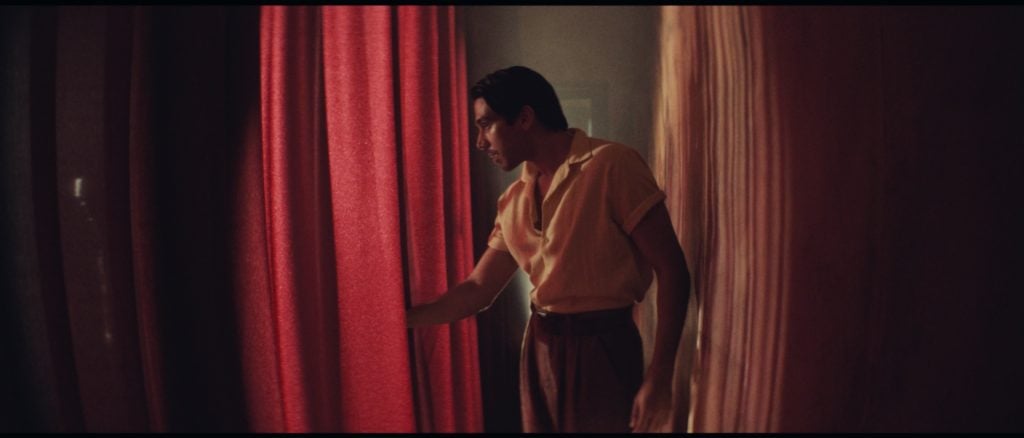
Narciso, based loosely on real figures, tells the story of the titular young man (Diro Romero), who has recently returned to Asunción from the big city of Buenos Aires. Because of his time there, he has been exposed to Rock n Roll music. His infectious energy and dashing good looks make him a captivating figure on the National radio station, run and owned by Don Luis Bermúdez, better known as Lulú (Manuel Cuenca). In many ways, Lulú is symbolic of the entire film, caught between two worlds. The old world of classic Paraguayan music (and morality) and the hidden nature of his own desires, that sexual freedom easily symbolized by the new form of music brought back on the shoulders of the youth.
Narciso, for better or worse, is more of a symbol than anything else. Importantly, despite his connection to music, he is not a singer or a performer, at least not in a stereotypical fashion. But he delivers the message of this freedom as much through his voice as through the sway of his hips. Those looking for answers to his death, shown in the opening scene of the film, will be sorely disappointed. This is not what writer and director Martinessi is interested in discovering. Instead, his focus seems to be on the effects of progress, especially in how leaders and governments will warp it to stay in power.
The subplot of a foreign character bringing fresh water to Paraguay, just as Narciso brings the music of Chuck Berry and Fats Domino (not to mention Bill Haley and his Comets) to the people, is a parallel that is easily drawn, if not brought to a satisfying conclusion. And that is not particularly surprising as powerful governments always seek to squash freedom and liberation, sexual or otherwise. Narciso’s role, as a symbol of desire to both men and women, only rings true because of Romero’s easy charms as he moves from one sexually charged situation to another.
Cinematographer Luis Arteaga is another star of the show, lovingly filming Romero, making him feel unattainable, yet the star of the show. Additionally, his use of light, specifically backstage at the radio station, hammers home the point of the film. Modernity is a light in the darkness. Many times, Artaega films Narciso with lights behind him, bending its beams around him to light the frame. Narciso, rock n roll, sexuality, and rushing water; all of these things are bringing truth and freedom to the people. Even in moments shrouded in violence, such as young men grappling with one another, light floods in, showing us the truth.
Now, it should be noted that, narratively, Narciso loses its way a number of times. Although mostly necessary, there are many scenes showing the machinations of the radio station behind the scenes, which could have been excised or changed for a tighter narrative. However, using the text of Dracula as a radio play (which the government frowns on just as much as new music) is a stroke of genius. It shows us that Lulú is capable of standing up to powers, at least in moments.
Art is always political. Art is revolutionary. This can even be true when performing texts that are hundreds of years old. The darkness, and danger, inherent in both rock n roll and Bram Stoker’s great work can frighten the old guard that desires control. It is no coincidence to choose Dracula, a story about (among other things) the loss of sexual control, exactly what the older generation fears in this new music. Narciso is a film of complex themes, addictive energy, and challenging norms. Watching it, especially when Diro Romero is onscreen, is to feel the sway of radicalized youth and freedom. The film may not have a happy, easy, or efficient ending. But such is life. These losses are all counted as the arc continues to bend.
Narciso had its World Premiere in the Panorama section of the 2026 Berlin International Film Festival.
Director: Marcelo Martinessi
Writer: Marcelo Martinessi
Rated: NR
Runtime: 101m



![‘The Boys’ Season 5 Premiere Doesn’t Pull Any Punches [SPOILER WARNING]](https://cdn.geekvibesnation.com/wp-media-folder-geek-vibes-nation/wp-content/uploads/2026/04/THBY_S5_UR_501_00331_R2_3000-450x300.jpg "‘The Boys’ Season 5 Premiere Doesn’t Pull Any Punches [SPOILER WARNING]")