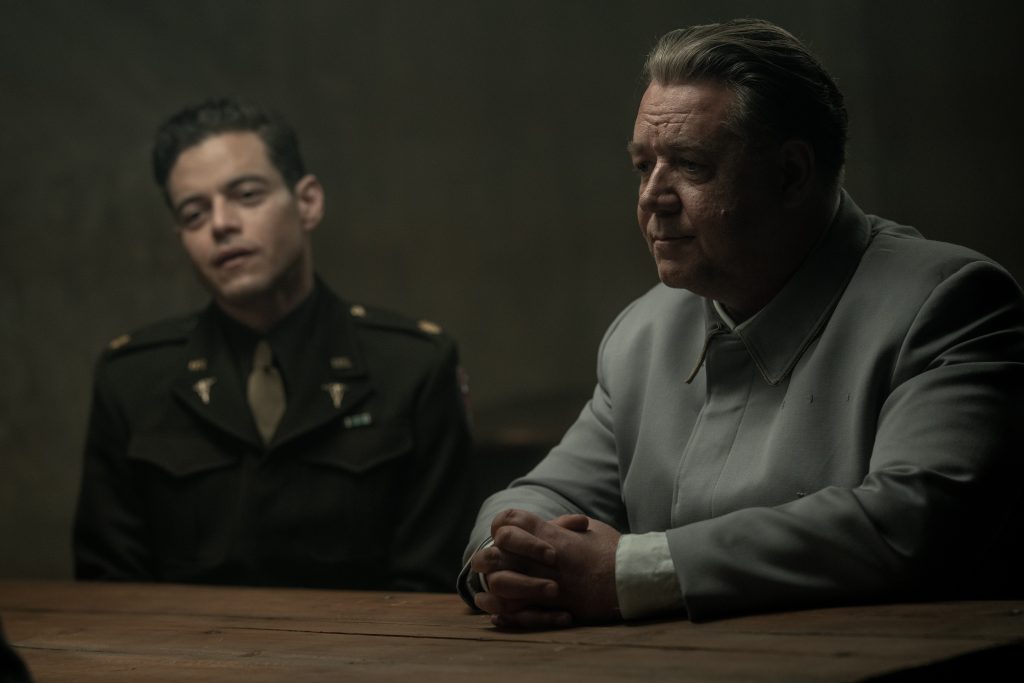
The aims of Robert H. Jackson in establishing the Nuremberg trials were to develop a standard of international law, as well as provide a complete account of the Nazi’s aggressions and atrocities.. Further, the ultimate goal of these trials was to deter rogue actors and states from committing war crimes. As a historical lesson, the film Nuremberg serves as a reminder to the watching world. As a film, it is both a compelling legal drama and a showcase for two masterful performances, even if the pacing runs amok.
Nuremberg is the story of how the famous trials came to pass, spearheaded by Supreme Court Associate Justice Robert H. Jackson (Michael Shannon). The film builds to the trials, showing the intricacies that created the tenets of the eventual proceedings. Much of the film’s runtime is devoted to an account of the trials, specifically Hermann Göring’s (Russell Crowe). The backbone of the movie is an account of how military psychiatrist Douglas Kelley (Rami Malek) was tasked with evaluating the mental competency of the Nazi leaders before the trial. Specifically, Kelley’s meetings with Göring. We witness an obsessive, if not disturbing, patient/client relationship that plunges into the mind of evil and the dark side of humanity.
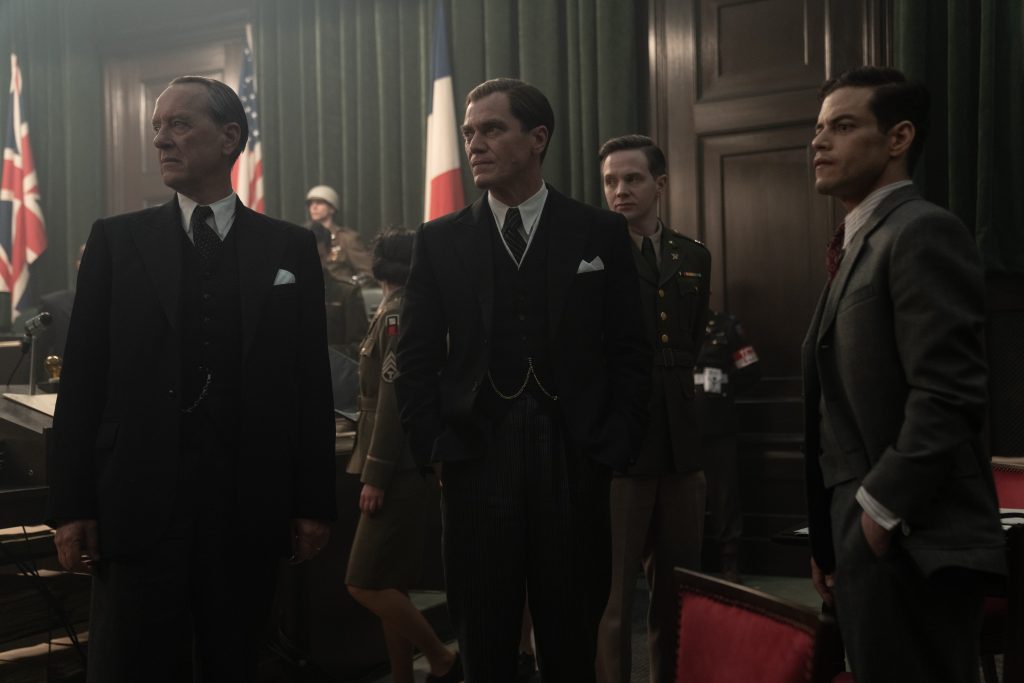
The main thrust of the film is that we focus on the trials, specifically Göring’s. The cross-examination of Göring by Jackson and British prosecuting counsel Sir David Maxwell-Fyfe (Richard E. Grant) plays out like a white-knuckle legal thriller, with the appropriate moments when they together outmatch Göring. Both Shannon and Grant are excellent in their roles. They relish in their verbal jousts with Crowe. We witness a historical event dramatized by a masterclass in acting.
Much of the film focuses on the meetings between Kelley and Göring. Here we witness a first-rate exchange between Malek and Crowe. Their scene-chewing moments ignite a cinematic spark in the film. Malek imbues a conflicted humanity as a psychiatrist finds himself playing mind games with Göring. Crowe is indomitable in this film. He brings a real-life monster to life in a complex performance that showcases pure evil.

Image: Scott Garfield. Courtesy of Sony Pictures Classics
There should be genuine discussion during award season about the magnitude of Crowe’s performance. Yes, there is some criticism of the lack of actual German performances in the film, but that shortcoming does not diminish Crowe. If anything, it only increases the dark magic he possesses on screen. It is a powerful and unsettling portrayal of a psychopathic monster who looks no different from anyone else. Crowe’s performance shows that evil can take many forms. Yet, the most frightening form does not hide in the shadows; it exists in plain sight.
In the final exchange between Göring and Kelley, the former asks the latter, when history is written, will the world even acknowledge people like himself as human? Kelley never answers him. However, in real life, and as we briefly see in the movie, he wrote about his experiences in 22 Cells in Nuremberg. A Psychiatrist Examines the Nazi Criminals.
In that book and in the final moments of the film, Kelley does answer that question in the words of RG Collingwood: the only clue to what man can do is what man has done. Wisely, the film ends with the quotation above, which should give us pause and invite introspection.
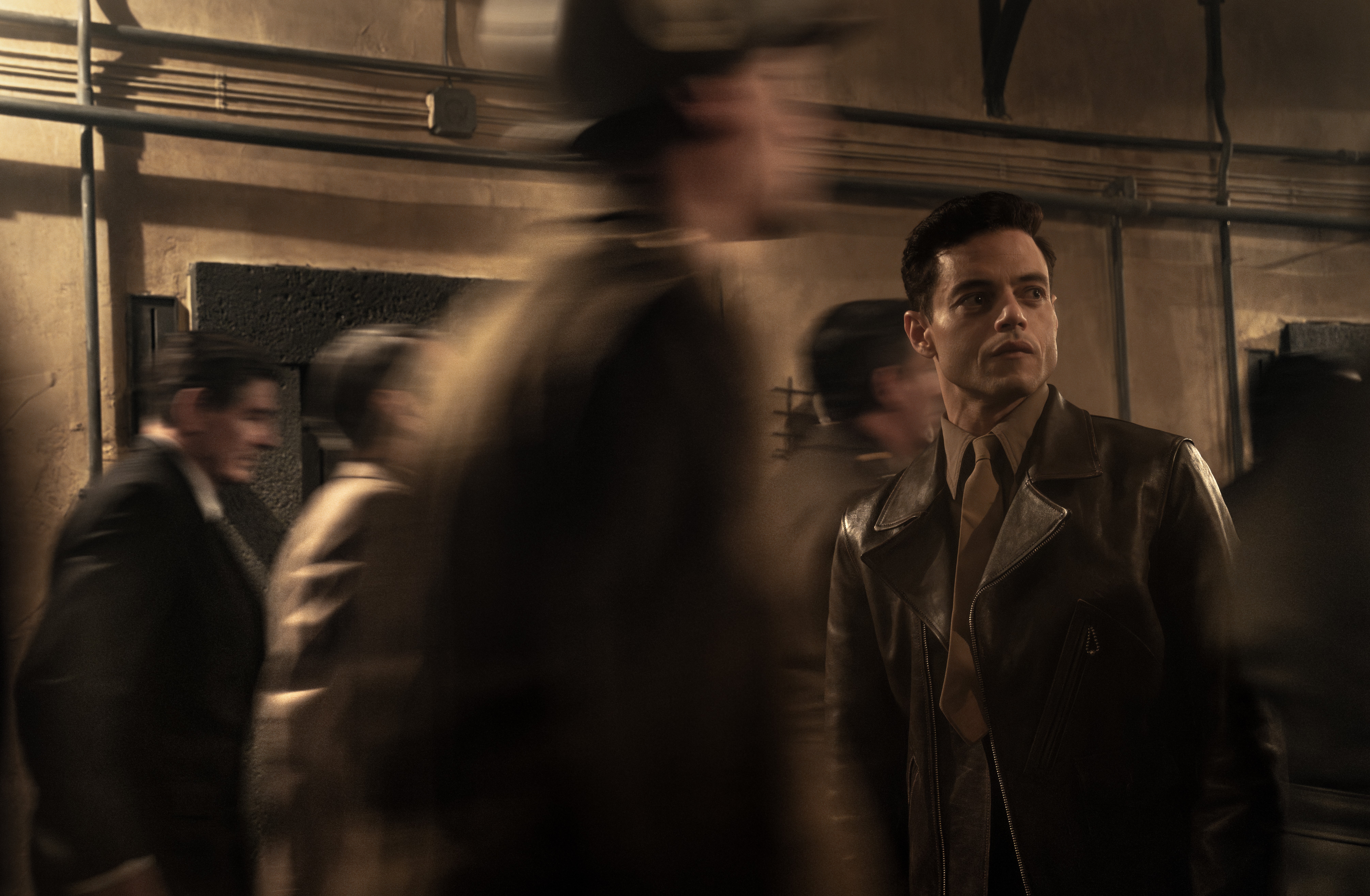
Image: Scott Garfield. Courtesy of Sony Pictures Classics
The movie is a historical lesson that sadly seems lost in the pages of world history. It is a necessary film that uses the scope and scale to tell a story that serves as an essential reminder of humanity’s nature. Further, the film spotlights the efforts of the Nuremberg trials, which laid the foundation for international law and war-crime culpability that persists to the present day.
Now, from a historical perspective, the film is a job well done. From a cinematic standpoint, it’s a mixed bag. It is such a broad, encompassing timeline that there is a sense of shortchanging time. Nuremberg does an explicitly effective job at showcasing the trials and lets the malicious words and deeds of the Nazis speak for themselves. However, because there is a lot to cover, the pacing at times moves at a breakneck pace, then stalls to the point of frustration at other junctures.
In a way, the two movies are talking at each other. On one side is the story between Göring and Kelley, and on the other is the trial itself. Yes, there is a clear overlap between the two, but merging the two circles often shortchanges or speeds up a story, and vice versa. Running at two and a half hours with credits, this is one case where another thirty minutes might have been a service rather than a hindrance. We are left feeling as if we have witnessed an experience, but never enough to feel completely immersed.
Nuremberg will debut in theaters on November 7, 2025, courtesy of Sony Pictures Classics.

As a historical lesson, the film Nuremberg serves as a reminder to the watching world. As a film, it is both a compelling legal drama and a showcase for two masterful performances, even if the pacing runs amok.

Writing & podcasting, for the love of movies.
His Letterboxd Favorites: The Dark Knight, Halloween, Jaws & A Christmas Story.