

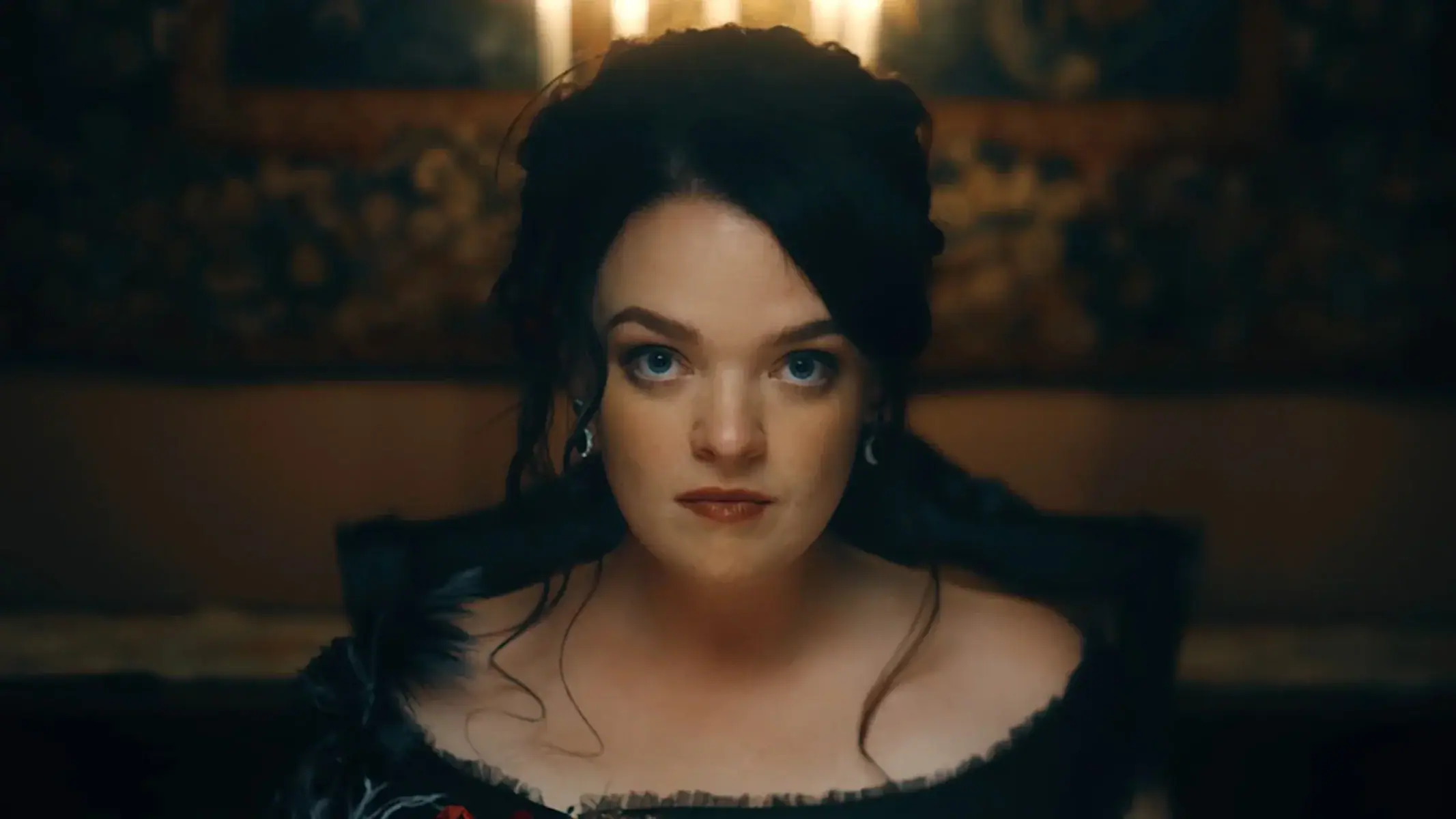
Plucked is a dark comedy about marital decay and female rage that takes place during the Gilded Age. It’s fun, scary, unhinged, and features a deliciously unlikeable female protagonist that I couldn’t keep my eyes off of throughout. It received a limited theatrical release in the United States on November 13, 2026, distributed by Dark Passage Films, with screenings planned in select markets, including New York, Los Angeles, and Rhode Island. The film will subsequently arrive on digital and VOD platforms on January 15, 2027.
When Katherine Greene resolves to divorce her emotionally unstable husband, Peter, the decision collides with a high-stakes dinner party meant to preserve appearances. As secrets surface and impulses take over, the evening spirals into chaos, jealousy, and escalating revenge, especially when his charming brother James enters the picture.
Geek Vibes Nation had the pleasure of interviewing director Usher Morgan, co-director/writer/actor Katie Vincent, and co-stars J. Anthony Crane (fresh off wrapping Outer Banks season 5) and Jared Canfield to talk about the fun of playing villains, the Gilded Age, female rage, Emily Dickinson, vulnerable moments on screen, the difficulties faced on a limited budget, indie filmmaking, and more!
You can watch the official trailer for Plucked and find additional cast and production information on IMDb.
For more GVN coverage of filmmaking outside the studio system, check out our review of My Movie Starring Paul Dano and our interview with Jim Cummings about The Last Stop in Yuma County.
Writing Plucked Together
Jaylan Salah: Usher and Katie, you wrote this together. How was the writing process, and what drew you to this particular story?
Katie Vincent: From the beginning, this has been a joint situation for Usher and me. We co-wrote it, co-produced it, and co-directed it. We were holding each other’s hands through every step of this. In terms of where it all began, I was recently getting out of a relationship and had an attitude about it. So Usher came up with a plot for our next project, and we loosely busted out our treatment. One night there was a storm outside, and we banged it out. Granted, the story shape-shifted considerably from there, but once we had the structure of the film, everything fell into place. We would tackle a scene at a time. We wrote some of them together and others separately, then we’d come together and chop them up. And a movie happened on the other side of all that.
Usher Morgan: We also talked initially about doing it as a one-take play. We were brainstorming a lot. I remember we started writing this right after we did Windblown, a little short film that we did up in Charlestown Beach, and then from there Plucked took a life of its own. We were supposed to shoot it in 2020, but then COVID happened, and everything got delayed and pushed back. That meant we had an opportunity to work on the script even more.
Finding the Characters and Building On-Set Chemistry
JS: I love the dynamic between the actors, but I’m equally fascinated by the relationships between the characters. You have Katherine, Peter, and James, each bringing something different to the equation, particularly in the way the relationships shift between the three of them.
From an acting perspective, how do you maintain that chemistry and keep those interactions feeling so natural and engaging, especially when the dynamic is constantly shifting depending on who’s sharing the scene?
KV: It was neat because I had a say in the casting process with Usher and our casting director, Pat McCorkle. I had a very strong idea in my head of who Katherine was, obviously, but also who James and Peter were. When both Jared and Tony walked into the room, if you will, or the Zoom, or the tape, what have you, it was an “Aha!” light bulb moment for me and Usher. So in terms of getting to work with these people who were already into playing these characters from the beginning, I was very lucky on my end. I didn’t have to develop chemistry with these people. For me, it was just there. It was organic.
J. Anthony Crane: You always seem to exhibit in film because of the nature of the organization of film. In theater, you meet, have rooms, and slowly rehearse, then you build chemistry. In film, you get there and your first day might be your love scene or some big fight that ends the relationship. So obviously you walk in with a whole lot inside of you, and if you’re lucky, you already extend the hand of a certain amount of trust right away. And you say, “Well, we haven’t had that much time to talk about this. What if you did this? What if you did that?” But you may be way off base. When you go back and start filming the beginning of the relationship in the movie, you finally get there and discover, “Oh gee! We should have done this over here.”
But it is a fun piecemeal of putting it together. It’s what’s on the day. You’re truthful, and what you get is what you get. So you throw the line out there as far as you can.
Jared Canfield: Katie and Tony are both awesome. One of the fun—and also very meta—things was that the three of us were in the same house.
J. AC: Yeah, all of us were in the same house. I can’t believe we haven’t talked about this.
JC: We were staying in this Victorian home, and when we’d finish a day shooting the night shoots, we’d go upstairs to sleep, one or two floors up.
So there was this element of being all crammed in there together. We couldn’t really get away from each other. So you get up in the morning, and there they are.
We’re going to go get breakfast, go for a walk, and whatever it was. It was as if we were living in the world of the play.
Of course, the antics of the drama itself were thankfully not carried over to meals and such. But you walk downstairs, and all the equipment’s there. The scene you did the night before, which was all dramatic, happened right there. And to add to Tony’s point, you wonder, “How did I do what I just did? How did that go? That was crazy, and I can’t believe that I did it. Oh, well, I guess I’ll go get a coffee now.”
It was very alive the whole time, which was really special.
J. AC: We shot in order as well.
KV: We tried. And this helps. Specifically, when Usher and I were strategizing all of that, we liked the idea of staying in the house and keeping that aliveness, as heavy as it was. We wanted to shoot in order, and we maintained that for 85 percent of the shoot so that things were happening to us as they happened in the movie.
J. AC: The bruising makeup was put on and stayed on for days.
KV: Couldn’t wash it off!
JC: I remember when I had the scar, and I’d never had one put on my face before. It was so late, and I wanted to go straight to bed, so I told myself, “I’ll just skip makeup. I’m going to deal with this myself.”
So I go upstairs, and I try pulling the thing off my face. Don’t ever do that! It becomes part of your skin.
I had something like a welt under my eye. It was so dumb of me.
J. AC: We were filming one of the first scenes after Jared destroyed me, and my face was entirely made of pulp. I’d been made up, and then we got on a break.
So I said, “I need to smoke a cigarette. It was my birthday, and I was kind of celebrating.”
I wandered a block and a half down the street to a 7-11. I walked in in a tuxedo jacket, a black coat, an undone tie, and it looked as if I’d had the worst wedding.
We were in Newport, by the way. Yes, there are some lower-class neighborhoods, but close to where we were shooting, everything is a venue and very hoity-toity.
Have you seen The Gilded Age? It is still that height of wealth over there, and we were around the corner from it most of the shoot.
So that was hilarious. I said nothing, and the guy at 7-11 didn’t ask me a single question either. He was still trying to figure out what happened. He was probably thinking, “I love this job.”
In conclusion, we were eating, sleeping, and breathing it nonstop throughout the shoot.
The Appeal of Playing Villains
JS: Tony, does any role that you play compare to the coolness of playing Chandler Gruff on Outer Banks? Or is James in Plucked a whole other level of coolness?
J. AC: Jared and I talked about this when we were working. It is more fun to play villains sometimes. There’s more motivation there. You can lean in, and you don’t have to worry about being a good guy. You don’t necessarily have to say they’re bad.
The interesting thing about James, which I leaned into—and I think is the best part of the writing and this time period—is a certain amount of charm. It’s like skating around on your charm and getting by on nothing except a certain alacrity in a certain society. Again, James is not a tremendously virtuous person, but that’s the period that we were bringing out in the film. People were, “Okay, I’ve showed up. I’ve got my gloves. Where’s the booze? We’re going to eat. I can make good conversation. I can have sex with my brother’s wife. The world is my oyster.”
Then he slams into the ethical gap of both their marriages, getting caught in the meat grinder of it.
There’s so much charm written into the character. Katie and Usher were so helpful in having me lean into that.
Whereas, and thank you for observing my most recent adult male work, with that villain (Chandler Gruff) on that show, there’s no charm written into the man. He’s a cockroach. He’s continually turning up, doing bad and worse things. It’s funny because I tried as hard as I could at all times to bring in charm, and that can mean a lot of things as an actor. But if you’re doing bad things and getting away with it, you’ve got some social skill. And that’s why people get fooled all the time.
Most well-written villains have a certain degree of facility out there in the world because that’s how they get by. That’s the sociopathy of their survival. So yeah, there’s something similar there.
JS: Jared, Peter is layered and complex because we see him evolve from a neurotic, scared guy in the beginning to an increasingly violent man during his interaction with Katherine. How did you tap into his complexity?
JC: Going back to what Tony said, that just comes out of the script, and it could be hidden by how he might seem at first.
One of the interesting challenges of approaching the role was that Katherine’s POV is so strong in the story. You know how she feels. Then I looked at Peter in the script and realized, “Man, he’s got a tough lot in life. He’s been dealt a really bad hand.”
I remember working on it, showing up with Usher and Katie, and starting to work. Even the crew say, “Man, this guy’s a loser. What a dork!” But I would say, “Well, there might be more to him. We’ll see what happens.”
I like trying to figure out what this guy is after. Can he level up in his career? Can he capitalize on his position in the world? What happens if he doesn’t get to do that? And just like what Tony is talking about, it differs whether you perceive him as a villain or as a hero. It’s cliché, but he sees himself as a hero, a justified soldier of the cause, misunderstood and then—ultimately—wounded by his brother. The more you worked on it, you started feeling bad for this guy. It would be a tough row to hoe as it is.
Katherine, Female Rage, and the Gilded Age
JS: Katie and Usher, you created Katherine, who is a very enjoyable female character to watch, especially during that time period when women were constrained, and there was a lot of pressure on them. How did you bring out that fiery nature in her?
KV: No one’s supposed to be a hundred percent the good guy or the bad guy. We made a cast of anti-heroes, and depending on your lot in life, you can pick who you’re rooting for.
Granted, there is some bias towards Katherine’s perspective. But even from the get-go, we really kind of wanted everyone to find Peter somewhat sympathetic the more you thought about him. Because even if you are playing a villain, you have to root for yourself.
You have to be the hero in your own story. I think Katherine is a horrible person. She does horrible things, but that doesn’t mean that her wants are horrible. It’s just that the way she goes about it is messy. That’s part of who she is. It’s also probably a side effect of her circumstances of the time period.
It is this caged-bird situation where she’s stuck. She’s trying all these different ways to get unstuck. Whether that be the polite route of getting a lawyer, doing the right thing, and getting this divorce, as provocative as it may be, or saying, “Screw it!” and screwing her husband’s brother. She says, “Why not? Because I can screw you.” There’s a lot of rebellion in her, and that was what I tried to keep in mind. Good people can do bad things. Bad people can do good things. I let that play out.
UM: The whole story is an allegory for change. We made a deliberate effort, even as far as the music that we used, the cinematography, and the way that we filmed everything. It was supposed to feel like a modern story, a retelling of an old story that wouldn’t die. There are characters that wouldn’t die in it, too. But the idea is basically an allegory for change.
You have one agent of change. Somebody who needs to change their circumstance, and there’s something getting in the way that is rooted in old systems designed to keep her where she is. This is what appealed to me when we started working on it. I did see it as a bird in a cage.
You can question the morality or the intentions of the bird left and right. But at the end of the day, it is a story about somebody who wants to be free. We get to sabotage ourselves a lot in those kinds of situations when we face them in real life.
I don’t necessarily think they’re all bad people. They made bad decisions. And we’re meeting them on the cusp of one night where everything goes to s***. Excuse my expression.
The Influence of Emily Dickinson
JS: Using poetry from Emily Dickinson to reflect Katherine’s situation is a smart move. Why did you pick Dickinson as an inspiration?
KV: The movie’s original title was The Thing with Feathers, based on her poem “Hope is the Thing with Feathers.” That’s why the book that Katherine holds in the beginning had a lot more relevance when the movie was specifically titled that. But now the movie still floats in the world of it.
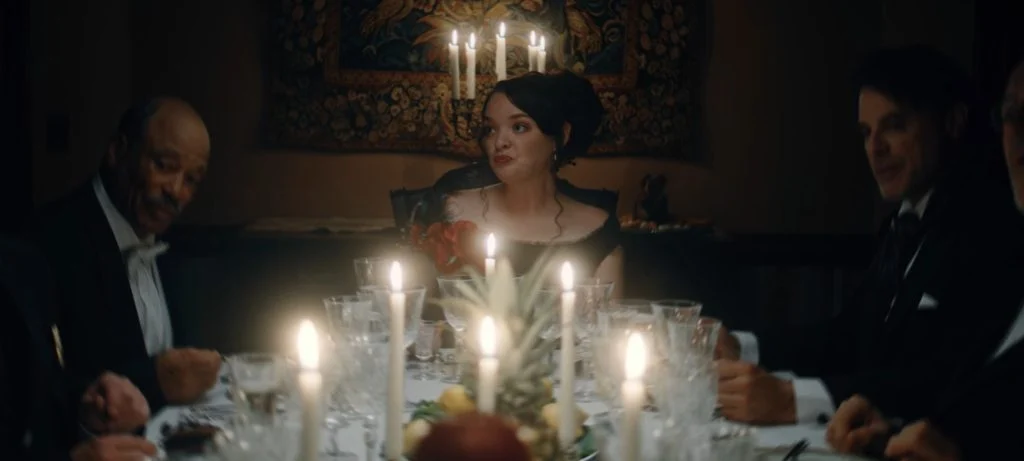
Filming the Dinner Party
JS: Shooting these long scenes where there is a banquet or a party, are they as exhausting as they seem? How do the dynamics feel? Does the director shoot more than one take and the actors have to repeat? Or are they smoother than the average viewer thinks?
UM: I wouldn’t say smooth. There are two elements that play here. You have the filmmaking side, and you have the acting side. From a filmmaking side, we were shooting in a historical mansion, and we had to be very careful about what we were doing and how we were doing it. You can’t rig lights a certain way.
There are a lot of limitations as far as how you’re supposed to shoot certain scenes. I love the way it ended up, especially in the banquets where the camera passes through the candles and you get to see them all. And then one character stands with candles on each side, which makes him look like the devil.
We had fun playing with the geography of where lights are going to be in the scene. With regards to the acting side, we rehearsed a lot as much as we could, at least in the space while everybody was sitting up. I’ll let Katie take up the acting element.
KV: There are moments of difficulty, and that’s the thing with these setups and the space that we were in. You have a plan going in, but you’re using certain equipment, which leads to certain things starting to happen, so you have to scratch that and rebuild. Especially when you’re working in an ensemble, and it is a party, you want to keep that energy because conflicting things need to happen. It also takes a long time to get ready in these outfits, and there were times when I would disappear for two or three hours because of hair, makeup, and the corsets. So you just plan for the bigger picture and trust that all the smaller pieces of what needs to happen all at the same time will come together, while also having to give a performance at the end of it that’s grounded in truth instead of worrying about the million other things that go into putting on this party in front of the cameras with these people.
UM: We were lucky enough to have good talent with us, good actors.
KV: Absolutely! It’s great when people prepare. That’s when it becomes fun. We all know our lines, and we all have choices, so now we can play dress up and do crazy stuff.
JC: I remember the food during the party that was something else.
J. AC: The guy who was creating the food thought he was on Top Chef and that each shot was just going to be watching him assemble his mise en place. However, there’s literally one shot of somebody eating a hot dog, the only food that you see being eaten in that scene. And that took hours out of our setup, from minute to minute, for them to rush on and change. At the end of the day, I told them, “Just do the candles, that’s all that matters!”
The candle work was amazing because, depending on what time of night it was, the candles would be at various heights. When we wrapped the movie, there was a giant box of candles, so I grabbed this big box and took it to my house. Now I’ll open up this box and get candles from a huge one to a nub of a candle.
We had a bunch of improvisational, fun, inventive actors who were waiting for Katie and Usher to say, “Go for it. Just have fun. Let it spin out in some direction, and we’ll keep shooting.” They called all those beautiful flowers for a scene, which I thought looked and felt great.
We lost an actor halfway through shooting this big, long scene, and we had to reshoot around that guy with his replacement, so that was wild.
UM: He was the main actor in the scene, and everyone was supposed to be congregating around him. The whole scene was supposed to take place around one person. We only had the team for two days, so all the actors were showing up, but the main guy was not there. We had to pretend that he was there and shoot around it. I’m surprised we pulled it off.
J. AC: You would never know!
KV: We recapped in the middle of the night, and people were showing up after taking the bus. It was wild
JC: Usher and Katie, you guys were so cool under pressure and indefatigable. There were definitely some chaotic moments and uncertainties, but you guys played it off like you’d been in the war for 40 years. You both had the attitude of, “I’ve seen it all.” They’re very steady captains at the helm.
J. AC: For a hangout that was structured like a reality show with all of us in the house.
UM: The biggest pressure for us was not only the schedule, but also the budget. This movie has such a tiny budget and we were very ambitious as far as what we wanted, so every decision had to be pushed against how much money do you have to spend? That was one of the more stressful elements of the shoot, the financial element.
The Challenges of Independent Filmmaking
JS: As an indie filmmaker, what are some of the other barriers that you faced while trying to get your project out the way you wanted to be?
UM: Time! We didn’t have much time. We had many scenes that we prepped and were going to shoot, and we ran out of time. That’s the disheartening part about indie filmmaking: you run against the clock a lot, and if you don’t have a huge budget, then you run out of time.
The Most Difficult Scenes to Film
JS: What was the most difficult scene for all of you to shoot?
KV: It’s not a scene, specifically, but I remember it was interesting because I wasn’t anticipating this to be so affecting. When we started doing the scenes where we’re tied up, that was a huge mental adjustment for me, because when they asked me, “Katie, are you ready for this?” I looked at the schedule and realized that for the next 10 days I’m tied up. I thought, “Oh my!” But I actually ended up using the surprise of my discomfort to help me with the scene, because Katherine would be surprised and uncomfortable. So in real time, I had to digest that, and I didn’t have a choice because of the time constraint to give myself 10 minutes to prepare in advance. So on the first shoot day, they tied my hands and feet, and I thought, “Okay, I trust these people.” It was a mental thing, but then we were good.
JC: It was funny because I remember we caught ourselves yelling at each other. Like, “You wrote this?”
That whole section by the fire when Tony and Katie are bound, and Peter’s going off, felt like a short film just to my experience within the movie. It felt like its own three-act play. Those were definitely long nights, and we were trying to get through it and not get anybody hurt. So yeah, that was quite long. I think it might be a four- or five-day shoot.
KV: We did that in two chunks, too. We did the farcical part of it with the morphine and the more comedic beats between Tony and me. Then we did the big argument, the marriage story parts that we had to stretch over three days. We had to shoot around it because Jared’s very tall. I’m sitting down on the floor, he’s pacing, and the camera is blocking. We found in real time that we had to shoot his lower half and then his upper half, and make sure those match.
UM: What you do when you film somebody really tall talking to somebody sitting down is to use really wide lenses. But we couldn’t do that, because of the way that the lighting was set up and the space was relatively small and compact. We had to be so deliberate about the types of lenses we would use and how we would frame Jared versus Katie. That was probably one of the bigger challenges, especially for me: figuring out how to get to a shot where there are 12 different things that we can’t use. There’s C-stands, there’s a light sitting over here, and it feels a little claustrophobic. So you need to figure out how to light it quickly, but also shoot it relatively fast without interrupting and intruding on what the characters are doing. We had the same thing happen in the dinner party scene, because there were so many people.
Right before we shot this, I read Peter Jackson saying that there was this big scene in The Hobbit where he had to film individual inserts of 20 people sitting around the table. So going back to Plucked, what was challenging for me was trying to figure out how to get all that stuff without the lights and the equipment getting in the way.
J. AC: For me, you have to go with an instinctual trust, because we were playing something very dramatic. When Jared’s character (Peter) would be talking to us, we were in a serious, in a Strindberg play. And then he would walk off to… I guess the character used the bathroom a lot. He would walk off, and it would immediately brighten up, and we’d look at each other and go, “Hey, you. Over here!”
It became a farce, and that was interesting to keep trying. I don’t think even we knew that was going to be the tone of it. But when you work with limitations and a clock, funny things sort of happen. We kept falling all over each other, and you decide in the moment to lean into that. In other words, every challenge becomes the strength. You lean into the thing that’s restraining you and think, “I guess this is going to be the virtue of what we do here.” The minute you do that, you end up with the gem of the ocean. Because when I look at those scenes, when I’m watching the movie, this is where the tone of the movie starts to feel original for us.
Every time these serious characters break into something, like when Peter and James got into the shoving match for four times too long, we knew then that was funny at the time. We thought maybe this wouldn’t survive what this becomes when they look at it.

Jaylan Salah Salman is an Egyptian poet, translator, and film critic for InSession Film, Geek Vibes Nation, and Moviejawn. She has published two poetry collections and translated fourteen books for International Languages House publishing company. She began her first web series on YouTube, “The JayDays,” where she comments on films and other daily life antics. On her free days, she searches for recipes to cook while reviewing movies.