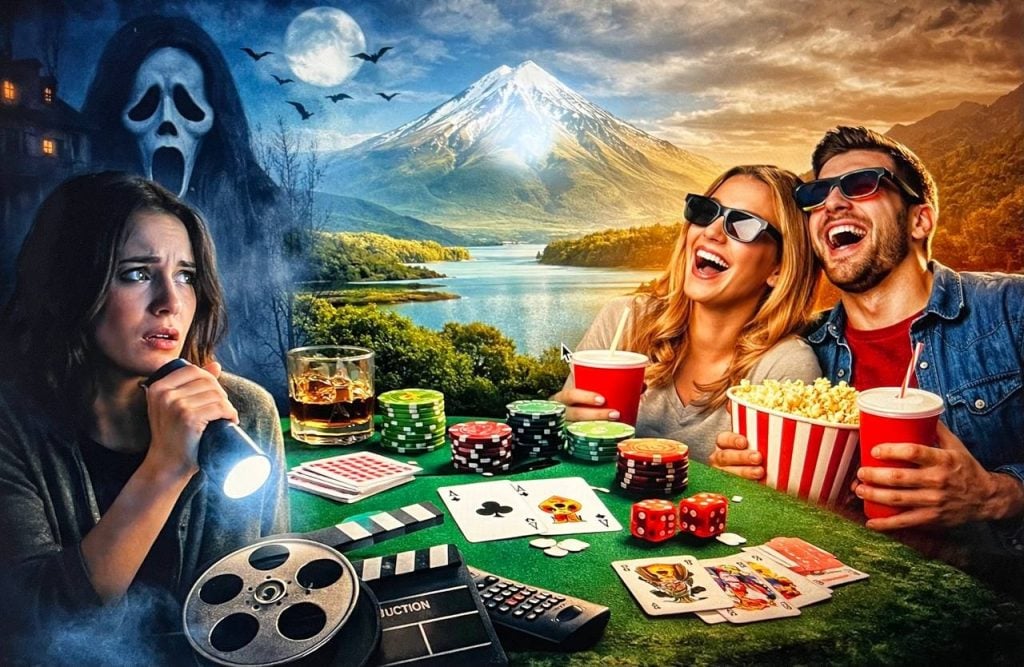
Poker has a grip on storytellers that few other games can match. It is not about the cards themselves; it is about what happens between the players. The tension of holding a strong hand while pretending otherwise, the slow unraveling of a bluff, the moment when everything rides on a single decision: these are dramatic elements that writers and directors have been reaching for across decades of film and television. Poker does not just fill screen time. It earns its place in some of the most memorable scenes ever made.
What Makes Poker So Dramatically Useful
Most games are transparent. Chess shows you everything. Blackjack is you against the house. But poker hides information, and that hidden information is where story lives. A character’s face at the table tells you who they are under pressure. Do they flinch? Do they overplay calm? Do they take risks that seem irrational until you understand their desperation? A poker scene can reveal all of this without a single line of exposition.
Directors understand this. A two-minute poker scene can do the work of an entire character study. When we watch Daniel Craig’s James Bond face Mads Mikkelsen’s Le Chiffre across the baccarat table, later adapted to Texas Hold’em, in Casino Royale (2006), the stakes are financial but also psychological. Bond is not just trying to win money. He is trying to break a man who funds terrorism by destroying his reputation in the one place he believes he cannot be beaten. That is storytelling compressed into card play.
The bluff is cinema’s favorite tool because it mirrors lying, and lying is at the heart of most dramatic conflict. When a character bluffs at a poker table, the audience is watching a performance within a performance, an actor playing a character who is, in turn, acting. That layering creates a kind of dramatic electricity that is hard to manufacture any other way.
The Films and Shows That Got It Right
Rounders (1998) remains the gold standard for poker on film. Matt Damon plays Mike McDermott, a law student and gifted poker player trying to stay straight while his friend Worm, played by Edward Norton, drags him back into the underground card rooms of New York.
What makes the film work is not the poker mechanics, though those are accurate and well observed, but the way poker functions as a language between characters. Mike reads people for a living. He knows when Teddy KGB, played with unforgettable intensity by John Malkovich, is weak. That ability to read people is both his gift and his curse in every other part of his life.
Television has found equally powerful uses for the game. Suits used poker scenes to establish the hierarchy between Harvey Specter and his opponents before a word of legal argument was made. Poker Face, the Peacock series starring Natasha Lyonne, inverts the premise entirely; its central character cannot be lied to, which makes poker a recurring site of irony and tension throughout the show. Even Breaking Bad used a quiet poker game between Walt and his neighbors to establish domesticity before dismantling it entirely.
What these productions share is an understanding that poker is not a backdrop. It is a pressure chamber. Put two characters in opposition across a felt table, and you have an automatic structure: ante, flop, turn, river, showdown. That built-in escalation maps perfectly onto dramatic structure, which is probably why writers keep returning to it regardless of genre.
The Wider Context of Poker Beyond the Screen
Poker as a game has not been limited to the screen only. Its cultural weight extends far beyond film sets and streaming platforms into real competition, real stakes, and real human drama that rivals anything a scriptwriter could invent. The reason poker translates so well to storytelling is partly that the stories it generates in real life are already extraordinary.
Poker tournaments have always been regarded as one of the essential proving grounds for human strategy, composure, and psychological endurance. The World Series of Poker, which began in 1970 and grew into a global institution. It also triggered what became known as the poker boom, flooding cardrooms and online platforms with a generation of new players who believed they could do the same.
Online poker is worth mentioning as well, particularly tournament play. The online format has made structured poker competitions more accessible to players who may not regularly visit live card rooms, while also introducing a wider audience to formats such as Sit & Gos, multi-table tournaments, freerolls, satellites, and knockout events. LegalUsPokerSites.com’s guide to poker tournaments provides a useful overview of how these different tournament formats work and what distinguishes them from one another. This accessibility has helped poker maintain a presence beyond traditional casinos and contributed to the game’s broader cultural reach.
Live poker streaming has added yet another dimension. Platforms like Twitch turned high-stakes cash games and tournament final tables into appointment viewing, with commentary, hole-card cameras, and personalities who built real audiences. The drama of a $500,000 pot being decided in real time, with a live chat reacting, is genuinely compelling entertainment, and it feeds directly back into the cultural visibility that makes poker such a reliable subject for screenwriters.
Why the Timing Feels Deliberate Right Now
There is a reason poker content has seen a resurgence across streaming platforms and prestige television in recent years. Audiences have grown more sophisticated in their understanding of game theory, probability, and decision-making, concepts that poker dramatizes in accessible, human terms.
Shows like Poker Face and films like Molly’s Game (2017), Aaron Sorkin’s sharp account of underground high-stakes poker games run by Molly Bloom, arrived at a moment when viewers were ready to engage with the mechanics beneath the drama, not just the surface tension.
Molly’s Game is particularly interesting because it treats poker as a lens on power, wealth, and gender. The players at Molly’s tables, many of them anonymous in the film but clearly drawn from real Hollywood and sports figures, use poker as a theater for dominance. Winning was never purely about money. It was about status, ego, and control. Sorkin understood that and built an entire film around it.
The broader cultural conversation around risk, behavioral economics, and rational decision-making has also elevated poker’s credibility as a subject. Annie Duke’s work on decision-making under uncertainty, which draws heavily on her professional poker career, found a mainstream audience in business and self-help circles. That crossover legitimized poker as more than gambling; it framed the game as a discipline, a framework for thinking clearly when outcomes are uncertain. And storytellers noticed.
Morgan Vance is an iGaming analyst with nearly a decade of experience covering online casinos and industry regulation. Known for breaking down complex betting systems into easy-to-understand insights, Morgan has reviewed over 500 casino platforms worldwide. His work often explores the intersection of blockchain technology and gambling, particularly the rise of crypto casinos and provably fair gaming.