Tarsier Studios returns — and this time, it’s personal.
When Tarsier Studios lost the rights to Little Nightmares, the reaction from fans was about what you’d expect — disappointment, frustration, and a genuine sense of loss. The series they had built from the ground up was now someone else’s to continue. But the mourning didn’t last long. Within a year, the original team announced a spiritual successor, quietly pushing the “impostor” sequel aside before it even had a chance to land.
REANIMAL arrived carrying serious expectations. It promised to be darker, more mature, and scarier than the beloved duology — a new nightmare in a new world, with none of the familiar faces. No Belly, no Sixth, no Black Tower. Instead: war orphans moving through a flooded, grotesque dreamscape in search of missing friends. For fans who had already written off Little Nightmares III, this was exactly the game they’d been holding out for.
Whether it fully delivers on that promise is a more complicated question. But as an artistic statement — as a piece of work that lingers after the credits roll — REANIMAL is something worth talking about.
A World That Tells Its Own Story
REANIMAL earns its spiritual successor label from the first moments. The faded color palette punctuated by rare vivid accents, the overwhelming scale of a dangerous world against two tiny, fragile children, the suffocating corridors and creeping sense of hopelessness — it’s all unmistakably Tarsier. The studio hasn’t abandoned what made Little Nightmares work. It’s built on it.
The main character — a boy with a noose bag over his head — wakes up alone in a boat on an open ocean and immediately sets off in search of his missing friends. The game offers no tutorial, no exposition, no hand-holding. The rules of this world are yours to figure out. First on the rescue list is a girl in a bunny mask, who doubles as a cooperative partner if you’re playing with someone. The relationship between the two kids is the emotional anchor of the whole experience.
Tarsier tells its stories through environment, not dialogue. Conversations between characters are rare and brief. To understand what’s actually happening, you need to pay attention to the eerie landscapes of the ruined city, study the concept art unlocked along the way, and let your imagination fill in the gaps. It’s an approach that rewards patience and punishes distraction. Expect to finish the game with a hundred unanswered questions — and to find that strangely satisfying.
At its core, REANIMAL is a bleak journey through a post-apocalyptic world that doubles as a powerful anti-war statement. The imagery is striking and deliberate — a battlefield, a military bunker, an orphanage, a hospital — each location layered with meaning that reveals itself slowly. The game has something to say, and it says it without ever spelling it out.
The tension REANIMAL builds is the kind that sticks with you well after you put the controller down. If you’re the type who enjoys high-stakes atmospheres even away from the screen, it might be worth looking into offers on 7 Gear Casino — a low-risk way to explore what the platform has to offer while you’re waiting for your nerves to settle.
Atmosphere Over Jump Scares
REANIMAL doesn’t rely on cheap scares. There are no sudden loud noises engineered to make you flinch, no darkness hiding a single obvious monster. Instead, the game asks you to stay alert in a quieter, more exhausting way — listening for rustles, watching the background for movement, anticipating something that may or may not come. The sound design is exceptional throughout, doing as much heavy lifting as the visuals.
And yet, being candid: REANIMAL scared me less than Little Nightmares did. The reason comes down to the villains. The original games drew horror from distorted human figures — the Teacher, the cooks, the wave of Belly visitors — enemies that felt familiar and unpredictable at the same time. There’s something uniquely unsettling about a human form twisted into something wrong. REANIMAL’s animal-based enemies are disturbing, but they don’t carry the same visceral dread. The first quarter of the game is genuinely tense. After that, the horror softens into something closer to mild unease.
The dynamic camera is one of the game’s genuine strengths. During chases, it shifts and tilts to frame the action cinematically, turning gameplay sequences into something that feels directed rather than just played. Every few minutes, the game produces a shot so well-composed it practically begs to be screenshotted. It’s one of the most visually confident games in recent memory.
Gameplay: Where Things Get Complicated
The journey takes the children through a forest, an abandoned city, a hospital, a battlefield, a military bunker, a hotel, a cinema, and an orphanage. Each environment is richly detailed and worth exploring slowly — secret rooms and hidden content reward thorough players, though finding everything likely requires a second playthrough or a guide.
The pacing leans heavily on short, emotional chases interspersed with light exploration and occasional puzzles. For a game so focused on atmosphere, this mostly works — there’s something to be said for keeping the experience lean, free of side activities that would dilute the tension. But the puzzle design is where REANIMAL genuinely falls short.
There are fewer than a dozen puzzles across the entire game, and calling them puzzles is generous. They rarely ask anything of the player beyond the most basic logic. Compare this to the original Little Nightmares, where something as simple as opening a door could become a small story in itself — dragging a chair across the room, climbing, problem-solving. REANIMAL replaces that environmental creativity with a crowbar. You find it early, and you use it constantly, in essentially the same way, throughout the rest of the game.
Interaction with the environment is similarly thin. Objects like cans and bricks can theoretically be thrown, but the mechanic serves a meaningful purpose exactly once in the entire game. The world looks rich and interactive, but the actual range of things you can do within it is narrower than it appears.
Game Design Choices That Frustrate
The more significant issue is a handful of game design decisions that feel like they belong in a film rather than an interactive experience. REANIMAL leans so hard into ambiguity that it occasionally forgets to communicate basic gameplay logic to the player. Some sequences are so abstract that it becomes genuinely unclear what you’re supposed to do or why — which works as surrealist storytelling but fails as game direction.
The most glaring example comes in the orphanage. Throughout the game, you deal with certain enemies using a crowbar — straightforward, consistent, effective. Then you enter a bedroom that looks identical to the ones before it, try the same approach, and get killed instantly. It turns out this particular room requires stealth. Nothing in the environment signals that shift. No visual cue, no behavioral difference in the enemies, no design element that tells you the rules have changed. Several players — myself included — spent multiple attempts trying harder at the wrong solution before realizing the approach itself needed to change. That’s a communication failure, not a difficulty spike.
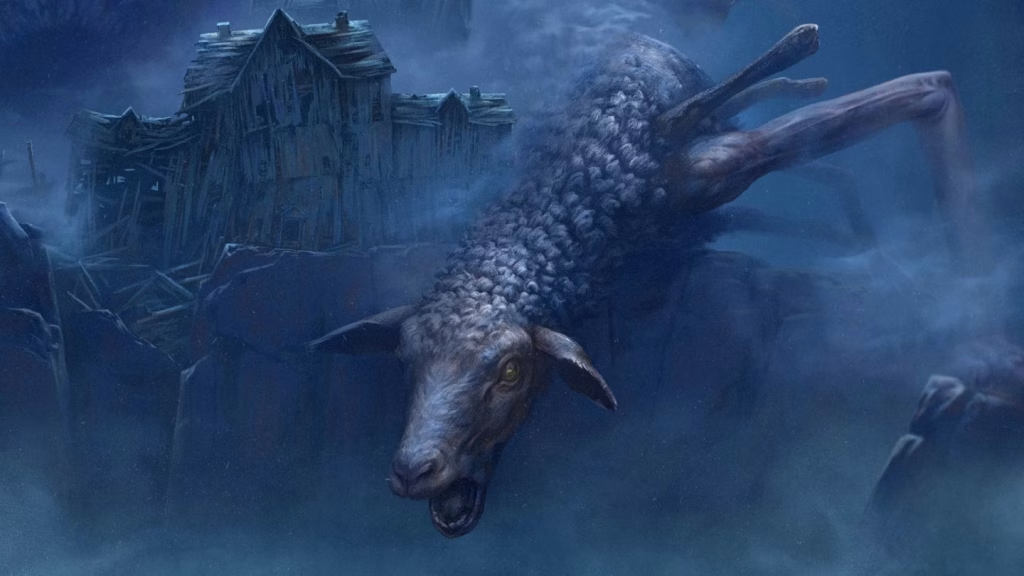
These moments are frustrating precisely because the rest of the game is so confident and intentional. When REANIMAL works, it really works. The first boss and its shifting forms are genuinely memorable. The final sequence lands with real emotional weight. The anti-war message, delivered entirely through imagery and environment, is more effective than most games manage with hours of cutscenes.
Every Frame an Art Book Page
Tarsier’s background in visual design has always been evident, but REANIMAL pushes it further than anything the studio has done before. The lighting work alone is remarkable — each location uses shadow and color accent with the precision of a cinematographer. The result is a game that looks stunning even in its most disturbing moments, and disturbing even in its most stunning ones.
Sound design matches the visuals step for step. The ambient audio creates a constant low-level anxiety that never quite lets you relax. The score knows exactly when to go quiet. Voice work is minimal by design, but what’s there carries weight. REANIMAL is the kind of game you’ll want to play with headphones in a dark room — not because it’s trying to scare you cheaply, but because the full sensory experience is worth having.
Final Verdict: Flawed, Beautiful, and Worth Your Time
REANIMAL is easier to admire than it is to play, and that gap matters. The puzzle design is thin, the environmental interaction underwhelms, and a few key moments fail to communicate their own rules clearly. These are real problems, not minor quibbles.
But the things REANIMAL gets right, it gets spectacularly right. The atmosphere is suffocating in the best way. The visual identity is among the most distinctive in modern horror. The anti-war narrative, told without a single line of exposition, is genuinely powerful. And as the opening chapter of a new independent series from Tarsier — one unshackled from the Little Nightmares brand — it’s an exciting, mature statement of intent.
If you came looking for a game that plays as brilliantly as it looks, you may leave slightly disappointed. If you came for a dark, artistic horror experience that stays with you long after it’s over, REANIMAL delivers. Sometimes that’s enough — and here, it almost certainly is.
Quick Breakdown
What Works
- Exceptional sound design that builds constant, low-level dread
- Outstanding lighting and use of visual accents throughout
- Every frame is composed like a page from an art book
- Mature, layered anti-war themes delivered entirely through environment
- Dynamic camera that turns chase sequences into cinematic moments
- A memorable first boss with a genuinely unsettling range of forms
- A final act that lands with real emotional weight
- Narrative that rewards patience and repays a second playthrough
What Doesn’t Work
- Fewer than a dozen puzzles — and none of them challenge you
- Limited environmental interaction despite a richly detailed world
- Scarier in the first quarter than it is for the rest of the game
- Some game design choices prioritize ambiguity over clarity
- Key gameplay rule changes go unSignaled, leading to avoidable frustration
- The cinematic camera occasionally works against the player
- Thin cooperative mechanics — the AI partner outperforms most human ones

Elara is a dynamic writer and blogger who specializes in pop culture and movie reviews. With a background in film studies and journalism, she combines her deep knowledge of the entertainment industry with a sharp, insightful writing style that keeps readers coming back for more.

![‘Black Zombie’ Review – Power To The Zombie [SXSW 2026]](https://cdn.geekvibesnation.com/wp-media-folder-geek-vibes-nation/wp-content/uploads/2026/03/Black-Zombie-BZ-STL46-2-300x169.jpg "‘Black Zombie’ Review – Power To The Zombie [SXSW 2026]")