
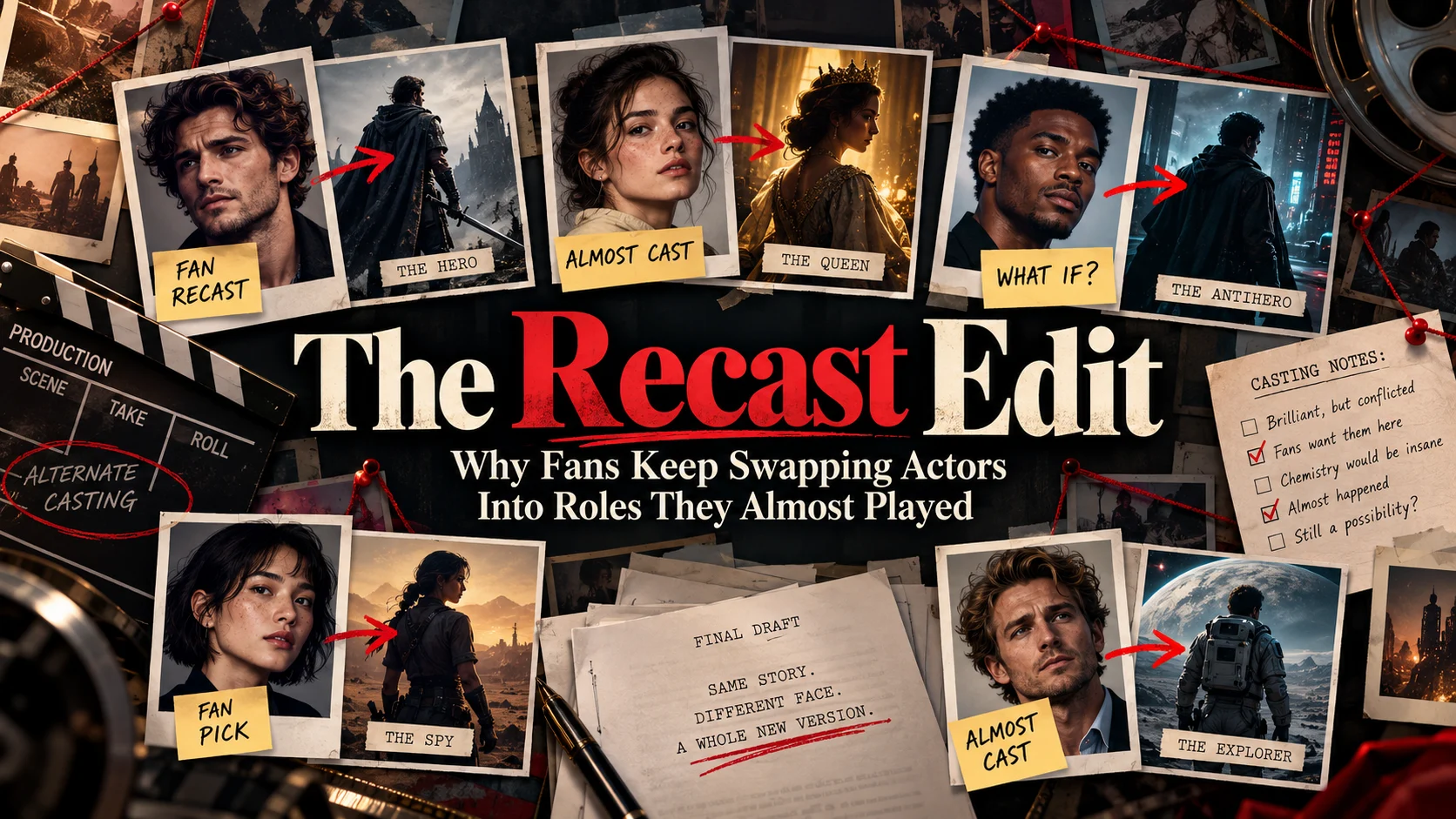
The alternate-casting edit has become its own small genre of fan filmmaking.
Every film fan has a favourite piece of casting trivia. Tom Selleck was the first choice for Indiana Jones until his contract with Magnum, P.I. got in the way. Will Smith turned down Neo to make Wild Wild West, a decision he has joked about ever since. Nicolas Cage spent a year in pre-production as Superman for a Tim Burton film that never got made, and the costume test photos still circulate online every few months.
For decades, those stories lived in DVD commentaries, magazine retrospectives and late-night forum threads. You could only imagine what the other version of the film would have looked like. Increasingly, fans are not willing to just imagine it.
A new kind of “what if”
Scroll through film corners of YouTube, TikTok or Reddit and you will find a steady stream of what people have started calling recast edits. Someone takes a well-known scene, the boulder chase, the lobby shootout, the first flight over Metropolis, and replaces the lead’s face with the actor who almost got the part. Some are rough and funny. A few are unsettlingly convincing.
The appeal is easy to understand. Casting is one of the most argued-about parts of any production, and the near-misses are part of film history. Watching a few seconds of the road not taken scratches the same itch as reading an old script draft or finding a deleted scene on a bonus disc. It turns trivia into something you can actually see.
It also tends to start good conversations. A recast clip of a beloved scene almost always ends up in the comments with people debating whether the original choice was the right one, which performances depend on the actor’s face and which would survive anyone in the role. In its own way, it is a form of film criticism.
Why most of them still look wrong
Anyone who has tried making one of these knows that the gap between a funny edit and a believable one is huge. The problem is not putting a face on a frame. The problem is keeping it there for every frame.
Film scenes are hard material. Characters turn their heads, walk through shadows, get lit by muzzle flashes, sweat, squint and talk. A face that sits perfectly in a static close-up can slide or flicker as soon as the actor looks over their shoulder. Profile shots, motion blur and anything partially covering the face, a hat brim, a hand, a cloud of dust, are where most amateur edits fall apart.
Older approaches did not help much. Photo-based filters would paste a still face onto a moving head, which is why so many early attempts looked like a cardboard mask drifting half a second behind the performer. Professional compositing could fix that, but it meant hours of manual tracking per shot.
What changed for hobbyist editors
The difference over the last couple of years is that tracking has moved from the editor’s hands into the software. An ai video face swap tool now maps facial landmarks on each frame, follows the head as it turns and blends the new face to the lighting of the scene, so the replacement moves with the performance instead of sitting on top of it.
iMideo AI, one of the browser-based video tools built around this kind of swap, works from a single clear photo and a short clip, and lets you pick which faces in a group shot get replaced. Output is a 720p MP4, which is fine for a social post or a comparison clip, though it is a long way from anything you would mistake for a 4K restoration. For a ten-second recast of a famous scene, that is usually all a fan editor needs.
Lighting and head movement, not the face itself, decide whether a recast holds up.
The craft has not disappeared, it has moved. The editors producing the most convincing recasts spend their time on choosing the right source photo, one with similar lighting and angle to the scene, picking shots where the face is not hidden for long stretches, and cutting the clip short enough that small errors never have time to register. Good taste still beats raw processing power.
The lines that matter
There is an obvious tension in all of this. These are real people’s faces, and the same technology that produces a charming what-if clip can produce something misleading or cruel.
The fan communities that have stuck around tend to follow a few unwritten rules. Label the edit clearly as an edit, ideally in the clip itself and not only in a caption that gets lost on reposting. Keep it to recognisable fiction: a famous scene from a famous film, not footage that could be mistaken for a real interview or event. Do not put anyone in a sexual or humiliating context. And do not try to make money from someone else’s likeness, which is where both platform rules and publicity rights get serious very quickly.
Most major platforms now have their own policies on synthetic media, and several require a label on realistic altered video. Even when the edit is obviously a joke to film fans, it may not be obvious to someone who sees it out of context three shares later.
Fan criticism by other means
The best recast edits are not really about the technology. They are about the same question film fans have been arguing over in pubs and comment sections for as long as there have been cast lists: would it have worked? Would Selleck’s Indy have had the same mix of panic and charm? Would The Matrix have been funnier, or worse, with Smith in the coat?
A ten-second clip cannot answer that. But it can make the argument a lot more fun, and if it sends a few more people back to watch the original scene with fresh eyes, that is not a bad outcome for a piece of fan editing.

Amanda Dudley is a lecturer and writer with a Ph.D. in History from Stanford University. After earning her doctorate in 2001, she decided to pursue a fulfilling career in the educational sector. So far, she has made giant strides by working as an essay writer for EssayUSA, where she delivers high-quality academic papers to students who need them.